
Enterprise AI Optimization White Paper 2026
The Enterprise AI Optimization White Paper 2026 examines why AI adoption is accelerating across industries while enterprise-level impact remains constrained. Drawing on research from McKinsey, Deloitte, and Gartner, this executive report explores the structural gap between tool access and measurable optimization—arguing that orchestration discipline, governance architecture, and sequencing strategy now determine enterprise AI outcomes.
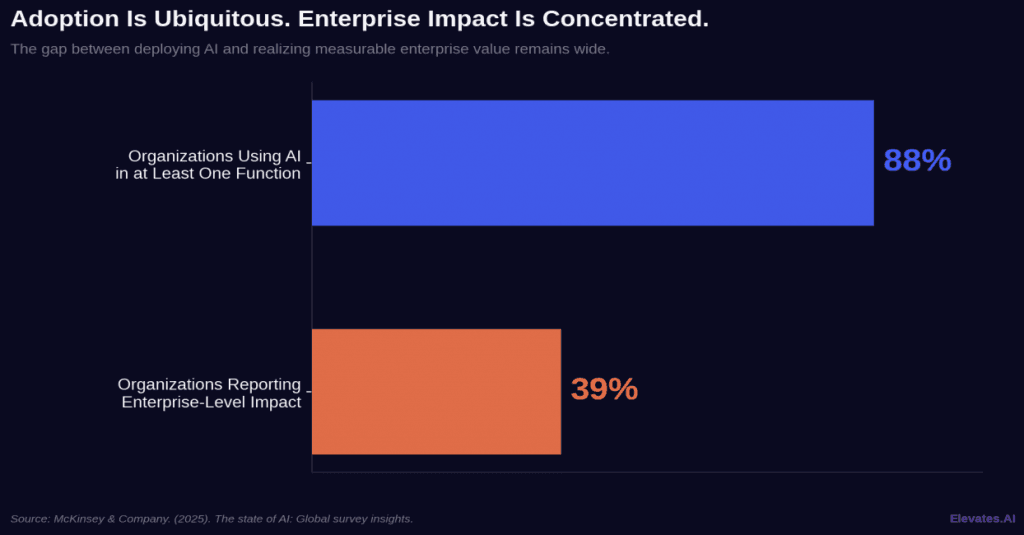
Enterprise AI adoption has accelerated faster in the past 24 months than most analysts predicted five years ago. According to McKinsey & Company (2025), 88% of organizations now report regular AI usage in at least one business function. Yet only 39% report measurable enterprise-level impact from those initiatives.
The technical barrier to AI implementation has collapsed. The strategic barrier has not.
Deloitte (2025) reports a 50% increase in sanctioned employee access to AI tools year-over-year. Meanwhile, Gartner (2025) forecasts that by the end of 2026, 40% of enterprise applications will embed task-specific AI agents — up from less than 5% in 2025. AI capability is no longer rare. Optimization discipline is.
Enterprises are not struggling to access tools. They are struggling to orchestrate them. This paper examines the illusion of internal AI control, the operational repercussions of building in-house without coordination, the emerging AI governance crisis, the shift from build vs buy to build vs buy vs orchestrate, and the role structured decision architecture plays in bridging the gap between adoption and optimization
This is not a defense of buying software. It is an argument for sequencing intelligence.
88%
Organizations using AI
(McKinsey, 2025)
50%
YoY increase in AI access
(Deloitte, 2025)
40%
Apps with AI agents by 2026
(Gartner, 2025)
The gap between AI usage penetration and enterprise-level value realization.
Source:
McKinsey & Company (2025)
Full Executive White Paper
Read the 2026 Elevates.AI executive white paper on AI readiness, orchestration, and optimization systems.