
What Is AI Readiness? Understanding the AI Readiness Score
An AI readiness score is a structured measurement of how prepared an organization is to adopt, scale, and sustain artificial intelligence across the enterprise. It evaluates whether your strategy, data, infrastructure, governance, talent, and culture are aligned enough to turn AI investment into measurable business impact.
Most companies think they need more AI tools. What they actually need is structural readiness.
That distinction explains why adoption is high — but enterprise ROI is not.
According to recent global surveys, the majority of organizations now use AI in at least one function. Yet less than half report measurable enterprise-wide value. The gap isn't technological. It's operational.
An AI readiness score quantifies that gap.
Why an AI Readiness Score Matters More Than AI Adoption
AI adoption metrics can be misleading. You can deploy:
Copilot licenses
Generative AI tools
AI chat assistants
Predictive analytics platforms
But if your organization lacks governance, data discipline, talent depth, or sequencing strategy, those tools create fragmentation instead of value.
An AI readiness assessment helps organizations:
- Identify structural gaps before scaling
- Avoid governance drift and compliance risk
- Prevent talent bottlenecks
- Sequence AI initiatives by business impact
- Align AI investments with revenue or efficiency goals
In short:
Readiness determines whether AI compounds or collapses.
AI Transformation vs Digital Transformation
Digital transformation modernizes processes and systems. AI transformation introduces adaptive decision systems that influence workflows, automation, and strategic planning. AI readiness ensures these changes occur responsibly and sustainably.
| Digital Transformation | AI Transformation | |
|---|---|---|
| Focus | Modernizes existing processes and systems | Introduces adaptive decision systems that influence workflows, automation, and strategic planning |
| Scope | Process and system upgrades | Cross-functional coordination across operations, strategy, and governance |
| Requirements | Tooling and process redesign | Executive sponsorship, infrastructure alignment, and risk oversight |
| Nature | Operational modernization | Structural, organization-wide preparedness |
| Risk Profile | Implementation risk | Regulatory, ethical, and operational risk requiring governance |
AI readiness ensures these changes occur responsibly and sustainably — unlike isolated AI projects, transformation-level AI adoption requires structural preparedness, not just new tools.
The framework
The 6 dimensions of an AI readiness score
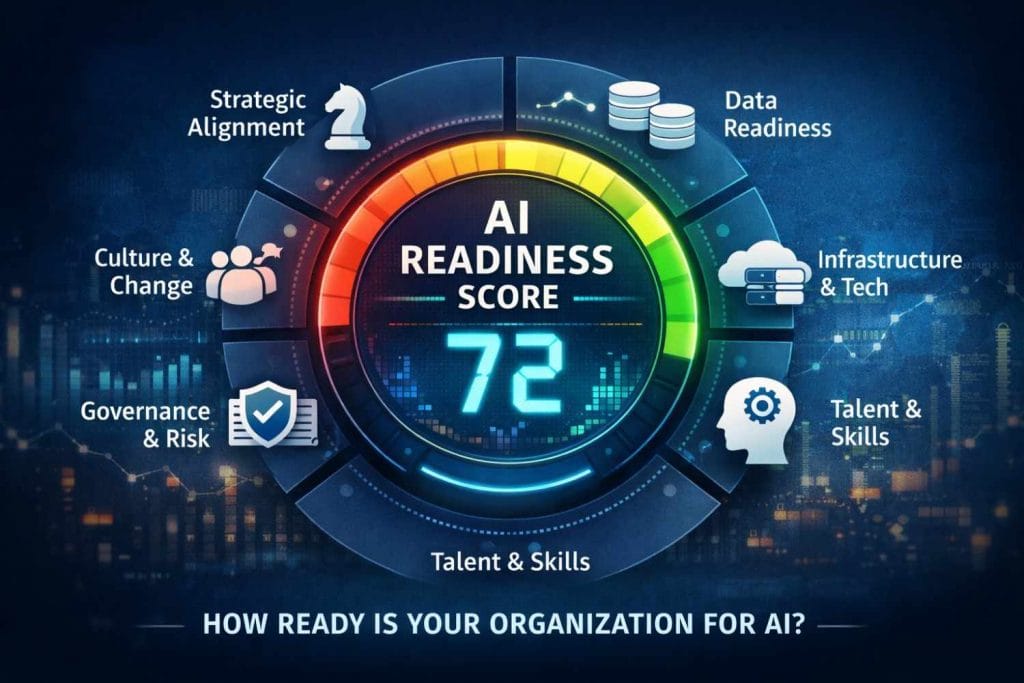
A credible AI readiness framework must evaluate multiple enterprise dimensions simultaneously. At Elevates.AI, readiness is measured across six interconnected pillars.
Strategic alignment
Does your AI initiative support business priorities — or is it vendor-driven?
- —Defined AI objectives
- —Executive sponsorship depth
- —Clear ROI metrics
- —Sequencing discipline
Data readiness
AI systems depend on structured, accessible, governed data.
- —Data quality
- —Integration maturity
- —Documentation
- —Access controls
Infrastructure & technology
AI workloads require scalable architecture.
- —Cloud readiness
- —API structure
- —Security controls
- —System interoperability
Talent & AI literacy
AI success depends on more than hiring data scientists.
- —AI literacy across departments
- —Leadership fluency
- —Training pipelines
- —Concentration risk
Governance & risk management
Responsible AI is not optional.
- —Model monitoring
- —Bias detection
- —Compliance protocols
- —Audit trails
Culture & change readiness
AI transformation is behavioral before it is technical.
- —Executive commitment
- —Change management discipline
- —Cross-team collaboration
- —Innovation tolerance
“The most common failure pattern isn’t no data. It’s fragmented data without accountability.”
The process
How to measure AI readiness
Captures current-state inputs
Scores each dimension against defined benchmarks
Identifies high-severity gaps
Prioritizes interventions
Generates a sequenced roadmap
Traditional consulting
2–4 weeks
Elevates.AI Launchpad
Minutes
Common confusion
AI readiness score vs AI maturity score
You can be mature in experimentation but not ready to scale. Readiness precedes maturity.
Readiness score
Maturity score
Start your AI readiness assessment
Get your readiness score, gap analysis, and 90-day roadmap in under 60 seconds.
Start free assessment →Frequently asked questions
What is an AI readiness score?
A structured measurement of how prepared an organization is to adopt, integrate, and sustain artificial intelligence across strategy, data, infrastructure, talent, governance, and culture.
How is AI readiness measured?
Across six dimensions — strategic alignment, data readiness, infrastructure, talent, governance, and culture — each scored against defined benchmarks.
Why do AI initiatives fail to deliver ROI?
Most failures stem from readiness gaps — poor data quality, lack of governance, insufficient talent depth, or weak strategic alignment.
How long does an AI readiness assessment take?
Traditional assessments take weeks. Automated assessments like Elevates.AI generate results in minutes.
Is AI readiness the same as AI maturity?
No. Readiness measures preparedness to scale. Maturity measures how far along an organization is in its AI journey.
Ship value in weeks, not quarters
Access our AI Marketplace for immediate quick wins while building your long-term strategy