
The most common question I get from mid-market operators is some version of how to know if my company is ready for AI. The honest answer most leaders give is a feeling, usually shaped by how the last pilot went and how confident the vendor sounded in the room.
That feeling is now measurably unreliable, and there is a number that proves it.
Readiness went backward while deployment went forward
Kyndryl published its 2026 People Readiness Report on June 25, 2026, a survey of 1,100 senior business and technology leaders across eight countries. Two of its findings sit next to each other and should not.
Fifty-seven percent say AI is embedded in core business processes or deployed broadly across the enterprise. Last year, 35 percent said AI was fully integrated. Deployment moved fast.
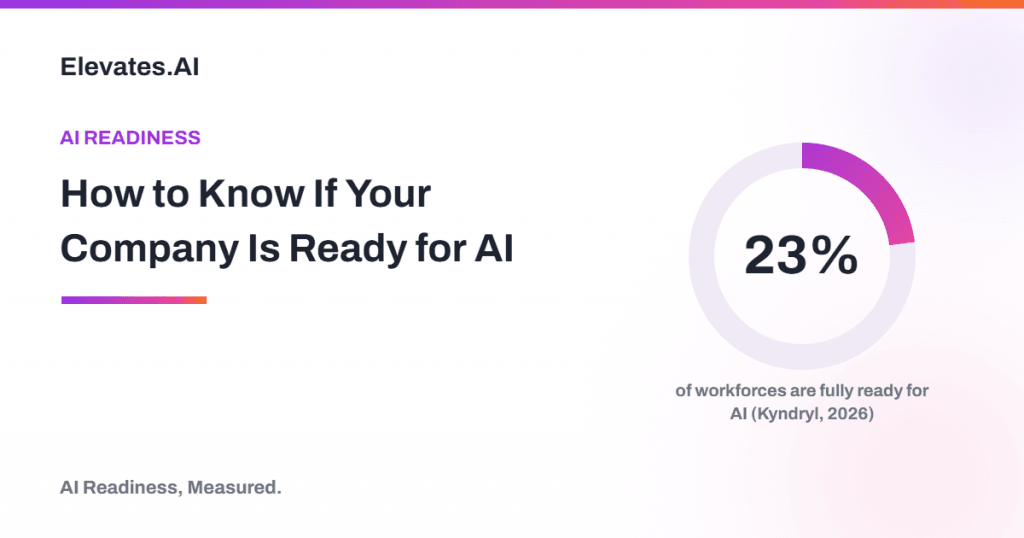
Twenty-three percent say their workforce is fully ready for AI. That is down six points from 2025.
Readiness did not simply lag. Readiness regressed while deployment accelerated. Seventy-nine percent of those same leaders agree the speed of AI will outpace their workforce, governance, and operating models.
Now set that against spend. Gartner forecasts that worldwide AI spending will total 2.52 trillion dollars in 2026, a 44 percent increase year over year. Spending is up 44 percent. Readiness is down six points. Only one of those two lines is a purchasing decision.
If you want a baseline that is not filtered through the program sponsor, the free 60-second assessment scores each readiness dimension on its own and returns the gaps rather than a single number.
Why the question is hard to answer honestly
Three things make readiness self-assessment unreliable, and all three are structural rather than a matter of effort.
Deployment gets mistaken for readiness. Rolling out a tool is a procurement event. Readiness is whether the organization changed shape to absorb it. Kyndryl found that only 32 percent of organizations achieved at least one of their top two AI goals and just 11 percent achieved both, against that 57 percent deployment figure. The tools are in. The outcomes are not.
The person answering has the most to lose from a low answer. Self-scoring almost always runs through whoever sponsored the investment, and a sponsor grading their own program is not a measurement.
And readiness is not one property. It is at least four, and they fail independently of each other.
The four things that fail independently
Data readiness is whether the information an AI system needs exists, is accessible, and is trustworthy enough to act on. Operating model readiness is whether roles, workflows, and decision rights have been redesigned around the new capability. Governance readiness is whether anyone can say what the systems are allowed to do and prove it afterward. Skills readiness is whether the people using the system understand what it does and what to do when it is wrong.
An organization can score well on data and have no decision rights at all. It can have strong governance and no skills. Averaging those four into a single composite score is how a genuinely unready company ends up with a reassuring 3.2 out of 5.
Anyone asking how to know if my company is ready for AI should start by refusing the composite. Score the four separately and look at the lowest one, because the lowest one sets your ceiling.
The order matters too. Data and skills can improve in parallel with a deployment. Operating model and governance cannot, because both of them define what the deployment is allowed to do. Companies that sequence the easy two first tend to arrive at launch with better data, trained staff, and still no answer to the question of who owns the outcome.
How to know if my company is ready for AI: five signals that hold up
Each signal below is verifiable by someone outside the AI team. That is the point. If confirming it requires trusting a self-report, it is not a signal.
Signal one: someone can produce the AI inventory today
Ask for a current list of every AI system in production with its owner, purpose, and risk classification. Kyndryl found that 27 percent of organizations use a registry and monitoring across all of their AI systems. If assembling the list takes two weeks, the answer to the readiness question is already no.
Signal two: roles were redesigned, not just equipped
Sixty-one percent of organizations say they have already redesigned roles and 24 percent are creating new roles focused on AI management. Adding a license to an unchanged job description is adoption theater. Ask which job descriptions changed and on what date.
Signal three: decision rights are written down
Thirty-three percent of organizations claim clear policies on which decisions AI can and cannot make. Ask to see the document. If the answer is a person’s judgment rather than a page, the organization has delegated authority it never defined.
Signal four: you can name the outcome you failed to hit
Readiness is always relative to an outcome, so an organization that cannot state its top two AI goals in measurable terms cannot answer the question at all. Only 11 percent of the companies Kyndryl surveyed hit both of theirs. The teams that know they missed are in better shape than the teams that never set a target.
Signal five: skills were built, not hired around
Fifty-two percent of leaders say it has become harder to find employees with the right skills to advance their AI strategy, and only about a third have fully implemented training programs for working alongside AI tools. Hiring is not a readiness strategy in a market that is short.
Score the five honestly and the picture is usually uncomfortable. That is the useful outcome. A company that fails three of five and knows which three is in a far better position than a company sitting on a 3.4 composite it cannot act on. Run the assessment if you want the same five dimensions scored against benchmarks instead of against your own optimism.
What the ready 9 percent actually do
Kyndryl identified a Pacesetters group, the 9 percent of organizations doing three things consistently. They redesign roles around AI. They run change management so the workforce understands the new operating model and the guardrails around it. And they build workforce readiness deliberately instead of assuming it arrives with the software.
Those organizations are 1.5 times more likely to report AI-driven revenue growth and 1.6 times more likely to report better product and service innovation. They are also roughly twice as likely to have fully implemented every governance dimension the study measured.
Nothing on that list is a technology choice. All three are operating model choices, and all three are available to a 200-person company with no data science team and no eight-figure budget.
There is a second reading of the Pacesetter data worth sitting with. If 9 percent are doing all three and they outperform on revenue and innovation, then the constraint on enterprise AI value is not model access. Every organization in that survey can buy the same models. The 91 percent are not losing on technology. They are losing on the decision to change how work is organized, which is slower, less exciting, and entirely within their control.
Anyone still asking how to know if my company is ready for AI can use the three Pacesetter behaviors as a blunt test. Redesigned roles, real change management, deliberate readiness investment. Two out of three is a plan. Zero out of three is a purchase order.
The trust ceiling nobody plans for
One more number, because it caps everything above it. Eighty-one percent of organizations expect AI agents to make impactful decisions within the next year. Twenty-five percent completely trust AI systems operating without human oversight.
That gap does not close with a better model. It closes with oversight design, which is a readiness output. Kyndryl found that organizations with stronger governance report higher workforce trust in the AI strategy, and high-trust organizations are significantly more likely to report transformative outcomes from their AI investments. The Elevates.AI AI agent readiness checklist works through the decision rights test in detail.
Anyone working out how to know if my company is ready for AI should treat oversight design as part of the readiness score rather than a follow-on project. Trust is downstream of governance. Governance is downstream of readiness. Skipping the first two and buying more capability is the most expensive sequence available.
We approached the same question from the operator’s side in the Elevates.AI breakdown of whether your business is AI ready, which covers what a self-check captures and what it structurally cannot.
If the answer is no, here is what changes first
The five signals above are the practical version of how to know if my company is ready for AI. Do not start with tooling. Start with the inventory, because it is the cheapest signal to fix and it unblocks the other four. You cannot assign decision rights to systems nobody has listed, and you cannot measure an outcome for a system nobody owns.
Then take one workflow and redesign the role around it rather than adding a tool to it. One workflow, one owner, one measurable outcome, one quarter. That is the Pacesetter pattern at a scale a mid-market team can actually run.
Rescore on a fixed cadence after that. Quarterly beats annually, because vendor capability and internal skill both move faster than a yearly review can catch. A fixed cadence also turns readiness from a document into a management practice, which is the only version of it that survives a leadership change.
If your AI spend is growing faster than your ability to absorb it, you are not alone and you are not stuck. Find the weakest of the five signals before the next budget cycle commits you further. The free 60-second assessment returns a scored baseline and a prioritized 90-day roadmap, and it costs you a minute.
Frequently Asked Questions
How to know if my company is ready for AI without hiring a consultant?
Test five things you can verify internally. Whether someone can produce a current AI system inventory today, whether job descriptions were redesigned rather than just equipped, whether decision rights exist as a written document, whether you can state your top two AI goals in measurable terms, and whether training programs are actually implemented. A free scored assessment gives you the same baseline in under a minute.
What percentage of companies are ready for AI in 2026?
Kyndryl’s 2026 People Readiness Report found that 23 percent of organizations believe their workforce is fully ready for AI, a six-point decline from 2025. Only 9 percent qualified as Pacesetters, the group that redesigned roles, ran change management, and built readiness deliberately.
Is having AI deployed the same as being ready for AI?
No. Kyndryl found that 57 percent of organizations have deployed AI broadly or embedded it in core processes, while only 32 percent achieved even one of their top two AI goals. Deployment is a purchasing decision and readiness is an organizational one, which is why the two numbers diverge.
What is the fastest way to assess AI readiness?
Score the four dimensions separately rather than as a composite, then act on the lowest one. Data, operating model, governance, and skills fail independently, and an average hides the constraint that is actually limiting you. The Elevates.AI assessment takes 60 seconds and returns the dimensions unaveraged.
Which department should own AI readiness?
Readiness sits with whoever owns the operating model, which is usually the chief operating officer or the chief information officer rather than a central AI team. IT can assess infrastructure and Legal can review policy, but neither can redesign roles or reassign decision rights on their own.
Be the First to Discover New AI Insights
Follow Elevates.AI on Google to stay updated with the latest AI readiness assessments, governance frameworks, implementation guides, buyer's guides, and enterprise AI best practices.
 Follow Elevates.AI on Google
The AI Readiness Brief
Every Week, receive practical enterprise AI strategies, implementation frameworks, governance updates, and expert insights—all delivered in a 5-minute read.
| ✓ Enterprise AI Strategy | ✓ AI Readiness Frameworks |
| ✓ Governance & Compliance | ✓ Exclusive Guides & Resources |
Join 500+ AI Professionals
Enter your work email below to receive one high-value email every week. No spam. Unsubscribe anytime.