
Most organizations grade their own AI governance, and most of them grade generously. An AI governance maturity assessment exists to replace that self-grade with something defensible, and a named auditor has now measured exactly how far off the self-grade runs.
The answer is 47 points.
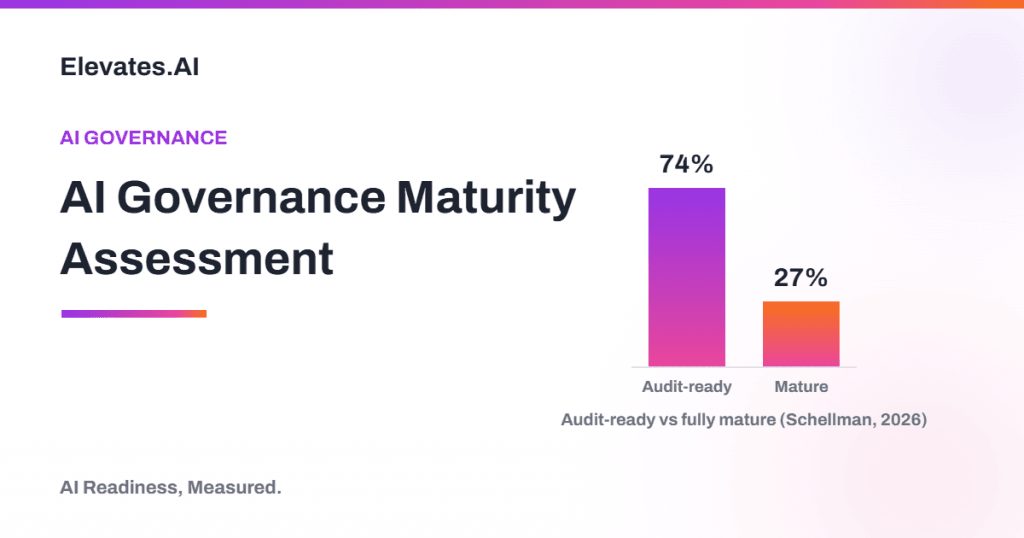
Schellman published its 2026 State of AI Governance Report on July 29, 2026. The survey covered 525 United States professionals who evaluate, deploy, secure, or govern AI inside their own organizations, fielded between April 13 and May 11, 2026. Ninety percent said their organization has allocated funding for AI governance. Seventy-four percent said they could pass an AI compliance audit today. Twenty-seven percent described their governance program as fully mature (Schellman via GlobeNewswire, July 2026).
Both numbers came from the same people, in the same survey, about the same organizations.
The 47-point gap is a measurement failure, not a maturity failure
Read the two questions again. One asks for a prediction about an external judgment. The other asks for a self-rating against a defined standard. When the same respondent answers 74 on the first and 27 on the second, the honest reading is that most people have never seen what an AI audit actually asks for.
Confidence is not calibrated by evidence. It is calibrated by the absence of a test. An organization that has never been audited has no data point to correct against, so it grades itself against its intentions.
It helps to know what the test looks like. An AI audit does not ask whether you take governance seriously. It asks for the register of systems, the risk classification behind each entry, the name of the person who signed it, the log showing the control ran, and the record of what happened the last time the system produced a bad output. Every one of those is a document that either exists or does not.
Teams that have sat through one stop overestimating. Teams that have not keep answering the first question instead of the second.
That is the argument for an external AI governance maturity assessment, and a third party made it rather than us. Funding is not the constraint. Ninety percent have already allocated it. Knowing where the program actually stands is the constraint.
The pattern is not unique to the Schellman sample. TDWI benchmarked 161 enterprises on agentic AI readiness this year and scored governance at 14 out of 20, ahead of data readiness and organizational readiness but behind technology infrastructure. The Cisco AI Readiness Index placed 13 percent of organizations in its fully-ready category across six pillars, one of which is governance. Three instruments, three methodologies, three different samples, and the same finding. Governance capability trails governance confidence by a wide margin.
You can get the shape of your own gap in about a minute. Our free 60-second AI readiness assessment tool covers governance ownership and decision rights alongside data and tooling, and it returns a prioritized gap analysis rather than a rating.
Governance is not the brake. It is the reason deployment happens.
The most useful finding in the Schellman data is not the confidence gap. It is what maturity correlates with.
Organizations with mature AI governance run agents in production at 78 percent. Organizations with developing governance programs run agents in production at 22 percent (CIO Dive, July 2026). Eighty-six percent of respondents have tested or piloted agents, and nearly half already have agents in production.
The standard executive objection to governance work is that it slows the program down. The data points the other way. Mature programs deploy more, not less, because the approval questions were already answered before anyone needed to ask them.
That matches what Gartner has been saying about the failure mode. More than 40 percent of agentic AI projects will be canceled by the end of 2027, attributed to escalating costs, unclear business value, and inadequate risk controls (Gartner, June 2025). Every item on that list is a governance artifact. None of them is a model problem.
There is a mechanical reason behind the 78 against 22 split. An organization that has already classified its systems by risk, assigned decision rights, and written an escalation path does not have to invent those answers when a business unit asks to put an agent in front of customers. The work was front-loaded, so the approval takes a meeting.
The organization that skipped that work now does the same work under deadline pressure, with a built pilot waiting and legal reading the contract for the first time. That is where the delay actually originates, and governance gets blamed for it.
Why the self-grade runs high
Three things inflate it, and all three are fixable inside a quarter.
The first is who answers. Governance surveys are usually completed by the person responsible for governance. That person knows the policy exists. They may not know whether the team building the retrieval pipeline has ever read it.
The second is that policy gets counted as practice. A published acceptable use policy is a real artifact. It is not evidence that anyone follows it, and an auditor will ask for the second thing.
The third is that the AI inventory goes stale faster than it gets written. Shadow AI moves faster than the register does, and the register is usually a spreadsheet owned by one person who has another job.
Here is the cheapest correction available, and it costs nothing. Have your governance owner complete an AI governance maturity assessment. Have the engineer closest to the production system complete the same one separately. Compare the two.
The disagreement is the finding. It is almost always more useful than either score, and it is the closest thing to an external audit you can run for free. Where the two answers diverge is where policy and practice have come apart, and that is the first place an auditor will look.
What an AI governance maturity assessment should actually measure
Most published maturity models score five levels across three or four dimensions, and most of them are self-administered. That design reproduces the exact bias the Schellman numbers expose. A useful AI governance maturity assessment asks for evidence rather than opinion. That is doubly true for agentic AI governance, where the system acts rather than advises.
Five things produce evidence.
- Inventory. How many AI systems are in production right now, who owns each one, and when the list was last updated. Most organizations cannot produce this document on request.
- Risk classification. Which of those systems make or influence decisions about people, money, or safety, and who performed the classification.
- Decision rights. For each agent, which actions require human approval, which require notification only, and which the agent may take alone.
- Monitoring. What is logged, who reads the logs, and how long it would take to detect an agent operating outside its intended scope.
- Recourse. What happens when the system is wrong, who is accountable for the outcome, and how the affected person finds out.
Notice what is absent from that list. There is no question about which model you chose, which vendor you bought from, or how much you spent. None of those determine whether an auditor signs off. What determines it is whether a stranger can reconstruct who decided what, on what basis, and what happened afterward.
Notice also that four of the five produce a document. That is the practical test to apply. If your team cannot put the artifact in front of you within a day, the maturity level is not what the self-assessment reported.
What to do in the next two weeks
Do not start with a framework. Start with the inventory, because every framework will ask for it first and most programs cannot produce it.
Write down every AI system currently in production, the person accountable for each one, and whether it can take an action without a human approving it. That list will take about a week and it will be uncomfortable to read. It is also the single artifact that separates the 27 percent from the 74 percent.
Expect the count to come back higher than your executive sponsor guessed. Registers usually capture the systems that went through procurement. The models embedded inside tools you already license never appear on a purchase order, and they are running right now.
Then classify by risk. Then assign decision rights. Our AI agent governance checklist walks through the classification step in detail.
Set the review cadence before you finish, not after. An inventory nobody updates is worse than no inventory, because it manufactures the exact false confidence the Schellman numbers describe.
Everything after that is process design. The gap closes at the inventory.
Find Out Which Side of the Gap You Are On
Seventy-four percent of the people who govern AI inside their own companies think they would pass an audit. Twenty-seven percent would. That gap is not a funding problem and it is not a policy problem. It is that almost nobody has been tested. Take the free 60-second assessment and find out which side of the gap your program sits on, before a regulator, a customer, or an incident finds out for you.
Frequently Asked Questions
What is an AI governance maturity assessment?
An AI governance maturity assessment is a structured evaluation of how well an organization governs the AI systems it runs, usually scored across dimensions such as inventory, risk classification, decision rights, monitoring, and accountability. A useful assessment asks for evidence rather than opinion, because self-reported governance maturity runs consistently high.
How mature is AI governance at most companies in 2026?
Schellman’s 2026 State of AI Governance Report found that only 27 percent of 525 surveyed United States professionals describe their organization’s AI governance program as fully mature, while 74 percent believe they could pass an AI compliance audit today. Ninety percent said their organization has already allocated funding for governance.
Does strong AI governance slow down AI deployment?
The evidence points the other way. Schellman found that organizations with mature governance programs have agents in production at 78 percent, against 22 percent for organizations with developing programs. Answering the approval questions in advance removes the delay that otherwise appears at deployment.
What is the first step in an AI governance program?
Build an inventory of every AI system currently in production, name an accountable owner for each one, and record whether the system can take an action without human approval. Most organizations cannot produce this list today, and every audit and framework asks for it first.
How often should we run an AI governance maturity assessment?
Quarterly is reasonable for organizations actively deploying agents, and twice a year is enough for organizations still piloting. Rerun it any time a new system enters production, and keep using the same instrument so the comparison between runs stays valid.
Be the First to Discover New AI Insights
Follow Elevates.AI on Google to stay updated with the latest AI readiness assessments, governance frameworks, implementation guides, buyer's guides, and enterprise AI best practices.
 Follow Elevates.AI on Google
The AI Readiness Brief
Every Week, receive practical enterprise AI strategies, implementation frameworks, governance updates, and expert insights—all delivered in a 5-minute read.
| ✓ Enterprise AI Strategy | ✓ AI Readiness Frameworks |
| ✓ Governance & Compliance | ✓ Exclusive Guides & Resources |
Join 500+ AI Professionals
Enter your work email below to receive one high-value email every week. No spam. Unsubscribe anytime.