
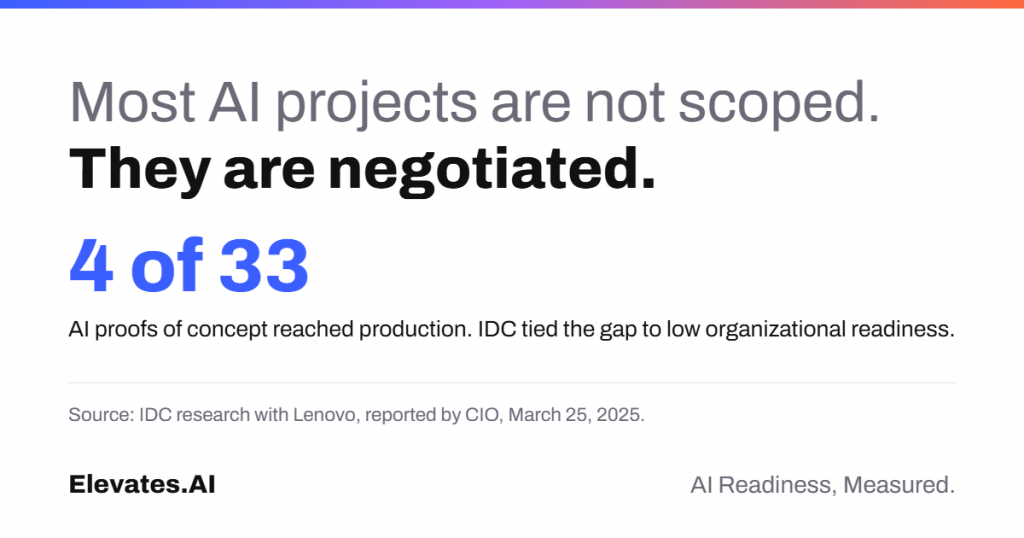
Most AI projects are not scoped. They are negotiated. The consultant interviews ten stakeholders, hears ten priorities and writes a scope that tries to satisfy all of them.
Here is the direct answer on how to scope an AI project. Establish a shared readiness baseline before anything else. Rank the gaps by what blocks the rest. Only then define the use case, data, integrations and success metric.
Scope built on a baseline survives leadership review. Scope built on interviews gets relitigated in every steering meeting.
Why Do AI Project Scopes Keep Getting Relitigated?
The typical AI discovery phase runs on interviews. Each executive describes the problem from their own function, and the consultant synthesizes a view. That view is an opinion, and every other executive is entitled to disagree with it.
The failure shows up downstream. IDC research reported by CIO found that only 4 of every 33 AI proofs of concept reached production. IDC tied the gap to low organizational readiness in data, processes and IT infrastructure, which interviews rarely measure.
I call this the opinion-driven scope. It is not a lack of rigor. It is the lack of a shared fact base that the client’s own leaders produced.
The consultant usually knows the answer long before the client agrees to it. The delay is not analytical. It is political, and more interviews rarely resolve a political problem.
What resolves it is evidence the client’s leadership cannot attribute to the consultant. That is the job of a readiness baseline. It moves the debate from whose opinion wins to what the scores say.
You can see it in how the meetings go. The CFO wants cost savings, the COO wants throughput and the CIO wants governance first. Each is right from where they sit, and none of them will accept the others’ priority on the consultant’s say-so.
If your client conversations stall at this stage, the Elevates.AI partner network gives you a readiness baseline to scope from.
How to Scope an AI Project in Five Steps
The order matters more than the checklist. Each step depends on the one before it.
- Establish the readiness baseline. Have the client’s leadership complete a structured readiness diagnostic before any interviews. The output is a scored view of data, governance, skills and ownership that nobody can dismiss as the consultant’s opinion.
- Rank the gaps by dependency. Some gaps block everything else. A missing data owner will sink any use case, so it outranks a skills gap in a single team.
- Pick the use case the baseline can support. Choose the highest-value use case that the current readiness level can actually carry. Park the rest with a named precondition.
- Define the production conditions up front. Name the data source, the integration points, the review step and the business owner before the pilot starts. MIT’s Project NANDA found that mid-market top performers averaged 90 days from pilot to full implementation, against 9 months or longer for large enterprises.
- Set one business metric and measure its baseline. McKinsey’s State of AI in 2026 found that AI high performers are twice as likely as others to have defined processes to measure the impact of AI. A scope without a measured baseline cannot prove it worked.
Step 4 is where most scopes quietly fail. We covered why in our breakdown of the missing middle layer between pilot and production.
What Do the Top Scoping Guides Leave Out?
Most published scoping guides are written by firms that sell a paid discovery phase. They list the right ingredients: the business problem, the workflow, the data, integrations, security and a quality bar.
What they leave out is sequencing. A list of ten scoping items does not tell you which one to resolve first, and each executive will pick a different one.
The baseline is what sets the order. Without it, knowing how to scope an AI project in theory does not help you close the scope in practice.
There is a second gap in most guides. They assume the client already agrees on the problem. In practice, agreement on the problem is the hardest deliverable of the whole scoping phase, and no checklist produces it on its own.
Why Does Scoping Matter More in 2026?
ISG’s State of Enterprise AI 2026 report, released September 23, found that most business and financial outcomes from AI fell short of expectations. It also found that 55% of AI work is still human-led.
ISG named a scoping failure directly. Requiring people to validate AI output creates bottlenecks when the system produces results faster than employees can review them. A scope that leaves out the review step has scoped a pilot, not a production system.
In McKinsey’s 2026 survey, 44% of respondents say AI is scaling across their enterprise. Only 37% report any EBIT impact from it. Clients have stopped paying for activity, and a scope that cannot name its business outcome is activity.
That is the gap the Elevates.AI partner program closes for consultants. Your client completes the diagnostic, and you scope from its results.
What Goes Wrong in the AI Consulting Discovery Phase?
The AI consulting discovery phase fails in predictable ways. Most of them come from asking people to describe readiness instead of measuring it.
- Discovery samples the loudest voices. The executives with the most calendar time shape the findings, and quieter functions with real data problems go unheard.
- Discovery has no defined output. It ends in a slide deck of observations rather than a ranked list of gaps with owners.
- Discovery is unpaid, so it gets rushed. The consultant compresses interviews to protect margin, and the scope inherits the blind spots.
- Discovery repeats itself. Each new stakeholder reopens questions the last workshop thought it had closed.
None of these are skill problems. They are structural, and they disappear once the discovery phase starts from a measured baseline instead of a blank page.
What Does an AI Readiness Baseline Measure?
An AI readiness baseline is a scored snapshot of whether an organization can run AI in production, not just build it. It should be completed by the client’s own leadership so the results are theirs.
A useful baseline covers data quality and ownership, governance and approval paths, and skills and change capacity. It also covers the technology stack and who is accountable for business outcomes. Each area gets a score, and the scores get ranked by what blocks the others.
The ranking is what makes it useful for scoping. A client with strong data and no named business owner needs a different first project than a client with the reverse. To see what a scored baseline looks like, run the free AI readiness assessment on your own organization first.
How Long Should AI Project Scoping Take?
Scoping takes as long as it takes leadership to agree on the first gap to close. Most of that time is spent resolving disagreements, not collecting information.
With a baseline in hand, interviews shrink to confirming and deepening what the diagnostic already shows. The time saved matters less than the argument avoided. On the buyer side, we broke down how long an AI readiness assessment takes at each tier.
What Should the Consultant Own After Scoping?
| Deliverable | Who produces it | Who owns it after scoping |
|---|---|---|
| Readiness baseline | Client leadership, through the diagnostic | The consultant, as the reference point |
| Gap ranking | Diagnostic plus consultant review | The consultant |
| Use case selection | Consultant with the business owner | The business owner |
| Production conditions | The consultant | Named data, IT and business owners |
| Success metric and baseline | Consultant with finance | The business owner |
The consultant’s value moves from gathering facts to making calls. That is a better use of a senior advisor, and it is easier to bill.
A practical rule for your next engagement: do not schedule a single stakeholder interview until the baseline is in. Use the interviews to test the scores, not to create them. You will run fewer sessions, and each one will end with a decision.
How Can Consultants Get a Baseline Without Building One?
Building your own diagnostic takes months, and it still reads as your opinion to the client. The Elevates.AI partner network gives consultants a vendor-neutral readiness diagnostic that clients complete themselves. It returns a scored gap analysis and a sequenced 90-day roadmap.
Partners keep 100% of the implementation work and earn a 30% commission on every qualifying client referral. Elevates.AI does not sell implementation, so the roadmap never points back at us. For the gap-ranking side, see how our AI gap analysis tool sorts findings.
The next time a client asks how to scope an AI project, you can hand them a process instead of a calendar of interviews.
Scope is not a document. It is an agreement about what to fix first. Get that agreement on facts, and the rest of the engagement gets easier.
Try it on one live engagement. Apply to become an Elevates.AI partner and scope your next AI project from a baseline instead of a stack of interview notes.
If you already run a structured assessment of your own, compare it against these five steps. If you do not, borrowing one is faster than building one, and the client will trust it more.
Frequently Asked Questions
How do you scope an AI project?
Start from a shared readiness baseline that the client’s own leadership completes. Rank the gaps by what blocks the rest, then define the use case, data, integrations and success metric. A scope built this way survives leadership review because the priorities come from the client’s own scores.
What should an AI project scope include?
An AI project scope should include the business problem, the use case, the data source and the integration points. It should also name the review step, the business owner and one measured success metric. Without those, the scope describes a pilot rather than a production system.
How long does it take to scope an AI project?
Scoping takes as long as it takes leadership to agree on the first gap to close. A structured readiness baseline shortens that, because executives review their own results instead of debating interview notes.
Why do AI projects fail after scoping?
Many scopes never address organizational readiness. IDC found that only 4 of every 33 AI proofs of concept reached production, and it tied the attrition to low readiness in data, processes and IT infrastructure.
Should AI discovery be paid?
Discovery that produces a defined deliverable is worth paying for. Discovery that produces only interview notes is hard to charge for, which is why many consultants absorb it. A readiness baseline gives discovery a defined output from day one.
Be the First to Discover New AI Insights
Follow Elevates.AI on Google to stay updated with the latest AI readiness assessments, governance frameworks, implementation guides, buyer's guides, and enterprise AI best practices.
 Follow Elevates.AI on Google
The AI Readiness Brief
Every Week, receive practical enterprise AI strategies, implementation frameworks, governance updates, and expert insights—all delivered in a 5-minute read.
| ✓ Enterprise AI Strategy | ✓ AI Readiness Frameworks |
| ✓ Governance & Compliance | ✓ Exclusive Guides & Resources |
Join 500+ AI Professionals
Enter your work email below to receive one high-value email every week. No spam. Unsubscribe anytime.