
An AI readiness assessment report should contain seven sections: a decision summary, an evidence log, a scoring method, a gap register, a sequenced roadmap, a governance map, and a statement of limits. A document missing most of them is a score, not a report.
A score is cheap to produce. A decision is what you paid for.
Here is the failure mode. A week after the assessment, a PDF arrives.
It carries a number out of 5, a radar chart, and six paragraphs of observations that would fit any company. Nobody in the room can say what to fund first.
We call this the score-only report. It is the most common way an assessment fails after it has technically been delivered. The buyer paid for a diagnosis and received a grade.
The tell is easy to spot. Ask what moved a score from 2 to 3 between two assessments. If nobody can answer in a sentence, nothing underneath the score is stable.
Scores also travel badly. A 3 out of 5 gets pasted into a slide, loses its footnotes, and becomes a fact about the company.
The data points the same way. Further surveyed 515 U.S. AI decision-makers and published the results on October 13, 2026.
Of that group, 83% see AI readiness as at least a partial competitive advantage, yet only 3% have a documented process for auditing AI. The limit is that this is a vendor-run survey of self-reported answers, and the release states no margin of error.
Why is a score alone not enough to act on?
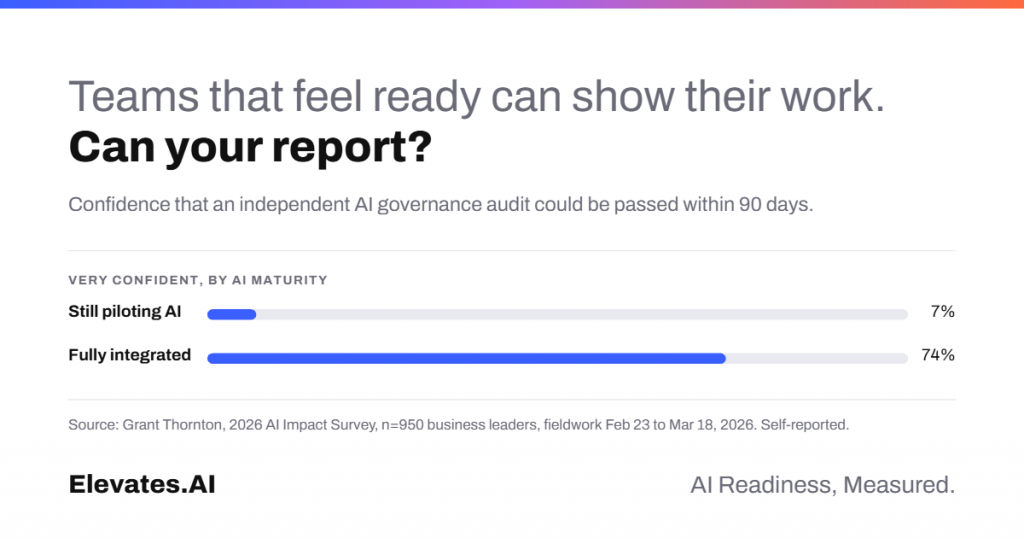
Because a score has no memory. It cannot tell you how it was reached, who checked it, or what to say when the board asks. The Grant Thornton 2026 AI Impact Survey asked 950 business leaders about audit readiness.
Of those leaders, 78% lack strong confidence they could pass an independent AI governance audit within 90 days. Among organizations still piloting AI, 7% were very confident. Among fully integrated organizations, 74% were.
The limit is that these are self-reported confidence levels, not audit results. Fieldwork ran from February 23 to March 18, 2026.
Read that gap as an evidence gap. The organizations that feel ready are the ones that can show their work. A readiness report that cannot show its own work gives you nothing to hand an auditor, a board, or a vendor.
If you want a first-pass version of this for your own organization, the free 60-second assessment maps it.
Money is the second test. Omdia surveyed 400 technology leaders for Valiantys and Atlassian, and the results were published on October 15, 2026. Of those leaders, 52% say formal ROI is the ideal way to measure AI value.
Only 21% use formal ROI calculations today. Just 3% call their organization fully ready.
The limit is that this is a company-issued release that omits survey dates and margin of error. Still, the 31 point distance between wanting ROI and measuring it is where a weak report leaves you. A report that never ties a gap to a measurable outcome leaves that distance exactly where it was.
What are the seven sections of an AI readiness assessment report?
Use the table below as a checklist. Every row should be answerable from the document itself, without a follow-up call. These are the AI readiness assessment deliverables worth paying for.
| # | Section | Question it answers | Red flag if missing |
|---|---|---|---|
| 1 | Decision summary | Build now, fix first, or stop, for each use case? | Every use case rated positive |
| 2 | Evidence log | What was read, who was asked, and what was only self-reported? | Findings with no source |
| 3 | Scoring method | How was each score produced, and how confident is it? | A number with no rubric |
| 4 | Gap register | What is broken, who owns it, and what does it block? | Generic recommendations |
| 5 | Sequenced roadmap | What comes first, and what does it make possible? | A flat list with no dependencies |
| 6 | Governance map | Which risks apply, and which framework does the report map to? | No mention of oversight or audit |
| 7 | Limits statement | What was not assessed, and what did the assessor collect? | Confident claims about systems nobody touched |
1. The decision summary
Open with the verdict. For each use case, the report says build now, fix specific things first, or do not build this.
A report that rates every use case positive is selling, not assessing. SpotDev, a consultancy that sells assessments itself, lists that pattern among its red flags, and it is right.
2. The evidence log
List every source. Name the documents read, the systems reviewed, and the people interviewed.
Mark each finding as observed or self-reported. This section lets a third party check the work, and none of the three top-ranking guides we reviewed describe it.
3. The scoring method
A score needs a rubric and a confidence level. State what each point on the scale means and how much evidence sits behind it. A 3 out of 5 backed by a signed policy and a 3 out of 5 backed by one survey answer are not the same score, and the report should say so.
4. The gap register
This section does the work, so it gets the most care. The AI gap register gives each gap one row with five fields: the evidence, the business impact, the owner, the effort, and what the gap blocks.
Take an illustrative example. The gap is that support tickets sit in two systems with no shared customer ID.
The evidence is a data review that found two ID formats that never match. The impact is that the ticket triage use case cannot start.
The owner is the head of support operations. The effort is three weeks. The gap blocks the triage pilot and the cost per ticket baseline.
The last field earns the register its keep. A gap that blocks three others goes first, even if it scores lower than a visible one. Without that field, you fund the symptom and leave the cause.
The gap described above is exactly what the AI readiness assessment scores, and it takes about a minute.
Data gaps usually sit at the top of the chain. In the Further survey, only 5% of respondents believe their data is largely AI-ready, and 29% have completed a formal data audit with a remediation plan. Our AI gap analysis tool guide shows how to turn a register like this into a spending order.
5. The sequenced roadmap
A roadmap is an order, not a list. Each step names what it depends on and what it makes possible.
Cap the first cycle at 90 days. Anything longer is a wish.
Sort the gap register by what each gap blocks, then group the steps into three windows of 30 days. Each window ends with a check that can pass or fail, such as a pilot running on clean data. If a step has no check, it has no end.
6. The governance map
Pick one framework and map to it. The NIST AI Risk Management Framework organizes the work into four functions called Govern, Map, Measure, and Manage. A report that maps its findings to a named framework gives your risk team something to review.
The map does not need to be long. A table of findings against the four functions is enough. What matters is that each finding lands in one place, so your risk team can see which functions have evidence and which have none.
Where a law such as the EU AI Act applies to you, have counsel confirm the mapping. Elevates.AI is not a law firm and this is not legal advice.
7. The limits statement
End with what the assessment did not cover and what the assessor collected from you. A report that claims certainty about private systems it never touched is overreaching. We cover the collection side in what an AI readiness assessment collects from you.
How can you test a sample AI readiness assessment report in ten minutes?
Ask the vendor for a sample AI readiness report before you buy. Then run five checks.
- Pick one score and ask what evidence sits behind it. If the answer is a conversation instead of a document, the evidence log is missing.
- Find the top gap and read its owner. A role or a name should be there. The organization is not an owner.
- Find what the report tells you not to build. If nothing appears, the decision summary is a sales page.
- Check the roadmap for dependencies. Every step should say what it waits on.
- Find the limits. Look for a plain statement of what was not assessed.
Score each check pass or fail. Fewer than four passes means you are buying a score.
What should happen in the first week after the report arrives?
Hold a one hour review with the owners named in the gap register. Ask each owner to confirm or dispute their row. Disputed rows go back to the assessor with a request for evidence.
Rows that survive the review become the first 30 days of work. This meeting is the real test of an AI readiness assessment report. If the owners cannot recognize their own gaps, the findings were written for the slide deck and not for the work.
Where does the Elevates.AI report fall short of this list?
We sell an assessment, so hold us to the same checklist. Our 60-second assessment is a first-pass map.
It produces a gap analysis and a 90-day roadmap from the information you submit. It cannot audit private systems, so it does not replace the observed evidence in section 2 of a full engagement.
Use it to find which gap blocks the others. Then decide whether you need a deeper, evidence-backed review before you commit budget. That order keeps the expensive work pointed at the right problem.
Treat everything it produces as a hypothesis to test in the first-week review. A hypothesis with an owner and a date is worth more than a finding nobody checks.
A fair question is whether a 60-second input can produce anything worth acting on. It can, for one job, which is ranking the gaps. It cannot do the rest of the list, and we would rather say so now than have you find out in week six.
Start with the 60-second readiness assessment and you will know which gap blocks the others before you spend anything.
Before you do, run the five checks on the next AI readiness assessment report that lands in your inbox, including ours. Write down which sections are missing.
Send that list back to the vendor and ask for the missing sections in writing. How they answer will tell you more than the score did.
One last rule. Do not let a vendor, us included, close the loop for you. The owners in the gap register should be people on your payroll, and the review meeting should be yours to run.
A report earns trust when your own team can defend it without the assessor in the room. Keep your pass or fail notes from the five checks. When a second vendor sends a sample, run the same checks and compare the two side by side.
If the report passes, the next step is turning it into work. Our guide to what to do after you have your AI score picks up from there.
Frequently Asked Questions
What should an AI readiness assessment report include?
A complete AI readiness assessment report includes a decision summary, an evidence log, a scoring method, a gap register with owners, a sequenced roadmap, a governance map, and a statement of limits. Each section should be answerable from the document itself. A report missing most of them is a score, not a deliverable.
How long should an AI readiness assessment report be?
Length matters less than completeness. A focused report that covers all seven sections can be short, while a long report that skips the evidence log and the gap register is not useful. Judge a report by whether a leadership team can make a funding decision from it.
Who should sign off on an AI readiness assessment report?
Each gap needs a named owner, and the decision summary needs an executive sponsor who accepts the verdicts. Sign-off from IT alone is not enough, because gaps in data, governance, and process cross functions.
What is the difference between an AI readiness score and an AI readiness report?
A score is one number or a set of ratings. A report explains how each rating was reached, what evidence supports it, who owns each gap, and what to do next.
Can an AI readiness assessment report be used in an AI governance audit?
It can support one, but only if the evidence log is complete. In the Grant Thornton 2026 AI Impact Survey, 78% of leaders lacked strong confidence they could pass an independent AI governance audit within 90 days. A report that records its sources gives an auditor something to check.
Be the First to Discover New AI Insights
Follow Elevates.AI on Google to stay updated with the latest AI readiness assessments, governance frameworks, implementation guides, buyer's guides, and enterprise AI best practices.
 Follow Elevates.AI on Google
The AI Readiness Brief
Every Week, receive practical enterprise AI strategies, implementation frameworks, governance updates, and expert insights—all delivered in a 5-minute read.
| ✓ Enterprise AI Strategy | ✓ AI Readiness Frameworks |
| ✓ Governance & Compliance | ✓ Exclusive Guides & Resources |
Join 500+ AI Professionals
Enter your work email below to receive one high-value email every week. No spam. Unsubscribe anytime.