
A team in your company built an agent last quarter. It reads a shared inbox, drafts replies, and writes to the CRM. It runs on a personal token. Nobody in IT or security knows it exists, and nobody will until it does something wrong.
An AI agent inventory is a living record of every AI agent your organization runs, including who owns it, what it can reach, and what it is allowed to do. Most companies do not have one. They have a register of the agents someone chose to enroll, and that is a different asset.
The distance between those two lists is the real risk. Every agent governance product launched this year starts from the same unstated assumption, that the agent is already registered. The agent nobody enrolled sits outside every control you bought.
Why does an AI agent inventory come before agent governance?
Governance acts on things it can see. A policy, a permission review, and an anomaly alert all need a named agent to attach to. Remove the name and the control has nothing to hold.
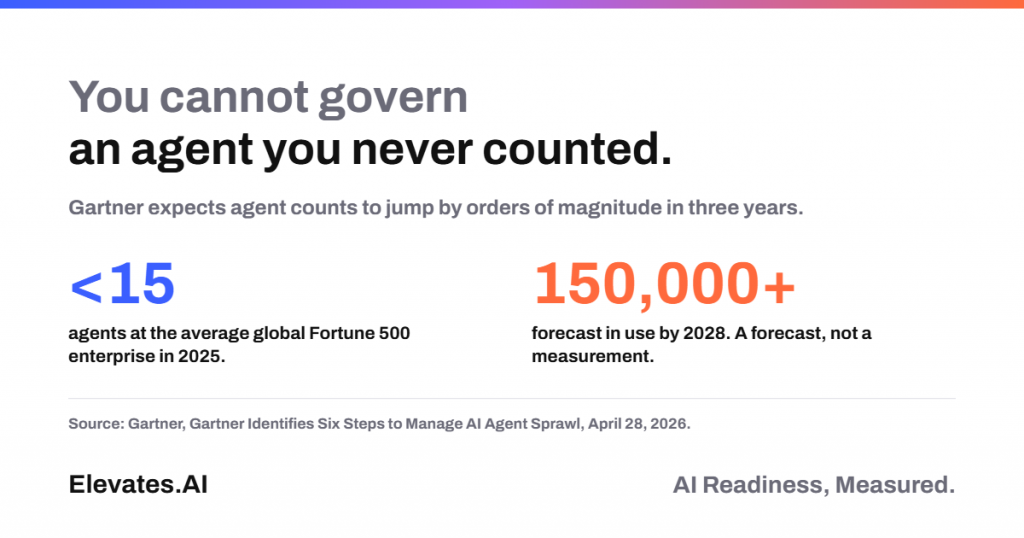
Gartner put the scale in numbers. Its April 28, 2026 press release says an average global Fortune 500 enterprise had fewer than 15 agents in 2025 and will have more than 150,000 in use by 2028. That is a forecast, not a measurement, and it covers only the largest enterprises. It still shows the direction. Counting by hand stops working long before 150,000.
The same release lists six steps to manage AI agent sprawl. Step one is governance and policy. Step two is a centralized agent inventory that finds and categorizes agents, shadow AI included. Gartner also reports that only 13% of organizations think they have the right AI agent governance in place today.
Deloitte found the same shape of problem from another angle. Its State of AI in the Enterprise 2026, published on January 21, 2026 from a survey of 3,235 business and IT leaders, reports that only 21% of companies planning agentic AI deployments have a mature model for agent governance. The survey was fielded in August and September 2025, so it is more than a year old. Agent launches have only multiplied since.
Registration is opt-in, and that is the flaw. The agents people enroll are the ones they already consider legitimate. The agents they skip are the ones built fast, on borrowed credentials, to solve a problem nobody took to IT. Those are also the agents with the widest access and the least review. A register built from enrollment forms measures how candid your teams are, not how exposed your company is.
Enrollment also decays. A form gets filled in once. Then the agent changes tools, scope, or owner, and the record stays frozen.
If you want to see where your organization stands before you start counting, the free 60-second assessment shows which readiness gap to close first.
What does an unenrolled agent look like in practice?
The SAP LeanIX Agentic AI Survey 2026 asked 228 enterprise architects and IT decision makers in March 2026. It found that 98% of companies have deployed AI agents or plan to. Only 17% report visibility into agent performance or conformance. The sample is small and drawn from LeanIX customers, so read it as a signal, not a census.
Gravitee’s State of AI Agent Security 2026 report surveyed more than 900 executives and practitioners and puts the share of agents that are actively monitored or secured at 47.1% on average. Gravitee sells agent management software and gates the full report, so we could not check its method. Treat the figure as a vendor claim.
The pattern behind those numbers is simple. Agents appear faster than anyone enrolls them. Four types go missing most often.
- Agents that business teams built on a low-code platform and run on the builder’s own credentials.
- Agents embedded in a SaaS product that a department switched on from an admin console.
- Coding agents and browser extensions that employees installed themselves.
- Agents a vendor or consultant built and left behind when the project closed.
Each of them has a real owner somewhere. None of them has a record.
How do you find AI agents that were never registered?
Do not start with a survey that asks teams to declare their agents. People report what they remember and what feels safe to admit. Start with systems that record activity whether anyone declares it.
| Discovery source | What it finds | What it misses |
|---|---|---|
| Identity provider and OAuth grants | Agents and apps granted access to mail, files, and the CRM | Agents that use shared keys or personal tokens |
| API gateway and cloud billing | Model calls and token spend by account | Agents paid for on a personal card or a free tier |
| SaaS admin consoles | Agents switched on inside a product you already license | Anything outside the products you check |
| Network and browser telemetry | Calls to model endpoints and installed extensions | Agents on personal devices off the corporate network |
| Owner interviews | Purpose, context, and intent | Whatever people forget or avoid mentioning |
No single source is complete. The method is reconciliation. Pull a list from each source, merge them on owner and system, and treat every agent that shows up in a source but not in your register as unenrolled. The size of that residue is your first honest number.
A short example shows the mechanism. Suppose the identity provider lists an app with mailbox access and no register entry matches it. Do not guess whether it is an agent. Send the line to its apparent owner with two questions. What does this do, and who approved it? Treat silence as a finding, because an access grant nobody can explain is a risk whether or not an agent sits behind it.
The gap described above, agents running with no owner and no record, is exactly what the AI readiness assessment scores, and it takes about a minute.
What should every record in an AI agent registry contain?
A record you cannot act on is clutter. Encryption Consulting, a vendor, publishes a twelve-field registry schema, and Palo Alto Networks describes similar metadata for the same purpose. You do not need twelve fields to start. Seven decide whether the record is useful.
- A named owner. A person, never a team alias.
- Purpose, written in one sentence.
- The platform or runtime where the agent runs.
- The systems and data it can reach.
- The credentials it uses and whose they are.
- Status, either active, paused, or retired.
- A review date, after which the record is flagged for retirement.
Notice what is missing. There is no risk score. Scores come after the count. A risk score on an incomplete list ranks the agents you found and says nothing about the ones you did not.
Who owns an AI agent when its builder leaves?
Orphans are the quiet half of the problem. An agent keeps running after its builder changes roles or leaves the company. Its credentials keep working. Nobody receives its alerts.
One rule fixes most of it. Every record names a person who can say yes or no to retiring that agent. When that person leaves, offboarding reassigns or closes the record. Without that link, the inventory is accurate on the day you build it and wrong after the next reorganization.
The inventory also gives security and finance the same list for the first time. Security sees what each agent can reach. Finance sees what each one costs. Neither can do that job from a list that is missing half the agents.
Should you buy an agent inventory tool or build the first count by hand?
Vendors are moving fast. On September 24, 2026, Dataiku announced Agent Management. It scans AWS Bedrock, Databricks, Google Vertex, Microsoft Copilot Studio, Azure Foundry, Salesforce Agentforce, and Snowflake Cortex into one inventory, with general availability planned for October 2026. AWS previewed an Agent Registry in April 2026, as CIO Dive reported.
Both are credible products. A connector-based tool finds what its connectors reach. The rest still needs the reconciliation above.
Dataiku’s release also cites IBM research saying fewer than one in five organizations keep a complete, current inventory of their AI systems. We could not reach the IBM original, so treat that figure as secondhand from a vendor with a product to sell.
Ask any vendor three questions before you buy. Which platforms does it connect to today, not on the roadmap? How does it surface an agent that runs outside those connectors? Who in your company will own the alerts it generates?
Our position is to do the first count by hand. A first count is a bounded exercise, not a program. It teaches you what your agents look like, which lets you judge any tool’s output. Buy a tool afterward, to keep the count current.
Elevates.AI sells a readiness assessment, not an inventory product. We gain nothing from the route you pick, so weigh this advice with that in mind.
What is a four-week plan to build your first AI agent inventory?
- Week one. Name one executive owner for the inventory. Pull the identity provider’s list of app and OAuth grants.
- Week two. Pull cloud billing and API gateway usage. Check the admin console of every SaaS product that ships agents.
- Week three. Merge the lists on owner and system. Interview the owner of every agent that appears in only one source.
- Week four. Write the seven fields for each agent, assign a retirement reviewer to each, and report the count to leadership.
Start with the 60-second readiness assessment and you will know which gap blocks the others before you spend anything.
Report the number as found, with the sources that produced it. A count with a stated method beats a bigger count with none. Expect the number to grow in the second quarter as better discovery turns up more agents.
The controls come after the count. Our AI agent governance checklist covers what to apply once every agent has a name and an owner. We argued in a separate post that the platform selling the agents cannot govern them. This post is narrower. Whoever governs, the count comes first.
The AI agent readiness checklist is the next read if you want the deployment side of the same question.
Count first, govern second. Every control you buy later inherits the quality of the list underneath it. A complete AI agent inventory makes a modest policy effective. An incomplete one makes an elaborate policy decorative.
Frequently Asked Questions
What is an AI agent inventory?
An AI agent inventory is a living record of every AI agent an organization runs, including its owner, purpose, platform, access, credentials, and status. It differs from a one-time list because it is reconciled against discovery sources on a schedule. Its job is to make every agent visible before any policy is applied to it.
How do you find shadow AI agents in your company?
Start with systems that record activity without relying on people to declare it, such as identity provider grants, cloud billing, API gateway logs, and SaaS admin consoles. Merge those lists by owner and system. Any agent that appears in a source but not in your register is a shadow agent.
What is the difference between an AI agent inventory and an AI agent registry?
Vendors often use the two terms interchangeably. We use registry for the agents someone chose to enroll and inventory for the reconciled count that also includes the ones nobody enrolled. The gap between them is the number to track.
How many AI agents does a typical enterprise have?
No reliable measurement exists yet. Gartner forecasts that an average global Fortune 500 enterprise will go from fewer than 15 agents in 2025 to more than 150,000 by 2028, but that is a forecast. Your own count, with its method stated, is the only number that matters for your organization.
Who should own the AI agent inventory?
One named executive should own the inventory as a whole, and one named person should own each agent record. The executive is usually in IT or security. Each agent owner should be someone who can decide to retire that agent.
Be the First to Discover New AI Insights
Follow Elevates.AI on Google to stay updated with the latest AI readiness assessments, governance frameworks, implementation guides, buyer's guides, and enterprise AI best practices.
 Follow Elevates.AI on Google
The AI Readiness Brief
Every Week, receive practical enterprise AI strategies, implementation frameworks, governance updates, and expert insights—all delivered in a 5-minute read.
| ✓ Enterprise AI Strategy | ✓ AI Readiness Frameworks |
| ✓ Governance & Compliance | ✓ Exclusive Guides & Resources |
Join 500+ AI Professionals
Enter your work email below to receive one high-value email every week. No spam. Unsubscribe anytime.