AI Workforce Readiness: Why the Model Is Rarely the Problem
The biggest misconception in enterprise AI is that it fails because the models are not good enough. AI workforce readiness tells a different story. Research from McKinsey and BCG points to the same conclusion that MIT researchers reached: the model is rarely the problem. The foundation underneath it is.
That foundation is the work itself. The processes, the roles, the data, the ownership, and the human dynamics that AI depends on. When those are unclear, AI does not fail quietly. It exposes every weakness already in the system.
Today’s Workforce Challenges Are Structural, Not Technical
Most organizations treat AI as a software problem. It is an organizational one. The barriers to AI workforce readiness show up long before a single model is deployed:
- Processes vary from team to team
- Roles evolve faster than job descriptions
- Ownership is unclear across functions
- Data is fragmented and unreliable
- Human dynamics go unmeasured
None of these are solved by a better model. They are solved by clarity.
AI Is a Multiplier, Not a Magic Fix
AI amplifies whatever foundation you give it. If the foundation is strong, AI becomes a catalyst. If it is brittle, AI becomes a liability. That is the uncomfortable truth most vendors will not tell you: AI will not save broken processes, unclear roles, or fragmented data. It surfaces them faster than any audit ever could.
AI is a multiplier, positive or negative. To unlock the positive, organizations need workforce clarity first.
Why We Built Levos
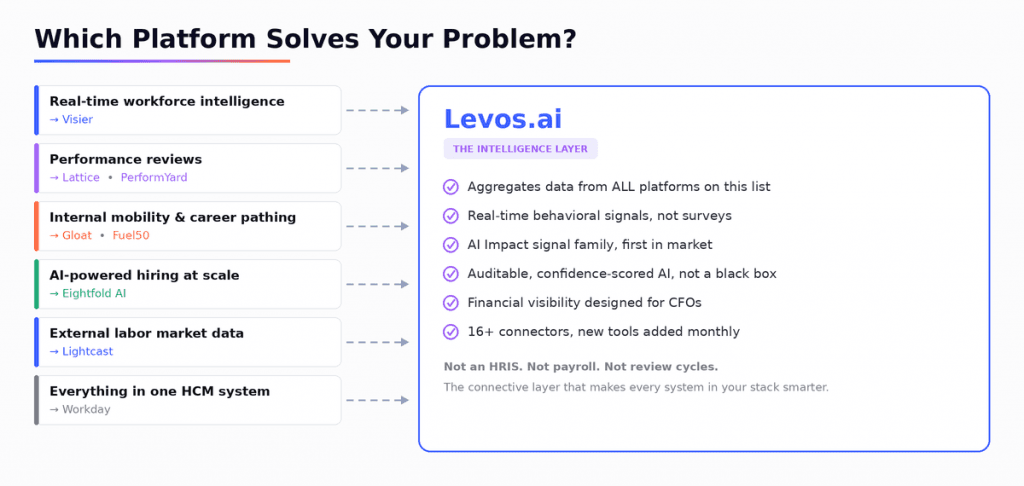
This is why we built Levos, not as another AI overlay, but as a clarity engine for AI workforce readiness. Levos shows organizations what is actually happening beneath the surface:
- How work is actually happening today
- Where capability gaps block progress
- Where ownership is unclear
- Where processes drift
- Where data is unreliable
- Where roles no longer match reality
Levos turns the behavioral signals from the tools your workforce already uses into one shared picture of readiness, so leaders can fix the foundation before they scale AI on top of it.
How to Measure AI Workforce Readiness
You cannot improve what you cannot see. Measuring AI workforce readiness means looking past adoption dashboards and vendor-supplied metrics to the behavioral signals that show how work actually happens. The goal is not a vanity score. It is a clear map of where the foundation is strong and where it will crack under load.
A credible AI workforce readiness assessment answers four questions before a single tool is rolled out:
- Are roles and ownership clear enough for AI to augment work rather than confuse it?
- Is the underlying data reliable enough to trust what AI produces?
- Do teams have the capability and AI literacy to use the tools well?
- Are processes consistent enough to automate without scaling chaos?
Answer those honestly and you have a roadmap. Skip them and AI simply accelerates the dysfunction you already had. That is the difference between AI workforce readiness as a slogan and AI workforce readiness as a discipline.
What AI Workforce Readiness Looks Like in 2026
2026 will belong to companies that treat AI transformation as an organizational redesign, not a software deployment. The winners will not be the ones with the most licenses. They will be the ones who measured their AI workforce readiness, closed the gaps, and then scaled.
That is the work we do at Elevates.AI. If you want to know where your organization actually stands, start with a structured assessment on the Elevates.AI Launchpad, then build the foundation that makes AI a multiplier instead of a liability.
Be the First to Discover New AI Insights
Follow Elevates.AI on Google to stay updated with the latest AI readiness assessments, governance frameworks, implementation guides, buyer's guides, and enterprise AI best practices.
 Follow Elevates.AI on Google
The AI Readiness Brief
Every Week, receive practical enterprise AI strategies, implementation frameworks, governance updates, and expert insights—all delivered in a 5-minute read.
| ✓ Enterprise AI Strategy | ✓ AI Readiness Frameworks |
| ✓ Governance & Compliance | ✓ Exclusive Guides & Resources |
Join 500+ AI Professionals
Enter your work email below to receive one high-value email every week. No spam. Unsubscribe anytime.