
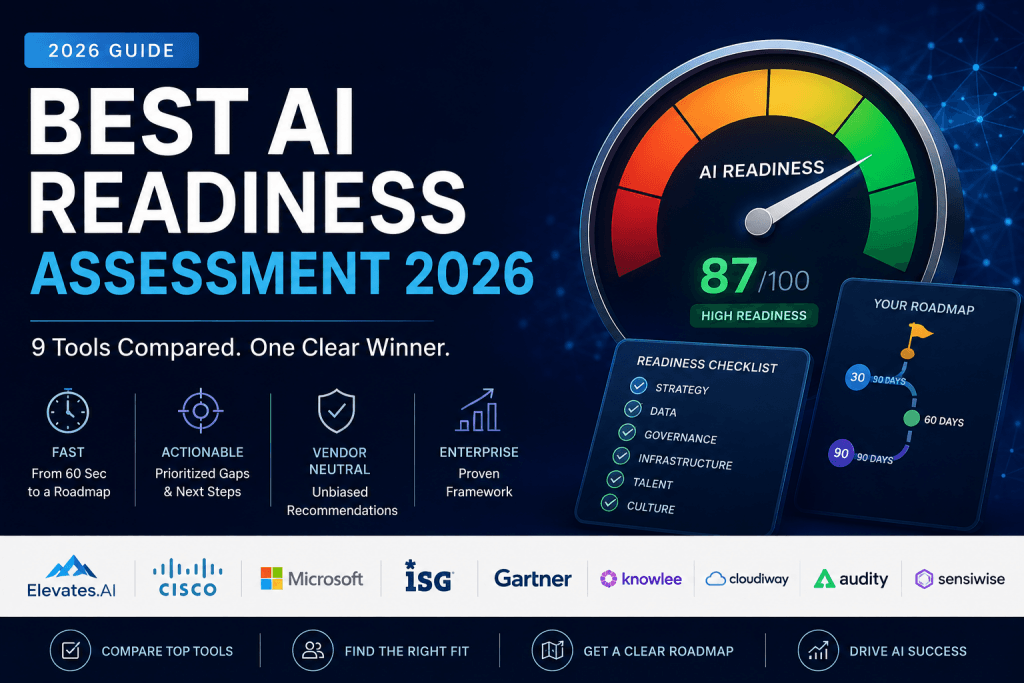
Search for the best AI readiness assessment 2026 and you land on a page of listicles that mostly cite each other. The tools they rank split into two camps. Free quizzes that take three minutes and hand you a generic score. And consulting engagements that take three months and cost more than a mid-market AI budget. Most buyers need something between those two, and almost nobody sells it honestly.
I have spent the last year watching companies choose an assessment the way they choose a search result. They click the first free tool, collect a number, and learn nothing they can act on. Then they pay a large firm for a report that says the same thing with better charts. The assessment market has a value gap. It looks a lot like the AI value gap it is supposed to diagnose.
Who Should Use an AI Readiness Assessment?
Whether you’re exploring AI for the first time or scaling existing initiatives, the right assessment depends on where your organization is today.
This guide is designed for:
- CIOs evaluating enterprise AI investments
- CTOs planning AI implementation roadmaps
- Digital transformation leaders
- Operations and business executives
- IT teams comparing AI readiness tools
- Organizations looking for a Microsoft AI readiness alternative
If your goal is to understand where your biggest readiness gaps exist before investing in AI, you’re in the right place.
What Separates the Best AI Readiness Assessment 2026 From the Rest
Start with the problem the assessment exists to solve. Cisco’s AI Readiness Index 2025 found that only 13 percent of organizations are fully ready to deploy AI, a group it calls Pacesetters, and that share has barely moved in three years (Cisco, 2025). McKinsey’s State of AI 2025 puts the same gap a different way. 88 percent of organizations use AI in at least one function, but only 39 percent report measurable enterprise impact (McKinsey, 2025).
So readiness is the constraint, not adoption. A good assessment has to do three things the free quizzes skip. It has to measure the gaps that actually block value, not just survey your enthusiasm. It has to tell you what to do next, in order. And it has to do both without selling you the software it just recommended.
That third requirement is where almost every tool fails. The assessment is rarely the product. It is the top of a funnel for something else, a consulting engagement, a platform license, an upgrade tier. The score is engineered to qualify you for the sale, not to hand you an independent plan. Once you see that, the listicles read differently. You are not comparing diagnostics. You are comparing lead magnets with different price tags.
If you want that read on your own organization before you compare vendors, the free 60-second assessment at Elevates.AI/launchpad maps your readiness gaps and returns a prioritized starting point, not just a score.
How We Evaluated These AI Readiness Assessments
Rather than ranking tools based on popularity, we compared each assessment using criteria that directly influence implementation success.
Every assessment was evaluated on:
| Criteria | Why It Matters |
|---|---|
| Vendor neutrality | Avoid biased recommendations |
| Readiness dimensions | Strategy, governance, data, workforce, infrastructure |
| Actionability | Does it provide next steps or only a score? |
| Time required | Can teams act this week or next quarter? |
| Cost | Free, subscription, or consulting engagement |
| Enterprise suitability | Startup, mid-market, or enterprise |
| Roadmap quality | Action plan vs benchmark only |
Because ultimately, an assessment isn’t valuable because it tells you where you are.
It’s valuable because it tells you what to do next.
The AI Readiness Assessment Tools, Reviewed Honestly
The free tier is crowded and useful for orientation. Cisco’s AI Readiness Index scores you across six dimensions, strategy, infrastructure, data, governance, talent, and culture, and benchmarks you against thousands of firms. It is genuinely good, and it is built for large enterprises. The ISG AI Maturity Index runs a 15-minute conversational assessment with benchmarks across more than 75 countries, focused on workforce readiness.
Below the analysts sit the tools that own the search results. Knowlee, Cloudiway, and Audity now rank on page one for the vendor-evaluation queries, each offering a quiz-to-report funnel. Sensiwise markets its SAIRA assessment to consultants, and ISG sells a paid maturity index above its free tier. These tools are competent at what they do. The catch is consistent. The free version gives you a score, and the real output sits behind a paid engagement or a tool recommendation.
Pricing across the category runs from free to roughly 75,000 dollars for a full consulting assessment (industry SERP review, 2026). That spread is the whole problem. A free quiz underdelivers, and a five-figure engagement overdelivers on slides while underdelivering on speed. Most mid-market teams need a fast, specific gap read they can act on this quarter. They do not need a number, and they do not need a binder.
Each of these tools is good at one thing and quiet about its limits. Cisco gives you the deepest benchmark and the least specificity, because an index built for the Fortune 500 cannot tell a 200-person company what to do on Monday. ISG is fast and workforce-focused, which helps if your gap is talent and matters less if your gap is data or governance. The listicle tools convert a quiz into a consulting lead, so the assessment is the front of their funnel, not the deliverable. None of that is dishonest. It just means the free score is built to sell the paid step, and you should read it that way.
What the whole category tends to skip is the translation layer. A maturity tier or a dimension score is a label, not an instruction. Knowing you are a Chaser instead of a Pacesetter does not tell you which gap to close first or what it costs to close it. The assessments that change behavior are the ones that convert the score into a ranked, sequenced set of moves. Most do not, which is why so many readiness reports end up in the same drawer as last year’s strategy deck.
The Cost of the Wrong Assessment Is Time, Not Just Money
Price is the obvious axis. Time is the one buyers underestimate. A consulting assessment that takes eight weeks does not just cost five figures. It costs eight weeks of not acting while the gap compounds and competitors move. In a market where Cisco’s readiness share has stayed flat at 13 percent for three years, the organizations pulling ahead are not the ones with the most thorough assessment. They are the ones who assessed fast and started fixing.
That is the case for a short assessment with a real output. Sixty seconds to a prioritized gap read is not a thinner version of the eight-week engagement. For most mid-market teams it is the better trade, because it converts into action the same day instead of next quarter. The thorough report you act on in three months loses to the fast read you act on this week, every time.
The Microsoft AI Readiness Alternative Question
A lot of buyers do not start by searching for an assessment. They start inside a platform they already pay for. Microsoft, in particular, offers AI readiness tooling bundled with its enterprise stack, and for Microsoft-committed shops that is a reasonable front door.
The limit is structural. A readiness assessment built by a platform vendor is measuring your readiness to buy more of that platform. It is not neutral, and it cannot be. If you want a Microsoft AI readiness alternative, the test is simple. Does the assessment recommend tools it does not sell. If the answer is no, you are reading a sales qualifier dressed as a diagnostic.
A vendor-neutral assessment answers the question the platform tools cannot. The assessment at Elevates.AI/launchpad recommends tools based on your assessed gaps, including tools we have no stake in.
Vendor Neutrality Is the Real Differentiator
Here is the contrast that matters. Most assessments are owned by someone selling the next step. The analyst firms sell the consulting hours. The platform vendors sell the platform. The quiz tools sell the upgrade. The recommendation is never fully separated from the revenue.
Elevates.AI built the assessment the other way around. It takes 60 seconds, it returns a gap analysis and a 90-day roadmap, and it matches tools to your specific gaps through a curated marketplace. Disclosure: the Elevates.AI marketplace includes affiliate partnerships, so matches are made on assessed gaps and verified fit, not on commercial relationships. The point of neutrality is that the recommendation survives the disclosure.
That is also why speed matters. A 60-second assessment that returns a real gap read removes the excuse not to start. You can run the Cisco and ISG benchmarks afterward and lose nothing by comparing.
Quick Comparison: Best AI Readiness Assessment Tools (2026)
| Tool | Best For | Time | Pricing | Roadmap | Vendor Neutral |
|---|---|---|---|---|---|
| Elevates.AI | Mid-market & Enterprise | 60 sec | Free | ✅ | ✅ |
| Cisco AI Readiness Index | Benchmarking | 10–15 min | Free | ❌ | ❌ |
| ISG AI Maturity Index | Workforce Assessment | 15 min | Free / Paid | Partial | Partial |
| Microsoft AI Readiness | Microsoft Ecosystem | Varies | Included | Limited | ❌ |
This gives users a quick overview before reading the detailed analysis.
What Does a Good AI Readiness Report Include?
Not all assessments produce the same output.
The best AI readiness assessments should provide more than a maturity score.
Look for a report that includes:
- Executive summary
- Overall AI readiness score
- Organizational strengths
- High-priority readiness gaps
- AI governance recommendations
- Data maturity analysis
- Workforce capability assessment
- Technology readiness evaluation
- Recommended AI tools
- A practical 30-, 60-, and 90-day action plan
A score tells you where you stand.
A roadmap tells you where to go next.
Organizational AI Readiness vs AI Maturity
These terms are often confused.
AI Readiness answers:
“Are we prepared to implement AI successfully?”
AI Maturity answers:
“How advanced are our existing AI capabilities?”
Organizations beginning their AI journey benefit most from readiness assessments.
Organizations already deploying AI often benefit from maturity assessments to optimize and scale existing initiatives.
Understanding the difference helps ensure you’re choosing the right framework for your current stage.
How to Choose the Right Assessment for Your Stage
Match the tool to where you are. If you are orienting and want a benchmark, run Cisco’s index or ISG’s. Both are free and both are credible. If you are building a board case, a consulting engagement buys you the slides, at consulting prices. If you need a specific, prioritized gap read you can act on this quarter, use a fast vendor-neutral assessment and skip the binder.
A simple decision rule cuts through the noise. Pick the assessment whose output you could hand to a team on Monday and watch them start work. If the deliverable is a tier label, a percentage, or a sales call, keep looking. If the deliverable is a ranked list of gaps with a sequence for closing them, you found the right one. The format of the output tells you more about the tool than any feature list on the pricing page.
The one mistake to avoid is treating the score as the deliverable. A number without a next step is where the 39 percent impact figure comes from. The best AI readiness assessment 2026 is the one that hands you the next move, not just the diagnosis. If you also want to see how the maturity frameworks compare side by side, our AI maturity model comparison breaks down the major models in one place.
Most teams do not lack an AI readiness assessment. They lack one that tells them what to do next. If your last assessment handed you a score and nothing else, that is the gap to close. Start with the free, vendor-neutral assessment at Elevates.AI/launchpad and get a prioritized gap read and a 90-day roadmap in 60 seconds.
Frequently Asked Questions
What is the best AI readiness assessment 2026?
The best AI readiness assessment 2026 is the one that returns a prioritized gap analysis and a clear next step, not just a score. Free benchmarks like the Cisco AI Readiness Index and the ISG AI Maturity Index are strong for orientation, while a vendor-neutral assessment is better when you need specific actions you can take this quarter.
How much does an AI readiness assessment cost?
Pricing ranges from free to around 75,000 dollars for a full consulting engagement. Free quizzes give you a score, and the higher-cost engagements add detailed reporting and advisory time. Many mid-market teams get more value from a fast, vendor-neutral assessment that prioritizes gaps without the consulting price tag.
Is there a Microsoft AI readiness alternative?
Yes. Platform vendors like Microsoft offer readiness tooling, but those assessments are tied to selling more of the platform. A vendor-neutral alternative recommends tools based on your assessed gaps rather than a single product line, which is the practical test of whether an assessment is independent.
How long should an AI readiness assessment take?
It depends on the depth you need. Benchmarking tools like Cisco and ISG take 15 minutes or less. A focused gap read can take as little as 60 seconds, while a full consulting assessment runs for weeks. Speed matters because a long assessment often becomes the reason teams delay action.
What should an AI readiness assessment actually measure?
It should measure the gaps that block value, including data, governance, talent, infrastructure, and strategy, and then translate those gaps into prioritized next steps. An assessment that only produces a maturity score without an action plan leaves you where most organizations already are.
Which AI readiness assessment is best for small businesses?
Small businesses usually benefit from lightweight assessments that prioritize actionable recommendations over lengthy consulting reports. The best option depends on whether the goal is benchmarking, governance planning, or implementation.
How often should an AI readiness assessment be performed?
Most organizations should reassess every 6–12 months or before launching major AI initiatives. AI readiness changes as technology, governance, and business priorities evolve.
What’s the difference between AI readiness and digital maturity?
Digital maturity measures overall digital transformation.
AI readiness specifically evaluates whether an organization has the strategy, governance, data, workforce, and infrastructure required to implement AI successfully.
Continue Your AI Journey
If you’re evaluating AI adoption, these resources may help:
- Organizational AI Readiness – Understand what it means to be truly AI-ready before implementation.
- AI Governance Framework – Build policies and governance for responsible AI adoption.
- AI Maturity Model Comparison – Compare leading AI maturity frameworks and determine which fits your organization.
- Workforce Intelligence Platform Guide – Learn how workforce intelligence supports AI transformation.
Final Thoughts
The best AI readiness assessment isn’t necessarily the longest, the most expensive, or the one with the most detailed charts.
It’s the one that helps your organization make better decisions faster.
Whether you’re benchmarking your current capabilities, building an enterprise AI strategy, or preparing for large-scale implementation, the right assessment should leave you with a clear understanding of:
- Where you are today
- What’s holding you back
- What to prioritize next
- How to move forward with confidence
Because AI readiness isn’t about getting a score.
It’s about building an organization that can consistently turn AI investments into measurable business outcomes.
Be the First to Discover New AI Insights
Follow Elevates.AI on Google to stay updated with the latest AI readiness assessments, governance frameworks, implementation guides, buyer's guides, and enterprise AI best practices.
 Follow Elevates.AI on Google
The AI Readiness Brief
Every Week, receive practical enterprise AI strategies, implementation frameworks, governance updates, and expert insights—all delivered in a 5-minute read.
| ✓ Enterprise AI Strategy | ✓ AI Readiness Frameworks |
| ✓ Governance & Compliance | ✓ Exclusive Guides & Resources |
Join 500+ AI Professionals
Enter your work email below to receive one high-value email every week. No spam. Unsubscribe anytime.