The complete guide and checklist for evaluating whether your factory is ready to scale AI — before you invest in another pilot.
Is Your Manufacturing Company Actually AI Ready?
Artificial intelligence is transforming manufacturing, but buying AI software does not automatically create a smart factory. Many manufacturers invest in predictive maintenance, computer vision, demand forecasting, or production optimization only to discover that their data, infrastructure, and operational processes are not ready to support AI at scale.
The organizations seeing the greatest value from AI are those that invested in AI readiness first. Before deploying AI across production lines, manufacturers need to evaluate data quality, machine connectivity, governance, cybersecurity, workforce readiness, and executive alignment — which is exactly what an AI Readiness Assessment is designed to uncover.
Why AI Projects Fail in Manufacturing
Legacy PLCs, disconnected MES and ERP systems, inconsistent sensor data, paper-based processes, fragmented operational data, and poor governance frequently prevent AI projects from moving beyond the pilot stage. A readiness assessment identifies these gaps before major investments are made.
What Is an AI Readiness Assessment for Manufacturing?
An AI Readiness Assessment evaluates whether a factory has the strategy, data, infrastructure, governance, and workforce capabilities needed to deploy AI successfully. Manufacturing-specific assessments also examine ERP, MES, PLC, SCADA, IoT sensors, maintenance history, cybersecurity, and OT/IT collaboration. If you’re new to the concept, What Is AI Readiness? is a good place to start.
The 7-Layer Manufacturing AI Readiness Framework
Manufacturing AI projects succeed when technology is supported by strong operational foundations. Elevates.AI recommends evaluating readiness across seven connected layers instead of focusing only on software.
- Business Strategy — Clear business objectives, executive sponsorship, and measurable KPIs.
- Production Processes — Standardized workflows suitable for automation.
- Machine Connectivity — PLCs, SCADA, IoT sensors, and production equipment connected reliably.
- Data Quality — Accurate, complete, and accessible production, maintenance, and quality data.
- AI Infrastructure — Cloud, edge computing, networking, cybersecurity, and integrations with ERP and MES.
- Governance — Data ownership, AI policies, risk management, compliance, and approval processes.
- People & Skills — Workforce readiness, training, and cross-functional collaboration between OT and IT.
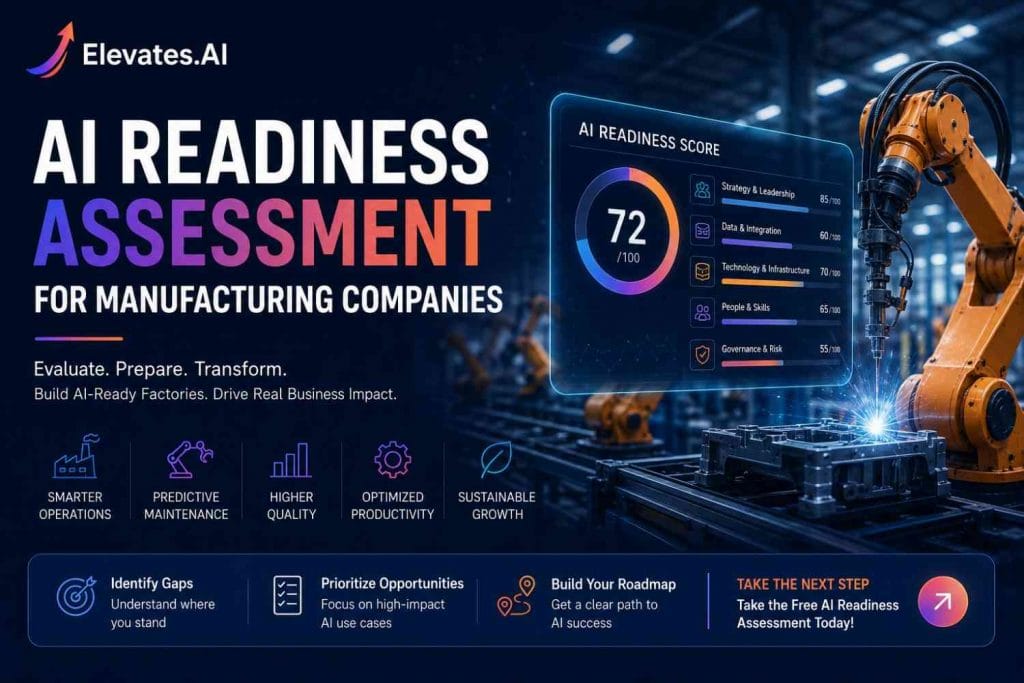
Manufacturing AI Readiness Score
A useful way to benchmark progress is to score each layer of the framework against a target. Here’s an illustrative scorecard for a mid-sized manufacturer partway through its readiness journey:
| Category | Target Score | Example |
| Business Strategy | 80+ | 82 |
| Production Processes | 75+ | 78 |
| Machine Connectivity | 80+ | 71 |
| Data Quality | 80+ | 55 |
| AI Infrastructure | 75+ | 68 |
| Governance | 80+ | 49 |
| People & Skills | 70+ | 61 |
Notice where the gaps concentrate — in this example, Data Quality and Governance. Those are the layers worth fixing before the next pilot, and they’re a core focus of the AI Governance Framework.
10 Signs Your Factory Is AI Ready
- Executive leadership supports AI initiatives with measurable business goals.
- ERP and MES systems are integrated.
- Production equipment generates reliable digital data.
- Historical maintenance records are available.
- Quality inspection data is digitized.
- Cybersecurity policies protect operational technology.
- Cross-functional OT and IT teams collaborate effectively.
- Data ownership is clearly defined.
- A pilot use case has been identified.
- Success metrics are agreed before deployment.
Manufacturing AI Readiness Checklist
Use this checklist as a quick self-audit before you commit budget to an AI initiative:
☐ Machine connectivity verified
☐ ERP and MES integration complete
☐ Reliable production data available
☐ AI governance policies documented
☐ Cybersecurity controls validated
☐ Executive sponsor assigned
☐ Pilot use case selected
☐ KPIs defined
☐ Workforce training planned
☐ Continuous monitoring process established
High-Impact AI Use Cases in Manufacturing
Once a manufacturer has established a solid AI foundation, the next step is selecting business problems where AI can deliver measurable value. The best pilots are focused, measurable, and supported by reliable production data.
Predictive Maintenance
Use sensor and maintenance history to predict equipment failures before they happen, reducing unplanned downtime and maintenance costs.
Computer Vision Quality Inspection
Detect product defects in real time using cameras and AI models, improving quality while reducing manual inspection.
Production Planning & Scheduling
Optimize production schedules based on demand, machine availability, labor capacity, and inventory.
Demand Forecasting
Combine historical sales, seasonality, and market signals to improve procurement and inventory planning.
Energy Optimization
Monitor machine utilization and energy consumption to identify efficiency opportunities and reduce operating costs.
Digital Twins
Create virtual representations of production assets to simulate changes before implementing them on the factory floor.
What’s Blocking AI Adoption in Manufacturing?
- Legacy ERP and MES platforms that do not integrate easily.
- Disconnected PLC, SCADA, and IoT data sources.
- Poor production data quality and inconsistent naming standards.
- Limited collaboration between operational technology (OT) and information technology (IT) teams.
- Cybersecurity concerns around connecting factory systems.
- Unclear ownership of AI initiatives and governance responsibilities.
- Lack of workforce training and change management.
Industry 4.0 vs AI Readiness
The two concepts are related but not the same. Industry 4.0 builds the connected factory; AI readiness determines whether that factory can actually put AI to work.
| Industry 4.0 | AI Readiness |
| Focuses on connected factories and automation | Focuses on organizational capability to deploy AI successfully |
| Emphasizes IoT, robotics and digitization | Emphasizes data quality, governance, people and AI operations |
| Technology transformation | Business and operational transformation |
| Foundation for smart manufacturing | Foundation for scalable AI adoption |
90-Day Manufacturing AI Roadmap
Days 1–30
Assess AI readiness, inventory factory data, identify high-value use cases, assign executive sponsor.
Days 31–60
Improve data quality, integrate ERP/MES where needed, establish AI governance and cybersecurity controls.
Days 61–90
Launch one pilot project, measure KPIs, review outcomes, and prepare a phased rollout plan.
Manufacturers who want a structured way to run this roadmap often use the Elevates.AI Launchpad to move from assessment to pilot without losing momentum.
Manufacturing AI Maturity Model
AI readiness is the starting point; AI maturity measures how far an organization has progressed after implementation. Manufacturers typically move through five stages:
Level 1 — Exploring
Little or no AI usage. Data is fragmented and initiatives are ad hoc.
Level 2 — Preparing
Leadership has identified AI opportunities and is improving data quality and governance.
Level 3 — Piloting
One or more AI pilots are running with defined KPIs and executive sponsorship.
Level 4 — Scaling
Successful pilots expand across multiple plants or business units with standardized governance.
Level 5 — Optimizing
AI is embedded into daily operations with continuous monitoring, improvement, and measurable business value.
Common AI Readiness Mistakes in Manufacturing
- Buying AI software before fixing data quality issues.
- Launching multiple pilots without executive ownership.
- Treating AI as an IT project instead of a business transformation.
- Ignoring cybersecurity and operational technology (OT) risks.
- Failing to define measurable KPIs before deployment.
- Not training production teams on new AI-enabled workflows.
Frequently Asked Questions
Q. What is an AI Readiness Assessment for manufacturing?
It evaluates whether a manufacturer has the strategy, data, infrastructure, governance, and workforce needed to deploy AI successfully.
Q. Why do manufacturing AI projects fail?
The most common reasons are poor data quality, disconnected systems, weak governance, unclear ownership, and lack of change management.
Q. How long does an AI readiness assessment take?
A high-level assessment can take minutes, while a detailed enterprise assessment may take several weeks depending on the size and complexity of the organization.
Q. What are the best first AI use cases for manufacturers?
Predictive maintenance, computer vision quality inspection, demand forecasting, production scheduling, and energy optimization are among the most common starting points.
| Ready to find out where you stand? Before investing in predictive maintenance, computer vision, or smart factory platforms, make sure your organization is ready. Take the free Elevates.AI AI Readiness Assessment to receive: Your AI Readiness ScoreManufacturing readiness insightsPersonalized recommendationsA practical 90-day AI implementation roadmap |
Explore more: What Is AI Readiness? · AI Governance Framework · AI Marketplace · Launchpad
Be the First to Discover New AI Insights
Follow Elevates.AI on Google to stay updated with the latest AI readiness assessments, governance frameworks, implementation guides, buyer's guides, and enterprise AI best practices.
 Follow Elevates.AI on Google
The AI Readiness Brief
Every Week, receive practical enterprise AI strategies, implementation frameworks, governance updates, and expert insights—all delivered in a 5-minute read.
| ✓ Enterprise AI Strategy | ✓ AI Readiness Frameworks |
| ✓ Governance & Compliance | ✓ Exclusive Guides & Resources |
Join 500+ AI Professionals
Enter your work email below to receive one high-value email every week. No spam. Unsubscribe anytime.