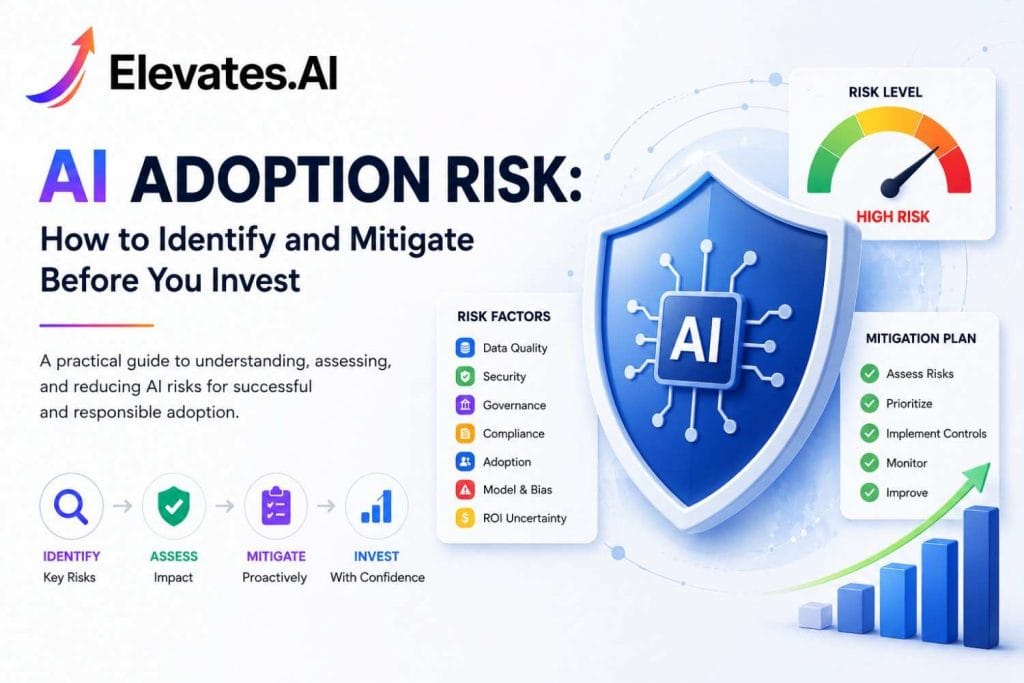
AI Adoption Risk: How to Identify and Mitigate Before You Invest
Introduction
Artificial intelligence is transforming every industry, but successful AI adoption starts long before a model is deployed. Organizations often focus on selecting the right platform or large language model while overlooking the operational, governance, and organizational risks that determine whether an AI initiative succeeds.
According to research from McKinsey and Deloitte, many organizations are experimenting with AI, yet far fewer achieve enterprise-wide business value because foundational capabilities are missing. AI adoption is not simply a technology project—it is a business transformation initiative requiring strategy, governance, quality data, executive sponsorship, and workforce readiness.
Before investing in enterprise AI platforms, organizations should understand their current level of readiness. A structured AI Readiness Assessment available from Elevates.AI helps identify gaps across strategy, infrastructure, governance, data quality, and people before significant investment is made:
AI Readiness Assessment
What Is AI Adoption Risk?
AI Adoption Risk refers to the collection of business, operational, legal, technical, security, and organizational factors that can prevent artificial intelligence initiatives from delivering expected business outcomes.
Unlike traditional IT projects, AI systems continuously evolve through new data, model updates, human interaction, and changing business conditions. That makes risk management an ongoing process rather than a one-time activity.
Organizations that manage AI Adoption Risk effectively generally have stronger governance, better data quality, clearer ownership, and more realistic implementation roadmaps.
Why AI Projects Fail
Many executives assume AI projects fail because the technology is immature. In reality, technology is rarely the primary obstacle.
The most common causes include poor data quality, unclear business objectives, fragmented ownership, weak governance, employee resistance, unrealistic expectations, and inadequate change management.
Rather than asking ‘Which AI tool should we buy?’, organizations should first ask ‘Are we ready to adopt AI successfully?’
Our guide to What Is AI Readiness explains why readiness should always precede implementation:
https://www.elevates.ai/what-is-ai-readiness/
If your organization has already started evaluating governance, the AI Governance Framework provides practical guidance for establishing ownership, approval workflows, and ongoing oversight:
AI Governance Framework
The Four Categories of AI Adoption Risk
1. Strategic Risk
AI initiatives launched without measurable business objectives rarely produce meaningful ROI. Every project should begin with a clearly defined business problem and executive sponsorship.
2. Operational Risk
Disconnected workflows, poor process documentation, and inconsistent operational practices prevent AI from scaling successfully.
3. Technical Risk
Legacy infrastructure, fragmented data, cybersecurity concerns, and integration challenges frequently delay AI deployment.
4. Governance Risk
Without policies, accountability, monitoring, and human oversight, organizations expose themselves to compliance and reputational risks.
Key Takeaways
- AI adoption is primarily an organizational challenge rather than a technology challenge.
- Readiness assessments reduce implementation risk before budgets are committed.
- Governance should be established before enterprise deployment.
- Executive sponsorship is one of the strongest predictors of AI success.
The 8 Biggest AI Adoption Risks
1. Poor Data Quality
Artificial intelligence depends on accurate, complete, and trustworthy data. Duplicate records, missing values, inconsistent formats, and disconnected systems often cause AI projects to produce unreliable results. Before investing in AI, organizations should audit their data sources and improve data governance. If you haven’t assessed your data readiness yet, start with the Elevates.AI AI Readiness Assessment: https://www.elevates.ai/ai-readiness-assessment/.
2. Unclear Business Objectives
Many AI initiatives begin with excitement about technology instead of a measurable business problem. Define KPIs before selecting tools, such as reducing customer support response time or improving forecast accuracy.
3. Weak AI Governance
Without clear ownership, approval processes, and monitoring, AI initiatives become inconsistent across departments. Establish governance early. The Elevates.AI AI Governance Framework provides practical guidance: https://www.elevates.ai/ai-governance-framework/.
4. Security & Privacy
AI systems frequently process confidential information. Organizations should implement role-based access, encryption, audit logs, vendor reviews, and incident response procedures before deploying production AI.
5. Employee Resistance
AI adoption succeeds when employees understand how AI supports their work. Training, communication, and executive sponsorship are essential for long-term adoption.
6. Vendor Lock-In
Evaluate APIs, data portability, integration capabilities, pricing, and exit strategies before selecting AI vendors.
7. Compliance & Regulatory Risk
Industries such as finance, healthcare, and manufacturing often require additional governance. Financial organizations can benefit from industry-specific readiness guidance: https://www.elevates.ai/ai-readiness-for-financial-services/.
8. Unrealistic ROI Expectations
Successful organizations begin with one measurable pilot, evaluate results, then scale gradually instead of expecting immediate enterprise-wide returns.
AI Adoption Risk Matrix
| Risk | Likelihood | Business Impact |
| Poor Data Quality | High | High |
| Weak Governance | High | High |
| Security & Privacy | Medium | High |
| Employee Resistance | Medium | Medium |
| Vendor Lock-In | Medium | Medium |
| Compliance | Medium | High |
| ROI Expectations | High | Medium |
| Infrastructure Limitations | Medium | High |
Mitigation Strategy
Reduce AI Adoption Risk by following a phased approach: assess organizational readiness, establish governance, improve data quality, identify one high-value pilot, define measurable KPIs, monitor outcomes, and scale only after success is demonstrated. Manufacturing organizations should also review the AI Readiness Assessment for Manufacturing Companies for factory-specific considerations: AI Readiness Manufacturing
AI Adoption Risk by Industry
Although every organization faces common AI adoption challenges, each industry has unique risks based on regulation, data sensitivity, operational complexity, and customer expectations. Understanding these differences helps organizations prioritize the right mitigation strategies before scaling AI.
Financial Services
Financial institutions must address model risk management, explainability, anti-money laundering controls, data residency, and regulatory compliance. Before deploying AI, banks and fintechs should evaluate governance, auditability, and oversight. Read more in the Elevates.AI AI Readiness for Financial Services guide: https://www.elevates.ai/ai-readiness-for-financial-services/
Manufacturing
Manufacturers often struggle with legacy ERP systems, disconnected PLC and MES environments, inconsistent production data, and OT/IT integration. A factory-specific AI Readiness Assessment for Manufacturing Companies can uncover these gaps before investment: https://www.elevates.ai/ai-readiness-manufacturing/
Healthcare
Healthcare organizations must balance innovation with patient privacy, clinical safety, explainability, and regulatory obligations. Human oversight remains essential for AI-assisted decision making.
SaaS & Technology
SaaS companies generally have stronger cloud infrastructure but still face governance, customer trust, prompt security, and vendor management challenges as AI becomes embedded into products.
Enterprise AI Risk Assessment Checklist
☐ Executive sponsor assigned
☐ Business problem clearly defined
☐ AI Readiness Assessment completed (https://www.elevates.ai/ai-readiness-assessment/)
☐ Data quality validated
☐ AI Governance Framework established (https://www.elevates.ai/ai-governance-framework/)
☐ Cybersecurity review completed
☐ Vendor risk assessment performed
☐ Regulatory obligations documented
☐ Pilot KPIs approved
☐ Monitoring and rollback plan defined
30/60/90-Day AI Adoption Roadmap
Days 1–30
Assess AI readiness, identify business objectives, inventory data sources, and establish executive ownership.
Days 31–60
Implement governance policies, improve data quality, evaluate vendors, and prepare one high-value pilot.
Days 61–90
Deploy the pilot, monitor KPIs, collect user feedback, review risks, and prepare a phased enterprise rollout.
Common Implementation Mistakes
- Choosing AI tools before defining business outcomes.
- Skipping governance until after deployment.
- Expecting immediate enterprise-wide ROI.
- Underestimating employee training and change management.
- Treating AI as an IT initiative instead of an organization-wide transformation.
AI Adoption Risk Maturity Model
Managing AI Adoption Risk is an ongoing capability rather than a one-time project. Organizations typically progress through five stages as they improve governance, data quality, operational readiness, and AI oversight.
Level 1 – Reactive
AI experiments happen independently with little governance or executive visibility.
Level 2 – Aware
Leadership recognizes AI risks and begins documenting policies and responsibilities.
Level 3 – Structured
The organization has formal governance, risk reviews, approved AI use cases, and defined KPIs.
Level 4 – Managed
AI projects follow standardized approval processes, continuous monitoring, and regular compliance reviews.
Level 5 – Optimized
AI governance, monitoring, security, and business measurement are fully integrated into enterprise operations.
Executive Recommendations
- Complete an AI Readiness Assessment before selecting AI vendors or platforms.
- Create an AI Governance Committee with representatives from IT, Security, Legal, Compliance, HR, and business units.
- Begin with one measurable pilot before expanding AI across the organization.
- Continuously monitor AI performance, security, bias, and business KPIs.
- Review governance policies quarterly as AI regulations and business needs evolve.
Frequently Asked Questions
What is AI Adoption Risk?
AI Adoption Risk includes the strategic, technical, operational, governance, security, and compliance risks that may prevent AI initiatives from delivering expected business value.
How can organizations reduce AI Adoption Risk?
By assessing readiness, improving data quality, establishing governance, defining measurable business objectives, launching controlled pilots, and monitoring outcomes continuously.
Why should organizations complete an AI Readiness Assessment first?
A readiness assessment identifies gaps in strategy, data, infrastructure, governance, and workforce capability before significant AI investment is made. Learn more: https://www.elevates.ai/ai-readiness-assessment/
Does AI governance reduce AI Adoption Risk?
Yes. A structured AI Governance Framework defines ownership, accountability, approval workflows, monitoring, and compliance, reducing operational and regulatory risk. https://www.elevates.ai/ai-governance-framework/
Final Thoughts
Successful AI adoption depends less on choosing the latest model and more on building the organizational capabilities that allow AI to deliver sustainable value. Organizations that invest in readiness, governance, quality data, and change management consistently reduce implementation risk and improve long-term outcomes.
Whether you are just beginning your AI journey or preparing to scale enterprise AI, start by evaluating your organization’s readiness, strengthening governance, and focusing on measurable business outcomes.
Further Reading on Elevates.AI
- AI Readiness Assessment — https://www.elevates.ai/ai-readiness-assessment/
- What Is AI Readiness? — https://www.elevates.ai/what-is-ai-readiness/
- AI Governance Framework — https://www.elevates.ai/ai-governance-framework/
- AI Readiness for Financial Services — https://www.elevates.ai/ai-readiness-for-financial-services/
- AI Readiness Assessment for Manufacturing Companies — https://www.elevates.ai/ai-readiness-manufacturing/
- Launchpad — https://www.elevates.ai/launchpad/
- AI Marketplace — https://www.elevates.ai/ai-marketplace/
Authoritative Sources
- NIST AI Risk Management Framework — https://www.nist.gov/itl/ai-risk-management-framework
- McKinsey – The State of AI — https://www.mckinsey.com/capabilities/quantumblack/our-insights/the-state-of-ai
- Deloitte – State of AI — https://www2.deloitte.com/
- IBM – AI Governance — https://www.ibm.com/topics/ai-governance
- OECD AI Principles — https://oecd.ai/en/ai-principles
- World Economic Forum – AI Governance Alliance — https://initiatives.weforum.org/ai-governance-alliance/home
Be the First to Discover New AI Insights
Follow Elevates.AI on Google to stay updated with the latest AI readiness assessments, governance frameworks, implementation guides, buyer's guides, and enterprise AI best practices.
 Follow Elevates.AI on Google
The AI Readiness Brief
Every Week, receive practical enterprise AI strategies, implementation frameworks, governance updates, and expert insights—all delivered in a 5-minute read.
| ✓ Enterprise AI Strategy | ✓ AI Readiness Frameworks |
| ✓ Governance & Compliance | ✓ Exclusive Guides & Resources |
Join 500+ AI Professionals
Enter your work email below to receive one high-value email every week. No spam. Unsubscribe anytime.