
Every vendor in this category now offers a free AI readiness assessment. Most of them are the same form wearing different colors. You answer twelve questions about your data, your tools, and your team, and a number comes back.
I keep seeing the same pattern. A leadership team runs three of these in one quarter, collects three different scores, and still walks into Monday morning with no idea what to change first.
The score was never the problem. The missing next step was.
A free assessment is a lead magnet, and that is fine
Start with the economics, because the economics explain the product. Published 2026 pricing analyses put a narrow small-business readiness audit at 2,000 to 8,000 dollars, a focused mid-market audit at 5,000 to 15,000 dollars, and an enterprise-grade engagement at 15,000 to 50,000 dollars and up. Consultancies price the assessment as a loss leader. Revenue arrives in the transformation project that follows it.
So when a tool costs nothing, ask what it was built to sell. That is not an accusation. It is a specification. It tells you which part of the output deserves your attention.
The part that deserves your attention is everything after the score.
A grading instrument sells you a benchmark. A diagnostic sells you a decision. If you want a baseline before you brief a consultancy, our free 60-second assessment returns a prioritized gap analysis and a 90-day sequence rather than a rating. We are a vendor too, so hold this post to the same five tests below.
The five tests a free AI readiness assessment has to pass
Run any tool you are considering against these five, including ours. Treat each one as pass or fail. Partial credit is how organizations end up believing they are ready.
One. It returns a gap, not a grade. A number tells you where you sit against an average of companies you have never met. A gap names the capability that is missing. Only one of those survives contact with a budget meeting. If the output is a 6.4 out of 10 and a color, you have a benchmark, not a diagnosis.
Two. It names a first action. When the output stops at a diagnosis, the translation work still sits with you, and translation is the step most teams never finish. A readiness report that ends with five priority themes has handed you a second project. Ask what happens in week one.
Three. It asks about decisions and ownership, not only about data and tools. Andus Labs published its Ground Truth Index in July 2026 after cataloging more than 200 documented patterns of enterprise AI failure. The firm traces the return gap to workflows, decision rights, and incentives rather than to technology. An instrument that only interrogates your data stack cannot see the thing most likely to stop you.
Four. It shows its method. You should be able to see which dimensions are scored, how they are weighted, and why that weighting was chosen. A weighting you cannot inspect is a weighting you cannot argue with, and every maturity model carries the bias of whoever published it. Ours included.
Five. It finishes in one sitting. If a free tool requires an internal data pull before you can complete it, it is not free. It costs you two weeks of someone senior. Length is not rigor. A long questionnaire filled in from memory produces worse data than a short one answered honestly.
Four of those five are about output design, not question count. That is the useful thing to know before you spend an afternoon comparing tools. We scored the major platforms against criteria like these in our 2026 assessment comparison, and the spread was wider on output quality than on question depth.
What a free AI readiness assessment structurally cannot do
Be honest about the ceiling. Any free instrument runs on self-report, and self-report has a known direction of error.
It cannot verify your inputs. If your team believes the data is clean, the tool records clean data. Nobody is lying. People are answering about a system they have never had a reason to audit.
It cannot see what you do not know. Blind spots are, by definition, absent from the questionnaire. This is the single strongest argument for a paid engagement, and any vendor who tells you otherwise is selling.
It cannot sequence work against your budget, your politics, or your hiring plan. Sequencing needs context no form collects. A tool can tell you that governance is your weakest dimension. It cannot tell you that your general counsel is three months from retirement.
That makes free triage, not audit. Triage is worth doing. Triage is how you decide whether to spend 15,000 dollars, and on which dimension. The damage happens when a team treats triage as an audit and skips the audit entirely.
There is a way to work around most of the self-report problem without paying anything, and almost nobody does it. Have more than one person answer, independently, and then read the variance instead of the average. The questionnaire cannot verify your data. Two colleagues who disagree about your data can.
That is the design decision behind our own tool. A free AI readiness assessment should be cheap enough to run three times in a week with three different people, because the comparison is where the signal lives. Sixty seconds is not a marketing number. It is what makes repeated use realistic.
The score is not the deliverable
The failure data is consistent across sources, and almost none of it is about model quality.
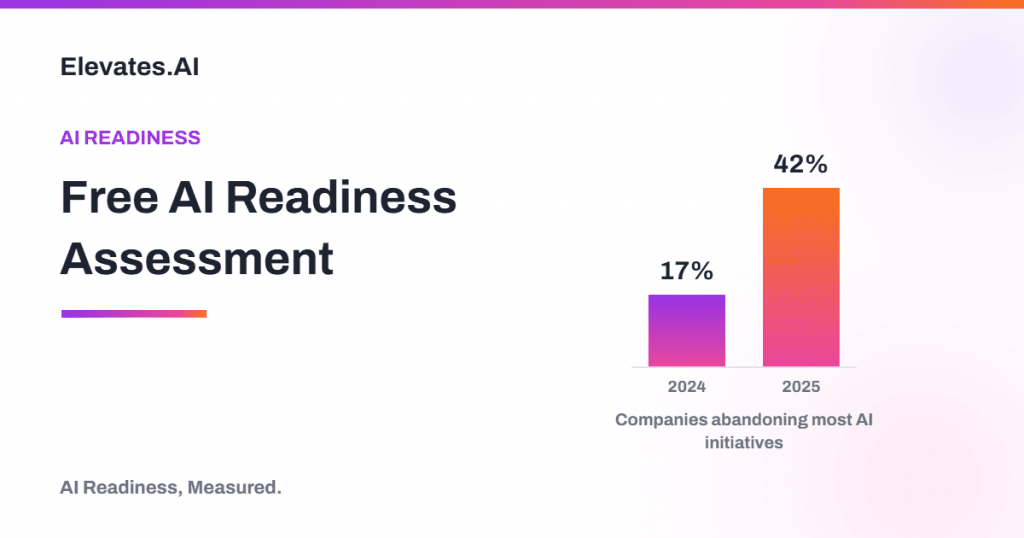
S&P Global Market Intelligence surveyed more than 1,000 organizations across North America and Europe for its 2025 study on generative AI adoption. The share of companies abandoning most of their AI initiatives climbed from 17 percent to 42 percent in a single year. The average organization scrapped 46 percent of its proof-of-concept projects before they reached production.
Those are not model failures. Those are organizations that started spending before they knew what was missing.
The adoption side tells the same story from the other end. Gallup surveyed more than 23,000 United States employees in February 2026 and found that 41 percent say their organization has integrated AI tools, while only 13 percent use AI daily and 28 percent use it a few times a week or more. Access spread faster than habit. No procurement decision closes that gap.
A scoring tool tells you where you rank on that curve. A diagnostic tells you which of those two numbers you are actually stuck on, and they call for completely different work. One is a tooling problem. The other is a management problem.
Most readiness reports never make that distinction, which is why so many of them get read once and filed.
The Andus Labs research puts a name on the pattern. Pilots are built to succeed under conditions the wider organization cannot reproduce, and when the pilot ends the old workflow reasserts itself. The firm calls the residue the Pilot Graveyard. Its top-ranked failure pattern is a trust problem, where leaders expect probabilistic systems to behave deterministically and declare them broken when they do not.
Notice that neither of those shows up on a data-maturity questionnaire. Both show up immediately if you ask two people the same question and compare the answers.
How to run one so it is worth the sixty seconds
Three habits separate the teams that get value out of a free assessment from the teams that collect scores.
Take it twice, with different people. Have the executive sponsor complete it, then have the person who owns the day-to-day workflow complete it separately. Compare the two. The disagreement is the finding, and it is usually more useful than either score on its own. When the sponsor rates data quality at four and the operator rates it at two, you have located your real starting point.
Write the first action within 48 hours. Not a plan. One action, with a name attached and a date attached. Readiness findings decay fast, and a report that sits for a month becomes a document about a company that no longer exists in that form.
Rescore in 90 days. A single reading tells you where you stand. Two readings tell you which direction you are moving, and direction is the more useful number. Readiness moves backward in organizations that keep deploying while their governance, skills, and process design stay flat.
None of that requires a budget line. All of it requires somebody to own the follow-through, which is the actual scarce resource.
One caution on rescoring. Do not change the instrument between readings. Teams that switch tools between quarters lose the only thing a second reading gives them, which is a comparable number. Pick one and stay with it for a year, even if a better one launches in month three.
What to do this week
Pick one workflow you already planned to put AI into. Run the assessment against that workflow rather than against the company as a whole, because company-level readiness is an average that hides the thing you need to see.
Then look at the output and ask one question. Does this tell me what to do on Monday? If it does not, the instrument failed, and no amount of rerunning it will fix that.
The honest summary is that a free AI readiness assessment is worth exactly as much as the decision it lets you make faster. Used as triage, it saves you from spending 50,000 dollars on the wrong dimension. Used as a scoreboard, it costs you a quarter of false confidence.
If you have taken three of these and still cannot name the single thing to fix first, the tools were wrong, not your team. The free 60-second assessment returns a prioritized gap analysis and a 90-day sequence you can hand to a person. Run it against one workflow, compare the sponsor and operator answers, and start with whatever they disagree about most.
Frequently Asked Questions
What is a free AI readiness assessment?
A free AI readiness assessment is a self-service diagnostic that evaluates an organization across dimensions such as data, tooling, skills, governance, and process design, then returns a readiness output at no cost. The useful versions return a prioritized gap analysis and a recommended first action. The weaker versions return only a composite score.
Are free AI readiness assessments accurate?
They are accurate about what people believe, which is not the same as being accurate about the organization. Every free tool runs on self-report, so it cannot verify data quality claims or surface blind spots that nobody on the answering team knows about. Treat the result as triage that tells you where to look harder, not as an audit.
How long should a free AI readiness assessment take?
A well-designed one finishes in a single sitting, usually between one and fifteen minutes. If completing it requires an internal data pull or a working session with three departments, the tool is not actually free because it consumes senior attention. Length is not a proxy for rigor.
What is the difference between a free assessment and a paid AI readiness audit?
A free assessment collects what your team believes and points you at the weakest dimension. A paid audit verifies those beliefs against systems, documents, and interviews, then sequences the work against your budget and constraints. Published 2026 pricing puts mid-market audits at roughly 5,000 to 15,000 dollars and enterprise engagements at 15,000 to 50,000 dollars and up, so the free version is best used to decide whether that spend is warranted and where to point it.
Who should take the assessment inside the company?
Have at least two people take it independently, ideally the executive sponsor and the person who owns the workflow day to day. Comparing their answers surfaces the perception gap between the people funding AI work and the people doing it. That gap is often the most actionable output of the entire exercise.
Be the First to Discover New AI Insights
Follow Elevates.AI on Google to stay updated with the latest AI readiness assessments, governance frameworks, implementation guides, buyer's guides, and enterprise AI best practices.
 Follow Elevates.AI on Google
The AI Readiness Brief
Every Week, receive practical enterprise AI strategies, implementation frameworks, governance updates, and expert insights—all delivered in a 5-minute read.
| ✓ Enterprise AI Strategy | ✓ AI Readiness Frameworks |
| ✓ Governance & Compliance | ✓ Exclusive Guides & Resources |
Join 500+ AI Professionals
Enter your work email below to receive one high-value email every week. No spam. Unsubscribe anytime.