
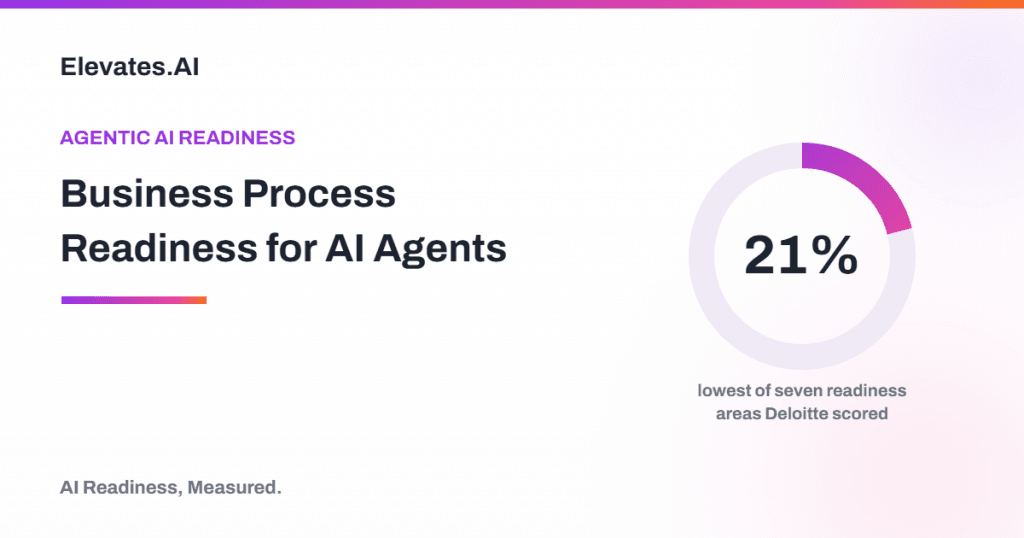
Deloitte scored seven areas of agentic AI readiness across 501 United States business and IT leaders, surveyed between April and June 2026 at organizations already piloting agents. Not one area cleared 52%. Business process readiness for AI agents finished last of the seven, at 21%.
Here is the whole scorecard, in the order Deloitte reported it.
- Vision and strategy: 52%
- Technology infrastructure: 48%
- Data foundation: 42%
- Risk, security and governance: 39%
- Ecosystem partnerships: 34%
- Workforce: 25%
- Business processes: 21%
Only 5% describe their business processes as highly prepared. The full survey announcement carries the complete breakdown.
Read the shape rather than the individual numbers. The scorecard descends in a specific order, and the two areas at the bottom are the two that no purchase order fixes.
The scorecard is a gap analysis, and Deloitte published it for free
Look at what that list actually is. Seven dimensions, scored, ranked, with the weakest named and the causes attributed. That is the structure of a gap analysis output.
Which makes it a strange thing to give away, until you notice what it cannot do. It is an industry average. It tells you what is hard for everyone. It does not tell you what is true of you.
Those are different products. An average tells a board that the problem is common. A score tells an operator which of seven things to fix first, and in what order, with a number attached.
If you want the version that is about your organization rather than about the market, the free 60-second AI readiness assessment scores process, data, and governance maturity in a single pass.
Adoption is a purchase. Readiness is a rewrite.
The scorecard separates cleanly along one line. Technology infrastructure sits at 48%. Business processes sit at 21%. That 27-point gap is the distance between what an organization can buy and what it has to write down itself.
Adoption is a procurement decision. One executive signs, one platform gets provisioned, and the metric moves inside a quarter.
Readiness is a description problem. It requires somebody inside the business to write down how work actually happens, including the parts that are awkward, undocumented, or held together by one long-tenured employee who knows which invoices to flag.
Nobody gets promoted for that. It does not demo. No vendor is pushing it, because there is no license attached to a written process.
The deployment data confirms the split. Among organizations that have already scaled AI agents, only 46% say their business processes are prepared. Buying your way to deployment does not move the process score. It just puts agents on top of it.
Deloitte named the cause and then priced the cure
The barriers in the research are consistent with the scorecard. 72% lack a unified and accessible data foundation. 70% do not feel they can trust and govern agents. 67% say integration is too costly and complex. Deloitte attributes the process gap specifically to poorly documented processes, fragmented data and systems, entrenched ways of working, and limited AI expertise.
Three of those four causes are description problems. Only one is a capability problem.
The prescription attached to the finding is an operating model rebuild. 31% of surveyed organizations expect the majority of their processes redesigned around agents within two years, and 74% expect nearly half redesigned within four.
Laura Shact, who leads AI growth for Deloitte’s United States Technology, Media and Telecommunications practice, framed the argument plainly. Limited, layered-on approaches create a sense of getting ahead with quick wins, and in reality may not be enough. True transformation asks for investment in work and organization design. Help Net Security’s write-up carries the fuller quote.
She is right about the direction. Bolting an agent onto a workflow built for humans a decade ago produces a faster version of a process that was already wrong.
The part worth arguing with is the sequence, and the four-year figure deserves the same scrutiny. That expectation was gathered from the same people who had just scored their own processes at 21%. Intent surveys forecast budgets rather than outcomes.
Business process readiness for AI agents begins with process debt
There is a useful term for the gap Deloitte’s respondents described. Process debt. It is the distance between the process as documented and the process as actually practiced.
Academic work presented through the Hawaii International Conference on System Sciences formalized this into a process-oriented agentic readiness framework, validated across nine processes and more than 40 stakeholders. The framework asks whether a process can support a system that makes autonomous decisions inside defined boundaries, pursues goals with measurable outcomes, adapts on real-time feedback, and hands off to other agents under a formal protocol.
Process debt is the variable that breaks all four. It is also the reason business process readiness for AI agents cannot be inherited from a general AI maturity score.
Here is why it matters more for agents than it ever did for software. A person executing an undocumented process silently patches the gaps. They call someone. They notice an input looks wrong. They skip a step that stopped making sense three years ago.
An agent executes what it was given. If the documented process is a fiction, the agent runs the fiction at full speed and produces a clean audit trail of it.
Process debt compounds the way technical debt does. Every workaround that never reached the documentation becomes a rule the agent does not know, and every one of those is a place where the output looks correct and is not.
Scoring this across an organization is what the 60-second assessment is built to do, and it costs a minute rather than a discovery phase. We also compared the four public frameworks competing to define this layer in our breakdown of agentic AI readiness frameworks.
Four questions that separate a documented process from a real one
Before a process is a candidate for an agent, someone has to answer these in writing.
- Who makes the exception call today, and on what basis?
- What inputs does the process actually consume, and where do those inputs live?
- What does finished mean, and who verifies it?
- What happens when it fails, and how quickly does anyone find out?
Most teams can answer the first question out loud and almost none of them on paper. That is the tell. If the answer lives in one person’s head, the process is not ready for an agent. It is ready for an hour of documentation.
The three processes most teams pick, and why two are usually wrong
Told to pick three processes, most teams reach for the same shortlist. Invoice processing. Customer support triage. Employee onboarding.
Two of those are usually the wrong first choice, and for the same reason. Support triage and onboarding both carry heavy exception handling that lives in individual judgment rather than in a rule set. They look automatable because they are repetitive. They are not, because the repetition hides a decision.
Invoice processing is often the better first candidate, and not because it is easier. It is better because somebody already had to write the approval thresholds down for audit reasons.
The general rule holds beyond that example. Pick the process a regulator, an auditor, or a finance team already forced you to describe. Its documentation debt is the lowest in the building, so it will show you what good looks like before you attempt a harder one.
Sequencing the pilot this way also gives you a defensible internal benchmark. Business process readiness for AI agents means very little as a company-wide average and a great deal as a per-process score you can compare against.
Why the sequencing matters more this year
Gartner forecasts that the average global Fortune 500 enterprise will run more than 150,000 AI agents by 2028, up from fewer than 15 in 2025, and that only 13% of organizations believe they have the right governance to manage them.
Scale changes the cost of the undocumented process. Last year a bad handoff was a slow handoff. At 150,000 agents a bad process definition becomes a policy executed thousands of times before a person reads the output.
The orchestration numbers show how early this still is. Only 15% of Deloitte’s respondents have scaled orchestrated, cross-functional multi-agent adoption, and 43% have deployed agents across more than one function. The complexity is arriving faster than the documentation.
The workforce timeline sits underneath all of it. 43% of leaders expect significant job disruption inside the next 12 to 18 months, rising to 72% over two to three years. Roles are being redesigned on the same clock as the processes, by organizations that have documented neither.
What to do in the next two weeks
The four-year program is not the first move. The first move fits in a fortnight, and it is how business process readiness for AI agents actually gets measured.
- Pick three processes, not the estate. Choose ones with real volume and a clear owner.
- Write each one down at the level of decisions rather than steps. Steps describe motion. Decisions describe authority.
- Mark every place the written version and the practiced version diverge. That list is your process debt, and it is the real scope of your readiness gap.
- Score readiness per process, not per company. The 21% is an industry average, and averages hide the fact that some of your processes are ready right now.
- Only then price the redesign, and price it against a documented baseline rather than a consultant’s discovery phase.
A readiness score does not make you ready. We are as subject to that critique as anyone else selling a framework. What a score does is tell you which of the seven areas is actually your constraint, so the money goes to the right one.
Start With the Process, Not the Rebuild
If your agent pilots keep stalling in the same place, the constraint is usually a process nobody has written down rather than a model that is not smart enough. Business process readiness for AI agents is measurable long before it is expensive. Start with the free 60-second AI readiness assessment and find out which of your processes are ready today.
Frequently Asked Questions
What is business process readiness for AI agents?
Business process readiness for AI agents is the degree to which a documented process can support a system that acts autonomously inside defined boundaries. It measures whether decision authority, inputs, completion criteria, and failure handling are written down rather than held informally. Deloitte’s 2026 research scored it at 21%, the lowest of the seven readiness areas it measured.
Why did business processes score lowest in Deloitte’s agentic AI readiness research?
Deloitte attributed the gap to poorly documented processes, fragmented data and systems, entrenched ways of working, and limited AI expertise. Three of those four are description problems rather than technology problems. Models and agent platforms are available to everyone at similar cost, so the variance comes from how well an organization can describe its own work.
What is process debt?
Process debt is the gap between how a process is documented and how it is actually performed. People absorb that gap every day without noticing, while an AI agent executes the documented version exactly as written. Measuring process debt is the fastest way to find out which processes can safely take an agent.
Do we need to redesign our business processes before deploying AI agents?
Not all of them, and not first. Documenting three high-volume processes at the level of decisions will tell you which ones are already ready and which ones carry real process debt. Redesign is expensive and should be scoped against a documented baseline rather than an assumption.
How long does an AI readiness assessment take?
The Elevates.AI assessment takes about 60 seconds and returns a gap analysis across process, data, governance, and workforce readiness. A full internal documentation exercise for three processes typically takes a working week. Neither requires the multi-year program the large consultancies scope.
Be the First to Discover New AI Insights
Follow Elevates.AI on Google to stay updated with the latest AI readiness assessments, governance frameworks, implementation guides, buyer's guides, and enterprise AI best practices.
 Follow Elevates.AI on Google
The AI Readiness Brief
Every Week, receive practical enterprise AI strategies, implementation frameworks, governance updates, and expert insights—all delivered in a 5-minute read.
| ✓ Enterprise AI Strategy | ✓ AI Readiness Frameworks |
| ✓ Governance & Compliance | ✓ Exclusive Guides & Resources |
Join 500+ AI Professionals
Enter your work email below to receive one high-value email every week. No spam. Unsubscribe anytime.