
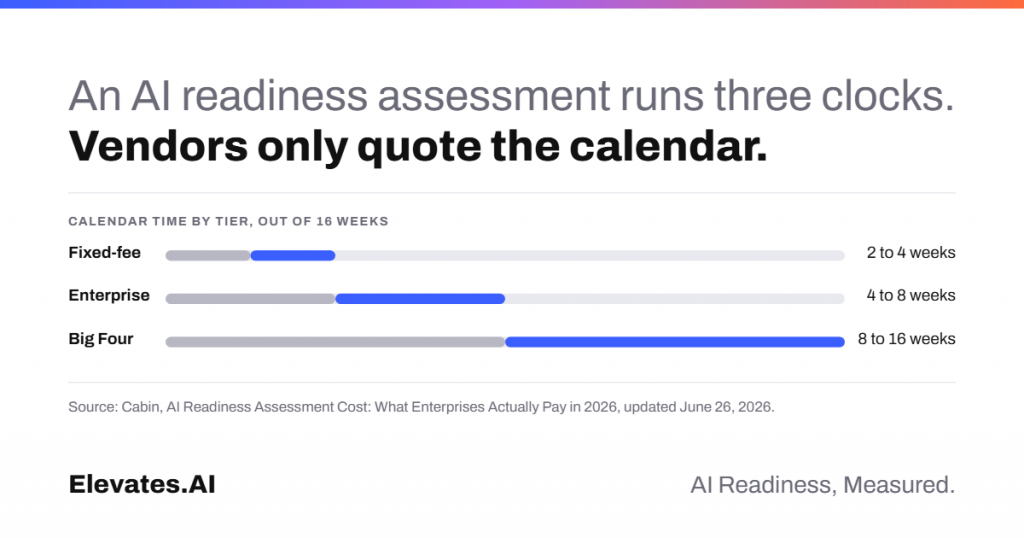
How long does an AI readiness assessment take? Between 2 and 16 weeks of calendar time, depending on the tier you buy. A free self-service scan runs in minutes. A fixed-fee assessment for a smaller organization runs 2 to 4 weeks. An enterprise engagement runs 4 to 8 weeks. A Big Four program runs 8 to 16 weeks.
That is the answer every page on this topic publishes. It is also the least useful number in the transaction.
Here is the pattern I keep seeing. A company signs a six-week engagement. Week six arrives and the report arrives with it. Then nothing happens for a quarter, because the calendar was the only clock anyone agreed to.
Three clocks run during an AI readiness assessment. Vendors quote one of them. The other two decide whether you got anything for the money.
How Long Does an AI Readiness Assessment Take at Each Tier?
The published ranges converge, which is unusual in a market this opaque. Two firms that sell the work publish enough detail to build a table from.
| Tier | Calendar time | Your team’s hours | Typical price |
|---|---|---|---|
| Free self-service scan | Minutes to 4 hours | 1 to 4 | $0 |
| Fixed-fee, smaller organization | 2 to 4 weeks | 20 to 40 | $2,000 to $25,000 |
| Enterprise practitioner | 4 to 8 weeks | 60 to 120 | $40,000 to $120,000 |
| Big Four or strategy firm | 8 to 16 weeks | 200 or more | $150,000 to $500,000 and up |
The calendar, stakeholder-hour and price bands come from Cabin. The source is AI Readiness Assessment Cost: What Enterprises Actually Pay in 2026, published May 4 2026 and updated June 26 2026. Pertama Partners corroborates the calendar side independently in AI Readiness Audit Pricing, published February 8 2026 and updated June 17 2026. Its bands run 2 to 3 weeks under 100 employees. They run 3 to 5 weeks from 100 to 1,000 employees and 4 to 8 weeks above 1,000.
Read the bands as observed ranges rather than a rate card. Cabin states plainly that its figures come from enterprise financial services, healthcare and insurance engagements in 2026. Pertama prices in Singapore dollars for Southeast Asia. The shape is reliable and the exact number in your quote will not be. We covered the money side of this separately in what an AI readiness assessment actually costs.
The shape is the point. Calendar time scales roughly 8x from the smallest paid engagement to the largest. Your own team’s time scales 10x. Those two numbers do not move together, and only one of them appears in the proposal.
If you want the specific version of this for your own organization before you price an engagement, the free 60-second assessment scores you across six dimensions and names the gap that blocks the others.
Why Does a Six-Week Assessment Contain Two Weeks of Work?
Cabin answers this against its own commercial interest. A six-week enterprise practitioner assessment is roughly two weeks of consultant work spread across six weeks, and the spread comes from interview scheduling, document gathering and review cycles. If your team is busy, the calendar stretches.
So calendar weeks measure your availability, not the depth of the analysis. The honest unit is stakeholder hours, and at the enterprise tier that means 60 to 120 hours pulled from the people who run the business. Price those at loaded cost and the $80,000 assessment carries a second invoice that never appears in the statement of work.
Pertama publishes the one lever that reliably cuts AI readiness assessment duration. Organizations that inventory their data assets, document their existing infrastructure and survey department heads on process pain before the engagement begins reduce total audit duration by 15% to 25%.
Read that backwards. Up to a quarter of the clock you are paying for is a consultancy discovering things your own people already know and never wrote down.
What Is the Third Clock, and Why Does Nobody Quote It?
The third clock is decision time. It runs from the day the report lands to the day a named person owns a specific change with a date on it. No vendor quotes it, no statement of work bounds it, and it is the only one of the three that determines whether the assessment was worth buying. The question “how long does an AI readiness assessment take” almost always means calendar weeks. It should mean decision days.
Grant Thornton’s 2026 AI Impact Survey gives that clock a hard edge. Across 950 C-suite and senior business leaders in 10 industries, surveyed between February 23 and March 18 2026, 78% lack strong confidence that they could pass an independent AI governance audit within 90 days. Only 22% of operations leaders are working with a fully developed and implemented AI strategy.
Hold on to the 90 days. Grant Thornton chose that window because it is the interval in which an organization is expected to be able to prove something. An 8-week enterprise assessment consumes two-thirds of it and then hands back a 12 to 18 month roadmap. The proving window is gone before the first action item starts.
The decision clock is exactly what the AI readiness assessment is built to shorten, because it returns a ranked gap list and a 90-day sequence in the same session rather than a quarter later.
The cost of that delay is measurable. In the same survey, organizations with fully integrated AI are nearly 4 times more likely to report AI-driven revenue growth than organizations still piloting, 58% against 15%. Among those still piloting, only 7% are very confident on the 90-day audit question. Among the fully integrated, 74% are. The limit on that finding is that it is self-reported confidence from US senior leaders, so read it as a gap between stages rather than as an audit result.
None of that argues for skipping the diagnosis. It argues for a diagnosis that ends in a decision rather than in a document. This is general business information rather than legal or compliance advice, and Elevates.AI is not a law firm.
How Fast Does the Ground Move Under a Running Assessment?
Pertama says the quiet part in its own scope disclaimer. The audit is a point-in-time assessment. That is an honest statement, and it is also the whole problem, because the point in time keeps moving.
On September 10 and 11 2026, Salesforce previewed the Trusted Enterprise AI Harness and shipped seven job-scoped agents. Alongside them came an AI Control Plane built to discover, register and govern third-party agents rather than only its own. Broad availability lands early in its fiscal 2027. An enterprise AI readiness assessment that started in August and delivers in October scoped an agent estate that will not be the estate anyone has to govern.
The pattern is not specific to one vendor. Deloitte surveyed 3,235 IT and business leaders across 24 countries and reported in April 2026 that only 21% have a mature governance model for agentic AI, while 74% expect to be using agents at least moderately by 2027. Roughly 80% are therefore scaling into a control gap. The limit is that every respondent had direct involvement in an AI program, so this describes active adopters and not the whole market.
Publicis Sapient measured the same mismatch from the ambition side. Across 1,550 AI decision-makers surveyed between April 29 and May 14 2026 at organizations above 500 employees and $100 million in revenue, 71% of US respondents expect significant progress scaling AI in the next 12 to 24 months and 20% say they are fully equipped today. Full findings sit in the 2026 Global Enterprise AI Report.
A 16-week measurement cycle cannot describe a system changing on a 6-week release cadence. Speed is not a convenience in the instrument. It is a correctness requirement. So how long does an AI readiness assessment take is really two questions. How many weeks does it run, and how many of those weeks does the answer survive.
How Do You Shorten the Clock Without Gutting the Assessment?
Five moves, in the order they pay off.
- Run a free scan the same day you start asking the question. It takes minutes rather than weeks. It will not replace an enterprise engagement, and it will tell you whether you need one and on which dimension.
- Do the discovery yourself first. Inventory your data assets, document your infrastructure, and survey department heads on process pain. Pertama measures the saving at 15% to 25% of total duration, and you keep the artifact afterward.
- Buy the tier you need, not the tier above it. Cabin’s framing is correct. The four tiers do not produce four versions of the same deliverable, and buying the wrong tier wastes more than overpaying inside the right one.
- Unbundle any proof of concept. Cabin notes that firms fold a 4-week POC into the assessment so the total looks competitive. That bundle adds a month to the clock and turns the diagnosis into a demo for phase two. Price them separately.
- Cap the scope by business unit. Cabin names business-unit count as the single largest price driver, at roughly 2.5x for three units against one. It is the largest calendar driver too, because each unit brings its own scheduling queue.
What Belongs in the Statement of Work Before You Sign
Before you price any of this, run the 60-second readiness scan and you will walk into the vendor conversation already knowing which dimension is weakest and what a defensible answer looks like.
Three lines belong in the statement of work, and they are short. Set the AI readiness assessment timeline before you set the budget.
One, name the calendar weeks with a hard end date and a stated consequence for missing it.
Two, cap the stakeholder hours and name the roles they come from. If a proposal will not put a number on your team’s time, the number is large.
Three, set a decision date no more than 14 days after delivery, by which a named executive commits to a sequence and an owner for the first item.
The third line is the one that draws pushback, and the pushback is the most useful signal in the negotiation. A firm selling a diagnosis will sign it. A firm selling the next engagement wants the report to sit. Once the timeline is bounded, the other half of the evaluation is the artifact itself.
Measure the assessment by the date on the first action item, not by the date on the report. If those two dates are more than two weeks apart, you bought a document.
Frequently Asked Questions
How long does an AI readiness assessment take?
How long does an AI readiness assessment take depends entirely on the tier you buy. A free self-service scan takes minutes, a fixed-fee assessment for a smaller organization takes 2 to 4 weeks, an enterprise engagement takes 4 to 8 weeks, and a Big Four program takes 8 to 16 weeks. Those are calendar weeks, and they measure your team’s availability more than the depth of the analysis.
How many hours of my own team’s time does an AI readiness assessment consume?
At the enterprise tier, Cabin reports 60 to 120 stakeholder hours, rising above 200 for a Big Four engagement. A fixed-fee assessment for a smaller organization runs 20 to 40 hours. Those hours come out of the people who run the business, and they rarely appear as a line item in the proposal.
Can an AI readiness assessment be completed faster than 2 weeks?
Yes. Pertama Partners publishes a rapid audit format that completes in 1 to 2 weeks and costs 30% to 40% less, with fewer stakeholder interviews and more caveats in the findings. A free self-service scan returns a score and a gap list in minutes, and it is the right first pass before you commission anything paid.
How long does an AI readiness assessment stay accurate?
Treat it as a point-in-time artifact, which is how the firms selling it describe it. Deloitte reported in April 2026 that only 21% of organizations across 24 countries have a mature governance model for agentic AI while 74% expect to use agents at least moderately by 2027, so the estate being measured is changing quickly. Re-score at least quarterly on any dimension you are actively investing in.
What is a reasonable gap between the assessment report and the first action?
Two weeks. Grant Thornton found that 78% of executives lack strong confidence they could pass an independent AI governance audit within 90 days, so a report that sits for a quarter has consumed the entire proving window. Put a decision date in the statement of work and name the executive who owns it.
Be the First to Discover New AI Insights
Follow Elevates.AI on Google to stay updated with the latest AI readiness assessments, governance frameworks, implementation guides, buyer's guides, and enterprise AI best practices.
 Follow Elevates.AI on Google
The AI Readiness Brief
Every Week, receive practical enterprise AI strategies, implementation frameworks, governance updates, and expert insights—all delivered in a 5-minute read.
| ✓ Enterprise AI Strategy | ✓ AI Readiness Frameworks |
| ✓ Governance & Compliance | ✓ Exclusive Guides & Resources |
Join 500+ AI Professionals
Enter your work email below to receive one high-value email every week. No spam. Unsubscribe anytime.