The tools are in place. The licenses are paid for. The dashboards are running. Then the executive team sits down to decide on a product pivot, a market entry, or a cost restructure, and they reach for a quarterly report that is six weeks old.
That is the decision intelligence gap. It is not a technology problem. It is a readiness and integration problem, and it shows up clearly in the data.
McKinsey found that 88% of organizations have deployed AI in at least one function, while only 39% report measurable enterprise-level impact (McKinsey, 2025). The distance between adoption and outcomes is wide, and slow, fragmented decision-making is one of the main reasons why.
Decision intelligence is one of the six core gaps the Elevates.AI assessment evaluates. When an organization scores poorly in that category, Snowfire AI is one of the marketplace tools we point readers toward. Here is the full rationale.
The Decision Intelligence Gap: When Data Moves Faster Than Decisions
The modern enterprise generates enormous amounts of operational data. Most of it sits in disconnected systems. A CRM here, an ERP there, a marketing platform, a financial model, a supply chain dashboard. Executives are expected to synthesize all of it in real time. Most cannot.
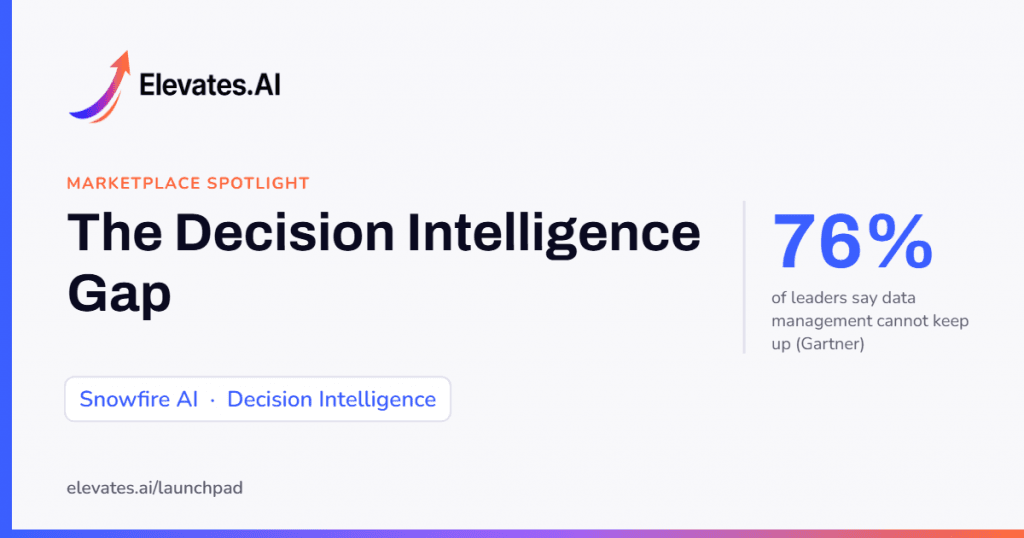
The numbers are stark. 76% of business leaders say their data management capabilities cannot keep up with business needs (Gartner, 2025). 68% of organizations cite data silos as their top operational challenge (DATAVERSITY, 2026). Employees lose an average of 12 hours per week chasing data across disconnected systems (VentureBeat, 2024). Bad data costs the average enterprise $12.9 million per year (Gartner, 2024).
The consequence is not just inefficiency. It is bad decisions made confidently. When a CFO works from last quarter’s actuals, or a COO misses a real-time supplier signal, the organization responds to the world as it was rather than as it is.
Gartner projects that 75% of Fortune 500 companies will adopt some form of decision intelligence by the end of 2026. The question is whether they do it thoughtfully, with tools matched to their readiness level, or reactively, by bolting on another dashboard nobody opens.
What Snowfire AI Does
Snowfire AI is an adaptive decision intelligence platform built for executive users: CEOs, CFOs, COOs, CROs, and their equivalents in government and institutional settings. Greg Genung founded the company in Austin in 2024 and raised a $2.3 million pre-seed round from US angel investors. His background is cybersecurity and data analytics, including work at Deepwatch, Rackspace, Intel471, and Praetorian.
The core mechanic is integration and synthesis. Snowfire connects roughly 1,000 business systems and external data sources, then converts that raw information into synthesized, role-specific insight delivered in real time. It builds knowledge graphs across the business data layer rather than serving another dashboard.
Rather than presenting a generic view, the platform’s adaptive engine tailors what surfaces to the individual executive’s role, priorities, and decision context. A CFO sees margin signals and cash flow alerts. A CEO sees cross-functional risk indicators and growth trend deviations. Alerts arrive by phone notification or Slack, not buried inside a BI tool that needs a data team to interpret.
What the platform does specifically:
- Real-time synthesis across roughly 1,000 integrated data sources
- Role-adaptive insight tailored to CEO, CFO, COO, and CRO profiles
- Proactive alerts and anomaly detection by mobile and Slack
- Cross-functional trend correlation that surfaces connections siloed tools miss
- Technical deployment in as little as 24 hours
The company claims a 50% reduction in executive decision-making time and a 30% improvement in decision accuracy. Both figures are internally sourced and worth stress-testing in a proof of concept before you treat them as a business case.
Who Snowfire AI Fits Best
Snowfire AI is the strongest fit for organizations that meet most of these criteria:
- Mid-market to large enterprise, roughly 200 employees and up, with multi-department operations
- Leadership makes decisions from delayed or fragmented data, on weekly or monthly reporting cadences rather than real-time signals
- Data sources are already in place, including CRM, ERP, and financial systems, but there is no synthesis layer above them
- Executives are not data engineers and need insight rather than raw data access
- The company operates in a fast-moving sector where late decisions carry material cost
- There is appetite to reduce dependence on BI teams for routine executive reporting
Snowfire is a poor fit for organizations still building basic data infrastructure. If you do not yet have consistent CRM usage, standardized financial data, or operational systems producing reliable signals, the assessment will surface foundational data readiness work before it recommends a synthesis layer.
What to Consider Before You Implement
Every recommendation in the marketplace comes with an honest look at complexity and readiness. Snowfire AI is not for everyone at every stage.
Pricing is not public. Snowfire uses custom enterprise pricing with no self-serve tier. You go through a sales conversation to get a quote. That is normal at this level of integration, but it means evaluation takes longer and needs stakeholder buy-in before you can even assess fit.
Integration groundwork is real. Connecting roughly 1,000 data sources sounds seamless, but the value is directly proportional to the quality of what you connect. Messy, inconsistent data will not become good decisions. Plan a data readiness audit before implementation.
The 24-hour claim has an asterisk. The interface is built for non-technical executives, but initial configuration means defining roles, setting alert thresholds, and mapping data sources. That needs technical support or dedicated onboarding time. The 24-hour figure covers technical deployment, not organizational adoption.
This is a culture change, not a software swap. Moving executive decision-making from periodic reporting to real-time synthesis changes how leaders work. If your leadership team is not aligned on data-driven decision frameworks, adoption will be low no matter how capable the platform is.
How the Elevates.AI Assessment Surfaces This Gap
When an organization completes the 60-second assessment at elevates.ai/launchpad, the platform evaluates six capability dimensions, including how effectively the organization translates data into executive action.
Organizations that score low to moderate on decision intelligence typically show one or more of these signals:
- Executives make decisions primarily from weekly or monthly compiled reports
- There is no single source of truth connecting financial, operational, and market data
- The BI or analytics team is a bottleneck between data and decision-makers
- Leadership has low confidence in data currency during high-stakes decisions
- AI tools are deployed but never connected to executive decision workflows
When those signals appear, the 90-day Roadmap recommends a decision intelligence layer as a priority action, and Snowfire AI is the tool currently surfaced in the AI Execution Marketplace for that category, based on its executive-first design, integration breadth, and deployment speed.
This is a curated recommendation, not a sponsored placement. The marketplace exists to match assessed gaps to verified tools. Every tool listed has gone through editorial review against the readiness framework.
Start Here
If your leadership team is making consequential calls from data that is weeks old, the decision intelligence gap is probably your highest-priority starting point. Confirm it before you buy anything.
Take the 60-second assessment at elevates.ai/launchpad.
Ready to evaluate the platform directly? Explore Snowfire AI through the Elevates.AI marketplace.
Disclosure: Elevates.AI may earn a commission if you purchase through our marketplace link, at no additional cost to you. Partner selection is based on assessment gap fit, not commission rate.
Sources
McKinsey, 2025. The State of AI. Gartner, 2025. AI-ready data research and decision intelligence adoption forecast. Gartner, 2024. Bad data cost benchmarks. DATAVERSITY, 2026. Data silo research. VentureBeat, 2024. Data search time research. Snowfire AI, 2025. Launch and funding announcements.
What is decision intelligence, and how is it different from business intelligence?
Business intelligence surfaces what happened, using historical data aggregated into reports and dashboards. Decision intelligence goes further. It synthesizes data in real time, identifies patterns across disconnected sources, and surfaces actionable recommendations or alerts at the moment a decision needs to be made. BI describes the past. Decision intelligence is built to inform the present.
How quickly can Snowfire AI be deployed?
Snowfire states its platform can be production-ready within 24 hours of technical setup. The more accurate framing is that the infrastructure deploys quickly once integrations are scoped and data sources are mapped. Full organizational adoption, which includes training executives, refining alert configurations, and establishing new decision workflows, typically takes several weeks. Set expectations accordingly before launch.
Is Snowfire AI appropriate for a small or mid-size company?
Snowfire positions itself for enterprise buyers. Smaller companies can benefit, but the ROI calculation changes significantly at lower data volumes and fewer integration points. If your organization has fewer than 100 employees or runs only a handful of core systems, a lighter-weight analytics tool may deliver comparable value at lower cost and complexity. The Elevates.AI assessment helps clarify this against your specific readiness profile.
Be the First to Discover New AI Insights
Follow Elevates.AI on Google to stay updated with the latest AI readiness assessments, governance frameworks, implementation guides, buyer's guides, and enterprise AI best practices.
 Follow Elevates.AI on Google
The AI Readiness Brief
Every Week, receive practical enterprise AI strategies, implementation frameworks, governance updates, and expert insights—all delivered in a 5-minute read.
| ✓ Enterprise AI Strategy | ✓ AI Readiness Frameworks |
| ✓ Governance & Compliance | ✓ Exclusive Guides & Resources |
Join 500+ AI Professionals
Enter your work email below to receive one high-value email every week. No spam. Unsubscribe anytime.