
Buyers ask two data security questions about an AI readiness assessment and most stop after the first. One is whether the assessment evaluates your data security. The other is what data the assessment itself takes from you. AI readiness assessment data security covers both, and only the first gets answered on the pages that rank.
We reviewed six pages that rank for this topic on 2026-10-05, from Cyera, Global Data Systems, AvePoint, Gagetech, Hrizns and the WestEd Data Integration Support Center. All six describe what an assessment evaluates. None states on the page what the assessment collects from the buyer.
That omission matters because the assessment arrives before the controls do. You hand architecture notes, process documents and system inventories to a vendor you have known for three weeks. Nobody has checked how that vendor stores them.
We sell an AI readiness assessment, so weigh this article accordingly. Every statistic below links to its source, and every limit sits next to the number.
Does an AI readiness assessment cover data security?
A good one does, and the scope is wider than most buyers expect. Cyera scores governance, data protection, infrastructure, model security, application safeguards and monitoring. Global Data Systems examines data sensitivity classification and access boundaries in SharePoint and Teams. Hrizns adds identity, endpoint and cloud controls.
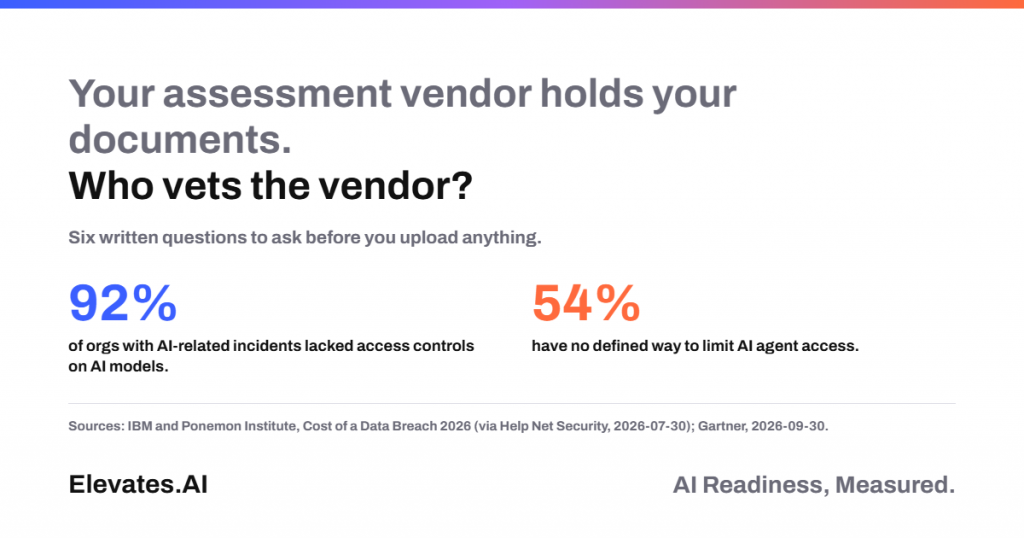
The reason is measurable. The 2026 Cost of a Data Breach Report from IBM and Ponemon Institute, covered by Help Net Security on 2026-07-30, found that unauthorized AI tools figured in 43% of security incidents. Among organizations with AI-related incidents, 92% lacked role-based access, multifactor authentication or similar controls on their AI models and applications. The limit is the sample. The study covers more than 600 breached organizations, so it describes companies that already had a breach, not the average company.
Gartner added a sharper number on 2026-09-30. Its five actions for CISOs reports that 54% of organizations lack a defined approach to limit AI agent access, using Q2 2026 data. Gartner also tells CISOs to treat frontier AI deployments as insider risks. An assessment that skips agent permissions skips the exposure Gartner now frames that way.
| Area | What the assessment should test | Reported gap |
|---|---|---|
| Access controls | Role-based access and multifactor authentication on AI models and applications | 92% lacked them after an AI-related incident, IBM and Ponemon Institute, 2026 |
| Shadow AI | Which unapproved AI tools staff use with company data | Unauthorized AI tools figured in 43% of incidents, IBM and Ponemon Institute, 2026 |
| Agent permissions | What limits the systems and data an AI agent can reach | 54% lack a defined approach, Gartner, 2026-09-30 |
| Audit trail | Whether you can show who or what touched which data | 50% cannot produce a complete AI data access audit record within one business day, Kiteworks, 2026-07-29 |
The audit figure comes from a Kiteworks survey, and Kiteworks sells data governance software. Read it as a signal, not a benchmark.
If you want the specific version of this for your organization, the free 60-second assessment maps it.
What data does an AI readiness assessment collect from you?
Every assessment collects three things. Answers are your survey responses on maturity, goals and constraints. Artifacts are the documents, links and process descriptions you upload. Identity is your name, email, company and role.
Risk concentrates in the artifacts. A survey answer says you have no AI policy. An uploaded architecture diagram shows an attacker where to look.
Our privacy policy lists all three categories. It states that Elevates.AI does not use uploaded documents or assessment data to train machine learning models. It also commits to removing personal information and assessment materials within 30 days of a deletion request, with carve-outs for legal compliance and disputes. Check that against the policy itself instead of taking our word.
Identity data is the easiest category to protect and the easiest to forget. Name, email, company and role tie your answers to a person. Ask whether answers are stored against that identity or can be anonymized.
Artifacts deserve a plain definition. They include architecture diagrams, vendor contracts, policy drafts, process maps and screenshots. Each one tells a reader how your company actually runs.
Every vendor also has a sub-processor chain behind its own page. Our policy names hosting, analytics and payment vendors under contractual confidentiality obligations. At most 2 of the 6 pages we reviewed pointed to a privacy notice or trust center at all.
Which six questions should you ask an AI readiness assessment vendor?
Send these before you upload anything. Ask for every answer in writing.
| Question | A good answer |
|---|---|
| 1. What do you collect? | An itemized list of answers, artifacts and identity fields |
| 2. Do you train models on it? | A written no that also covers your sub-processors |
| 3. Who are your sub-processors? | A named list with the purpose of each |
| 4. How long do you keep it? | A stated period and a deletion path with a deadline |
| 5. Can I skip the uploads? | A tier that runs on survey answers alone |
| 6. Who on your staff can read it? | Role-based access with an access log |
A vendor that cannot answer question 1 in writing is not ready to hold your documents.
The gap described above is exactly what the AI readiness assessment scores, and it takes about a minute.
Why does AI readiness assessment data security include the vendor’s own handling?
Gartner’s insider-risk framing applies to the vendor too. A firm that holds your documents is an outsider with read access to your weakest points. Gartner does not mention assessment vendors, so that extension is ours.
Buyers rarely have a process for this. The Cisco 2026 Data and Privacy Benchmark Study, released 2026-01-26 with 5,200 respondents, found that only 12% describe their AI governance structures as mature. The study does not measure vendor vetting. Treating low governance maturity as low vetting maturity is our inference.
The risk is usually quiet rather than dramatic. Documents sit in a shared drive after the engagement closes. A subcontractor keeps a copy. A former staff member keeps access. Retention and access terms exist to close those three paths.
A security-led assessment also has limits. It does not replace a penetration test or an independent audit of your controls. It tells you where to look and in what order.
Does the type of assessment change what it collects?
Yes, and the range is wide. A survey-based assessment collects answers and identity. A consultant-led engagement adds interviews and documents. A technical assessment adds access to your systems.
Global Data Systems says it examines SharePoint and Teams governance and access boundaries. Examining those boundaries implies some access to your tenant, so ask which permissions the assessor needs and for how long. That is our reading of the page, not a statement Global Data Systems makes.
Cyera lists an executive summary, scorecard and prioritized roadmap as outputs. Ask for the same detail on inputs. A scorecard built from a survey carries different risk from one built from a scan of your environment.
How should you sequence an AI readiness assessment to limit exposure?
Let exposure grow only when the evidence justifies it. This order works for AI readiness assessment data security in practice.
- Run a survey-only pass first. It scores gaps without a single uploaded file.
- Upload artifacts only for the gaps that need proof. Redact names, customer data and credentials first.
- Get retention and deletion terms in writing before the second upload.
- Delete the materials when the assessment closes and keep the confirmation.
The survey-only pass can score ownership, policy, process and tooling readiness. It cannot verify how your access controls are configured. That needs evidence, which is why artifacts come second and only for the gaps that matter.
Redaction is cheap. Remove customer names, credentials, internal hostnames and contract values before you upload. It takes about an hour and removes most of the sensitivity. Keep a log of what you shared.
Retention terms deserve a number. Our policy states 30 days after a deletion request. Ask every vendor for its number and whether backups are included. Note which vendors answer quickly, because response quality is itself a signal.
Shadow AI is the cheapest gap to measure. Ask each team which AI tools they used last week with company data. The answers usually exceed the approved list, and they show where the access controls IBM measured are missing.
Our guide to what a free AI readiness assessment should deliver sets the bar for that first pass. If agents are in scope, add three questions. Which agents exist, what may each one reach, and who can revoke that access. The AI agent governance checklist covers controls to put in place before scaling agents.
Platform vendors will offer to govern those agents for you. Our argument on platform independence explains why you should assess before you buy that control.
Ask that the data processing terms name your deletion deadline and the full sub-processor list, and that both flow down to every sub-processor. Elevates.AI is not a law firm and this is not legal advice. Have counsel review the terms before you sign.
Start with the 60-second readiness assessment and you will know which gap blocks the others before you spend anything.
What should you do this week?
Send the six questions to every vendor on your shortlist. Drop any vendor that will not answer in writing. Run the survey-only pass before you share a single document.
On Monday, send the six questions. By midweek, score each vendor from 0 to 6, one point for each written answer that matches the good answer in the table. On Friday, run the survey-only pass and review the gaps.
If a vendor scores below 4, ask whether the missing answers reflect a missing control or a missing document. A missing control disqualifies the vendor. A missing document can be fixed in a day.
Then decide what evidence to share, and only for the gaps that need it. Delete the materials when the work closes, and keep the confirmation. That is AI readiness assessment data security done in the right order.
Frequently Asked Questions
Does an AI readiness assessment cover data security?
A thorough one does. AI readiness assessment data security scope usually includes access controls, data classification, shadow AI use and agent permissions. Ask any vendor to list the exact controls it tests before you buy.
What data does an AI readiness assessment collect?
Most assessments collect survey answers, uploaded artifacts such as documents and process descriptions, and identity details such as name, email, company and role. The uploaded artifacts carry the most risk. Ask the vendor for an itemized list in writing.
Is it safe to upload company documents to an AI readiness assessment?
Upload nothing in the first pass. A survey-only assessment answers the readiness question without exposing documents, and you can add redacted artifacts later for the gaps that need evidence.
Does an AI readiness assessment vendor train AI models on my data?
It depends on the vendor, so get the answer in writing. The Elevates.AI privacy policy states that uploaded documents and assessment data are not used to train machine learning models.
How do I vet an AI readiness assessment vendor’s security?
Ask six questions on collection, model training, sub-processors, retention, upload-free options and staff access. A good vendor answers each one in writing and names its sub-processors.
Be the First to Discover New AI Insights
Follow Elevates.AI on Google to stay updated with the latest AI readiness assessments, governance frameworks, implementation guides, buyer's guides, and enterprise AI best practices.
 Follow Elevates.AI on Google
The AI Readiness Brief
Every Week, receive practical enterprise AI strategies, implementation frameworks, governance updates, and expert insights—all delivered in a 5-minute read.
| ✓ Enterprise AI Strategy | ✓ AI Readiness Frameworks |
| ✓ Governance & Compliance | ✓ Exclusive Guides & Resources |
Join 500+ AI Professionals
Enter your work email below to receive one high-value email every week. No spam. Unsubscribe anytime.