
Picture a team that spends four months building an agent to route support tickets. The routing rules fit on one page. A fixed workflow would have shipped in three weeks, cost a fraction per run, and behaved the same way every time. The team built the agent anyway because the roadmap said agentic.
When not to use agentic AI comes down to three conditions. Skip the agent when you can write the steps down in advance, when a wrong action is costly to reverse, or when you cannot yet measure whether a run succeeded. In those cases a fixed workflow or a single model call does the job for less money and with fewer surprises.
Agents are real and useful. The problem is the default. Somewhere in the last year, building an agent became the answer before anyone asked the question.
Why do so many agentic AI projects not need an agent?
David Linthicum, founder of Linthicum Research, told SiliconANGLE on September 4, 2026 that probably 95% of the agentic AI applications he sees do not need to be agentic. He said most of them add complexity, operational overhead, and security concerns that an agent-based architecture does not justify. That is one analyst’s hedged estimate and not a measured rate. It still matches what the harder evidence shows.
Gartner predicted on June 25, 2025 that over 40% of agentic AI projects will be canceled by the end of 2027. It named escalating costs, unclear business value, and inadequate risk controls as the causes. The same release estimated that only about 130 of the thousands of agentic AI vendors are real, a practice Gartner calls agent washing.
Readiness is thin underneath the activity. Fivetran’s 2026 Agentic AI Readiness Index, published on May 5, 2026, surveyed 400 data professionals. It found that 41% of organizations already run agentic AI in production and only 15% are fully prepared to support it. Fivetran sells data pipelines, so read the survey as directional.
Agent washing matters here for a practical reason. When vendors relabel chatbots and scripted automation as agents, buyers inherit the cost of autonomy without getting any. Ask what decides the next step in the product, the model or a rule. The answer tells you what you are paying for.
Put those numbers side by side. Many teams run agents in production without being ready for them. By one analyst’s count, most of those agents did not need to be agents.
If you want the specific version of this for your organization, the free 60-second assessment maps it.
AI agent vs workflow: what is the real difference?
Anthropic’s engineering team drew the line in its December 19, 2024 guide, Building Effective Agents. In a workflow, code decides the path and the model fills in individual steps. In an agent, the model decides its own path and its own use of tools. Anthropic recommends finding the simplest solution possible and adding complexity only when needed. Sometimes that means not building an agentic system at all.
Anthropic also notes that agentic systems generally trade higher latency and cost for better task performance. Autonomy brings the risk of compounding errors. Both facts belong in the business case, and neither shows up in a vendor demo.
The table turns that guidance into a buying conversation. Match the job to the pattern before you match the pattern to a vendor.
| Pattern | Use it when | Cost and latency | Typical failure |
|---|---|---|---|
| Single model call | The task has one step and the input holds the context | Lowest | Weak when the answer needs facts the call cannot see |
| Workflow | The steps are known, repeat, and need predictable output | Moderate and predictable per run | Brittle when inputs change shape |
| Agent | The path cannot be written in advance and tool use varies by case | Highest, and varies per run | Errors compound across steps |
When not to use agentic AI: which five tests decide it?
Run the task through five tests before anyone writes code. One failed test is a reason to pause. Two failed tests are a reason to build a workflow instead.
- Can you write the steps down? If an experienced employee can describe the process in a page, you have a workflow. Agents earn their cost on tasks where the path changes with every case.
- Is a wrong action easy to undo? An agent that drafts is cheap to correct. An agent that sends, pays, or deletes is not. Without a human approval step for those actions, skip the agent.
- Can you score a run? You need a test set and a pass mark before launch. If nobody can say what a correct result looks like, nobody can tell when the agent is wrong.
- Does the unit cost survive volume? Each model decision costs money, and the cost multiplies with every run. High volume and low value per run punish an agent’s cost profile.
- Is the plumbing in place? The agent needs clean data, system access, and a named owner. Missing any of the three means you are building on sand.
Where a task lands on these tests is exactly what the AI readiness assessment scores, and it takes about a minute.
A worked example shows how the tests split two similar jobs. Invoice matching has known steps, a clear right answer, and a high volume. It fails test one and test four as an agent job, so it belongs in a workflow. Researching a vendor dispute has no fixed path, a human reviews every output, and the volume is low. It passes all five tests. That is the pattern behind when not to use agentic AI. The same department can need both, and only the second job needs an agent.
Teams usually fail test three first. They launch, then discover they have no way to tell a good run from a bad one. The agent keeps running and nobody can say whether it works.
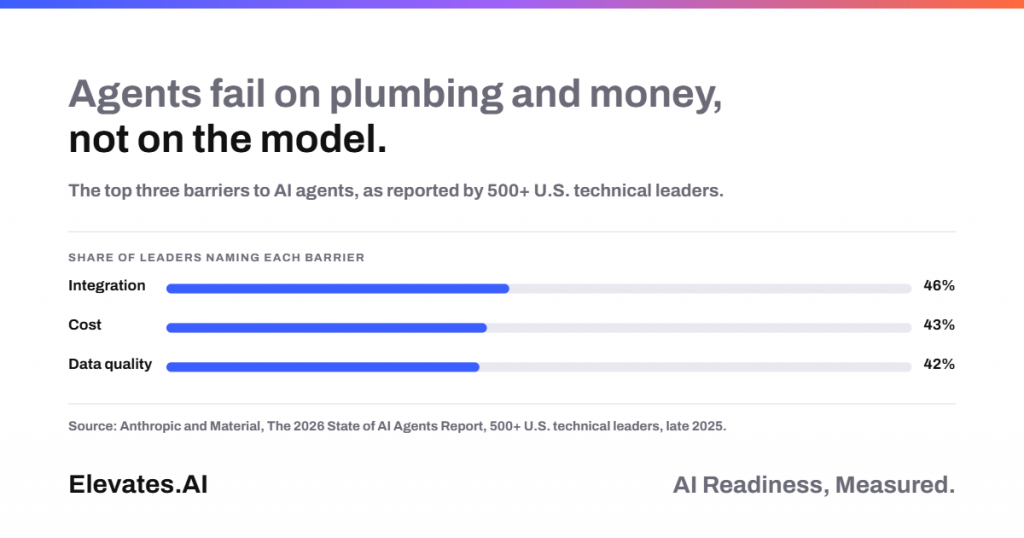
Test five deserves its own evidence. Anthropic’s The 2026 State of AI Agents Report surveyed more than 500 U.S. technical leaders with research firm Material in late 2025. The top barriers were integration with existing systems at 46%, implementation costs at 43%, and data access and quality at 42%. Anthropic sells the models these agents run on, so it has a stake in adoption. None of the top three barriers is the model. They are plumbing and money.
What does a wrong agent actually cost?
Start with the arithmetic. If each step in a ten-step run succeeds 95% of the time and the steps are independent, the full run succeeds about 60% of the time. That figure is an illustration and not a measured rate. Real agents recover from some errors. The direction is the point. Every step the model decides adds a chance to be wrong, and a workflow removes those decisions.
Now add the Gartner causes. Escalating cost shows up in the invoice. Unclear value shows up in the review meeting. Inadequate risk controls show up in the incident report. A workflow with fixed steps makes all three easier to see and to fix.
Ownership matters too. An agent without a named owner becomes an orphan the day its builder changes roles. The cost of a wrong action then lands on a team that never agreed to carry it.
None of this makes an agent a bad choice. It makes the agent a choice you should price. Write down the cost of one wrong action, the cost of one run, and the cost of the person who reviews the output. Then compare that total to the workflow alternative.
Does your readiness assessment ever say do not build?
Most do not. A readiness assessment that can only return a go verdict is a sales qualifier and not a diagnostic. A useful one returns build, wait, or use a workflow for each use case.
Elevates.AI sells a readiness assessment, so weigh our view with that in mind. We also gain nothing when you build an agent that you did not need. The verdict that saves you the most money is often the one that says use a workflow.
Agentic AI readiness covers data, ownership, evaluation, and approvals. Our AI agent readiness checklist lists the decision rights an agent needs before it runs. Our post on business process readiness for AI agents covers the process side. Both assume you have already decided an agent is the right pattern.
How do you decide in one week?
Do not turn this into a program. A week is enough to sort a short list. The goal is a decision on when not to use agentic AI for each candidate, written down and owned.
- Day one. List your top five agent candidates and name an owner for each.
- Day two. Write each candidate as numbered steps. Any task that fits on one page becomes a workflow candidate.
- Day three. Run the remaining tasks through the five tests and write down the cost of one wrong action.
- Day four. Choose one agent candidate. Define its test set, its pass mark, and the human approval step.
- Day five. Price the agent against the workflow alternative and decide. Record the decision and the reason.
Most lists shrink. That is the result you want. Every candidate you move to a workflow is cost you did not take on and risk you did not create.
Start with the 60-second readiness assessment and you will know which gap blocks the others before you spend anything.
Write the reason next to each call in one sentence. Workflow, because the steps fit on one page. Agent, because the path changes with every case and we can score every run. Six months from now someone will ask why the team built what it built. A recorded reason ends that argument and shows whether the tests held up. Revisit the list each quarter, because a workflow that outgrows its rules can graduate to an agent later.
If you want the data-readiness side of this argument, we covered the Fivetran index in more detail in a separate post on agentic AI readiness. The short version is that agents inherit the quality of the data underneath them.
Build the agent when the path cannot be written down. Build the workflow when it can. Decide before the roadmap decides for you.
Frequently Asked Questions
When should you not use agentic AI?
Skip agentic AI when the steps are known in advance, when a wrong action is costly to reverse, or when you cannot measure whether a run succeeded. In those cases a workflow or a single model call is cheaper and more predictable. The rule of thumb from Anthropic is to find the simplest solution possible and add complexity only when needed.
What is the difference between an AI agent and an AI workflow?
In a workflow, code decides the path and the model handles individual steps. In an agent, the model decides its own path and tool use. Workflows give predictable cost and behavior, and agents give flexibility at higher cost and with more risk of compounding errors.
How do I know if I need an AI agent?
Ask whether an experienced employee could write the process in one page. If yes, you probably need a workflow. You need an agent only when the path changes with every case and you can score each run against a test set.
Are most agentic AI projects canceled?
Gartner predicted on June 25, 2025 that over 40% of agentic AI projects will be canceled by the end of 2027. That is a forecast and not a measured outcome. Gartner named escalating costs, unclear business value, and inadequate risk controls as the causes.
Does an AI readiness assessment tell you not to build an agent?
A good one does. It should return a verdict for each use case, including use a workflow instead. If an assessment can only say go, treat it as a sales tool and not as a diagnostic.
Be the First to Discover New AI Insights
Follow Elevates.AI on Google to stay updated with the latest AI readiness assessments, governance frameworks, implementation guides, buyer's guides, and enterprise AI best practices.
 Follow Elevates.AI on Google
The AI Readiness Brief
Every Week, receive practical enterprise AI strategies, implementation frameworks, governance updates, and expert insights—all delivered in a 5-minute read.
| ✓ Enterprise AI Strategy | ✓ AI Readiness Frameworks |
| ✓ Governance & Compliance | ✓ Exclusive Guides & Resources |
Join 500+ AI Professionals
Enter your work email below to receive one high-value email every week. No spam. Unsubscribe anytime.