
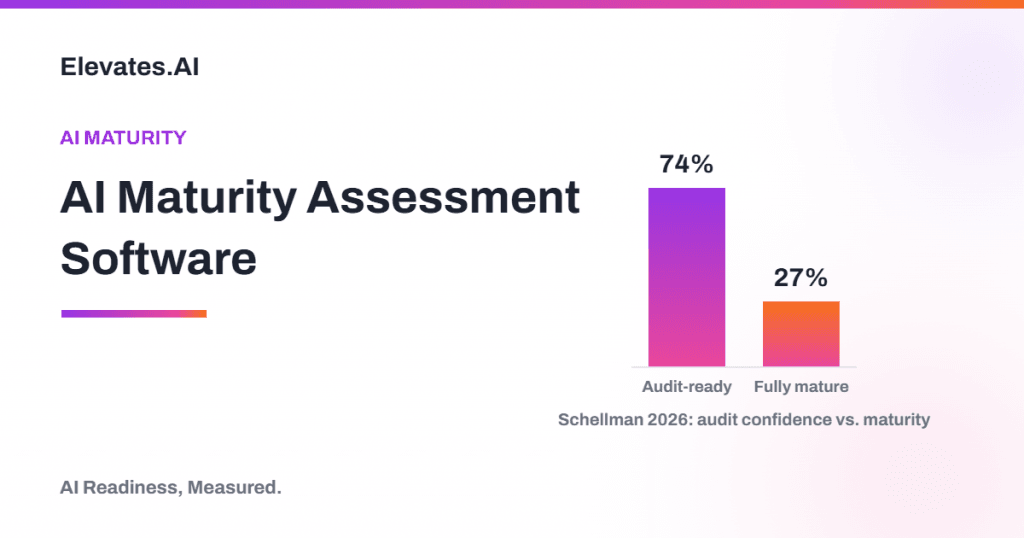
Seventy-four percent of enterprises say they could pass an AI compliance audit today. Twenty-seven percent describe their AI governance program as fully mature. Both numbers come from the same respondents, in the same survey, published yesterday, and the distance between them is the strongest argument yet against how most AI maturity assessment software works.
Schellman released its State of AI Governance Report 2026 on July 29. Researchscape fielded it between April 13 and May 11, 2026, across 525 United States professionals at companies with at least 500 employees and 100 million dollars in revenue. Confidence is not the constraint. Evidence is.
Read the 74 percent gap carefully before you quote it
The headline writes itself, and it is slightly wrong. Nobody audited these companies. The 27 percent figure is not an audit result. It is a second self-report, where respondents described their own program as fully mature.
So the finding is not that three quarters of enterprises would fail. The finding is that inside a single respondent pool, 74 percent would sit an audit while 27 percent claim a mature program. That is an internal contradiction, and it is more damning than an external failure rate, because nobody had to grade them to produce it.
The supporting numbers show where the confidence is resting. Schellman found 57 percent maintain a formal AI governance policy, 64 percent have an acceptable use policy actively communicated to employees, and 44 percent maintain AI-specific incident response procedures.
Set those against the 74 percent. At least 17 points of audit confidence sits on top of no written governance policy at all. An auditor cannot read intent.
One more caveat worth stating out loud. Schellman sells AI audits. It is an ANAB-accredited ISO 42001 certification body and an authorized AIUC-1 auditor, so a report concluding that enterprises are not audit-ready lands close to its order book. The methodology is disclosed and the sample is real, which is why the numbers are usable. Note the incentive and keep reading.
Why self-scored AI maturity assessment software inflates every result
Most AI maturity assessment software asks a version of the same question. Do you have an AI governance policy? Do you monitor model drift? Do you maintain an inventory? The respondent answers from memory, and memory is generous.
Three failure modes produce the inflation, and they compound.
- Intent scores as implementation. A policy drafted, circulated, and never enforced answers yes to the same question as a policy that governs live systems.
- One person scores the whole company. Schellman found 42 percent name the CIO or Head of IT as primarily responsible for AI purchasing and 37 percent name that same role as accountable when AI risks emerge. Ask one function and you get one function’s view of the enterprise.
- Nothing has to be produced. A questionnaire that never requests an artifact cannot distinguish a governance program from a good intention.
The category-level evidence backs this up. ServiceNow surveyed 4,500 executives across 19 countries and 12 industries for its Enterprise AI Maturity Index 2026 and found the average maturity score rose to 51 from 35 the previous year, while AI spending rose 110 percent over the same period.
Spending roughly doubled and self-reported maturity jumped 16 points. Those two move together for a reason that has nothing to do with governance. People who just spent money report progress.
We have written before about the specific gaps these instruments leave, in our breakdown of what most AI readiness assessment tools miss. The Schellman data is the first large sample that puts a number on the blind spot.
What AI maturity assessment software has to do differently
Four design requirements separate an instrument that measures from one that flatters. None of them is exotic, and most tools on the market implement zero or one.
- Ask for artifacts, not opinions. Every claim of a control should name the document, the system, or the log that proves it. The scoring question stops being do you have a policy and becomes where does the policy live and when was it last enforced.
- Triangulate across roles. Put the same questions to engineering, legal, and the business owner separately. Where the three answers diverge is the actual finding, and a single-respondent tool destroys that signal by design.
- Split intent from operation. Report two scores. What the organization has decided to do, and what it currently does. A gap between them is normal and useful. Collapsing them into one number is how a 74 percent forms.
- Expire the result. Schellman found 86 percent of organizations have tested or piloted AI agents and 46 percent already run agents in production. A maturity score calculated before an agent reached production describes a company that no longer exists.
The fourth point deserves emphasis because it changes the buying decision. Maturity is not a certificate. It decays every time the scope of what you have delegated to software expands, and in 2026 that scope expands quarterly.
Our gap analysis ranks each finding by cost to close and by what it unblocks, then sequences the result into a 90-day roadmap. See what the assessment returns before you commit budget to a platform.
Five questions to ask a vendor before you buy
Run these against any AI maturity assessment software you are evaluating, including ours. They take ten minutes and they eliminate most of the market.
- What does the tool accept as proof? If the answer is the customer’s own checkbox, you are buying a survey with a dashboard on it.
- Who answers it? A tool built for one respondent cannot detect the disagreement that matters most.
- Does the output rank by cost to close? A list of 40 gaps with no sequencing transfers the hard decision back to you and calls it a deliverable.
- Does the score expire? A result with no recency logic will be quoted in a board deck 18 months after it stopped being true.
- Can you fail it? If every path through the questionnaire produces an encouraging result, the instrument is a lead magnet rather than an assessment.
The last question is the one that disqualifies fastest, and it is the easiest to test. Answer the questionnaire as badly as you can and see what the tool tells you.
For a side-by-side of the tools currently competing in this category, our 2026 buyer’s guide to AI readiness tools compares them on scope, output, and price.
AI maturity assessment software against a consultant engagement
The honest comparison is not software against nothing. It is software against the four-to-six week consulting diagnostic most enterprises buy instead, and each option fails in a different direction.
A consultant interviews people. That solves the triangulation problem, because a good one will notice when engineering and legal describe the same control differently, and will ask for the artifact on the spot. It introduces a different bias. The diagnostic is usually scoped by the firm that would deliver the remediation, and findings that a multi-quarter engagement can close have a way of surfacing.
AI maturity assessment software has the opposite profile. It is cheap, repeatable, and consistent across business units, which matters more than it sounds. Comparing this quarter to last quarter requires the same instrument both times, and a consultant engagement is almost never rerun at that cadence.
The failure mode is that software cannot push back. Nobody asks a follow-up question when a respondent overstates, and nobody notices the control that was described but never built.
The practical answer is sequencing rather than choosing. Use AI maturity assessment software quarterly to track movement and catch drift, and bring in an independent examination when a customer, a regulator, or a board asks for proof instead of a score. Buying the consultant first is how organizations end up with a 200-page diagnostic and no way to tell whether anything improved six months later.
Our own incentive, stated plainly
Elevates.AI sells an AI readiness assessment. Every argument above is one we benefit from you accepting, and you should weigh it accordingly.
So here is the specific claim rather than the general one. Our assessment is self-reported at the input stage, exactly like the tools this post criticizes. What it does differently is refuse to return a single flattering number, separate what you have decided from what you operate, and rank the gaps by what it costs to close them.
It does not audit you. No 60-second instrument can, and any vendor claiming otherwise is selling you the 74 percent.
What to do this quarter
If you already hold a maturity score, do not buy more AI maturity assessment software. Test the instrument you have.
Take the three highest-scoring controls on your current report and ask the owner of each to produce the evidence within one business day. A document, a log export, a ticket history, a dated approval. Anything an outsider could read without a briefing.
Whatever cannot be produced in a day is not a control. It is a belief, and it is the part of your score that will not survive contact with a customer questionnaire, a procurement review, or a regulator.
Then fix the sequencing rather than the score. Schellman found that organizations with mature governance are far more likely to have agents in production, 78 percent against 22 percent for organizations with developing programs. Governance is not the tax you pay for deployment. On this evidence it is the thing that permits it.
Run the free 60-second assessment to get a baseline you can defend, then work the roadmap it returns in order. Start with whichever gap costs the least to close, because the cheap controls are the ones that gate the expensive ones.
Frequently Asked Questions
What is AI maturity assessment software?
AI maturity assessment software is a tool that scores how prepared an organization is to adopt, operate, and govern AI across dimensions such as data, infrastructure, talent, and governance. Most products deliver a numeric score and a gap list from a structured questionnaire. The quality of the result depends almost entirely on whether the tool requires evidence or accepts self-reported answers.
Why do AI maturity scores overstate readiness?
Self-reported questionnaires cannot distinguish a control that exists from a control that operates, so intent scores the same as implementation. Schellman found in July 2026 that 74 percent of enterprises believe they could pass an AI compliance audit while only 57 percent maintain a formal AI governance policy. A single respondent scoring an entire enterprise compounds the effect.
How do I choose AI maturity assessment software?
Test five things before buying: what the tool accepts as proof, whether it collects answers from more than one role, whether it ranks gaps by cost to close, whether the score expires, and whether it is possible to fail. A tool that returns an encouraging result no matter how you answer is a marketing instrument rather than an assessment.
Is AI maturity assessment software a substitute for an AI audit?
No. An assessment is a self-directed diagnostic that tells you where to look and what to fix first. An audit is an independent examination by a qualified third party against a defined standard such as ISO 42001. Use an assessment to prepare for an audit, not to replace one.
How often should an AI maturity assessment be repeated?
Rescore at least quarterly, and immediately after any change in what the organization has delegated to software. Schellman found 46 percent of organizations already run AI agents in production, and a maturity score calculated before an agent went live no longer describes the business. Treat the result as a perishable measurement rather than a certification.
Be the First to Discover New AI Insights
Follow Elevates.AI on Google to stay updated with the latest AI readiness assessments, governance frameworks, implementation guides, buyer's guides, and enterprise AI best practices.
 Follow Elevates.AI on Google
The AI Readiness Brief
Every Week, receive practical enterprise AI strategies, implementation frameworks, governance updates, and expert insights—all delivered in a 5-minute read.
| ✓ Enterprise AI Strategy | ✓ AI Readiness Frameworks |
| ✓ Governance & Compliance | ✓ Exclusive Guides & Resources |
Join 500+ AI Professionals
Enter your work email below to receive one high-value email every week. No spam. Unsubscribe anytime.