Best AI Readiness Tools comparison is tougher than most organizations expect. A quick Google search returns AI maturity models, consulting firms, governance frameworks, downloadable PDFs, Microsoft assessments, and dozens of AI readiness quizzes—all claiming to help you prepare for AI. The challenge isn’t finding an AI readiness tool; it’s knowing which one actually helps your business make better AI investment decisions.
Buying an AI Readiness Tool? Start With the Right Question
Artificial Intelligence has moved beyond experimentation. Organizations across every industry are investing in copilots, large language models, workflow automation, intelligent search, predictive analytics, and AI agents. Yet despite record investment, many projects still fail to deliver measurable business value.
The reason isn’t usually the AI technology itself.
It’s that organizations invest in AI before understanding whether they’re actually ready to adopt it.
Many leadership teams compare Microsoft Copilot, ChatGPT Enterprise, Claude, Gemini, IBM watsonx, or other AI platforms without first asking a much more important question:
Is our organization actually ready for AI?
That’s where an AI readiness tool becomes valuable.
Rather than recommending another AI product, a good readiness assessment evaluates your organization’s current capabilities, identifies gaps, prioritizes opportunities, and creates an implementation roadmap that reduces risk while maximizing return on investment.
If you’re unsure where your organization stands today, start with the AI Readiness Assessment:
Unlike vendor-specific assessments, it focuses on organizational readiness before recommending technologies.
Why Most Companies Choose the Wrong AI Readiness Tool
One of the biggest mistakes organizations make is assuming every AI assessment serves the same purpose.
It doesn’t.
Many assessments are designed primarily as lead-generation tools for consulting firms or software vendors. After completing the questionnaire, the recommendation often points toward that company’s services, cloud platform, or implementation package.
There’s nothing inherently wrong with vendor-led assessments—they can be extremely valuable if you’ve already committed to a particular ecosystem.
However, they’re rarely the best place to start.
Imagine asking a CRM vendor whether you need CRM software.
Or asking a cybersecurity vendor whether your organization should invest in security.
The answer is almost always “yes.”
AI readiness works the same way.
A vendor-neutral assessment separates diagnosis from implementation.
Instead of recommending products first, it helps answer questions like:
- Is our data ready?
- Do we have executive alignment?
- Are our business processes documented?
- Is governance in place?
- Do we have measurable AI use cases?
- Is our infrastructure capable of supporting AI?
- Are employees prepared?
- What should we fix before buying software?
Only after understanding these answers should organizations begin comparing vendors.
If you’re new to organizational readiness, this guide explains the concept in more detail:
AI Tool Chaos Is Becoming a Bigger Problem Than AI Adoption
Another challenge rarely discussed in AI buying guides is tool sprawl.
Many organizations don’t have an AI strategy. Instead, they have dozens of disconnected AI subscriptions.
- Marketing uses ChatGPT.
- Engineering uses Claude.
- Sales uses Copilot.
- HR uses Gemini.
- Operations uses another internal chatbot.
- Customer support experiments with yet another platform.
Each department purchases tools independently, creating duplicated costs, inconsistent security policies, fragmented knowledge, and multiple versions of the truth.
This phenomenon is increasingly described as AI tool chaos.
Rather than improving productivity, organizations spend more time switching between assistants than actually benefiting from them.
Industry observers have begun highlighting a shift toward centralized AI workspaces—platforms that consolidate AI capabilities, knowledge management, governance, collaboration, and workflows into a unified experience rather than adding another standalone assistant.
A good discussion of this trend can be found here:
Vom Tool-Chaos zur KI-Zentrale – Warum Teams heute einen einzigen KI-Workspace brauchen
https://www.netzpiloten.de/vom-tool-chaos-zur-ki-zentrale-warum-teams-heute-einen-einzigen-ki-workspace-brauchen/
While every organization’s approach will differ, the broader lesson remains the same:
Before buying another AI tool, understand whether your organization needs another product—or simply a better AI strategy.
What Should an AI Readiness Tool Actually Evaluate?
Many online AI readiness quizzes ask fewer than ten questions and produce a generic score.
Unfortunately, that rarely provides meaningful insight.
A comprehensive AI readiness assessment should evaluate the organization across multiple dimensions—not just technology.
The best AI readiness tools examine:
| Area | Why It Matters |
|---|---|
| Business Strategy | AI initiatives should align with measurable business objectives rather than technology trends. |
| Leadership Alignment | Executive sponsorship significantly improves adoption success. |
| Data Quality | AI is only as reliable as the data it receives. |
| Technology Infrastructure | Existing systems must support secure AI deployment and integration. |
| Governance | Organizations need policies covering ownership, approvals, monitoring, and responsible AI usage. |
| Security & Compliance | AI often processes sensitive customer and operational data that requires protection. |
| People & Skills | Employees need training, change management, and confidence using AI responsibly. |
| Implementation Roadmap | Organizations need practical next steps—not just a score. |
A readiness assessment should help executives understand what to improve first, what can wait, and where AI is likely to deliver the highest business value.
A Good AI Readiness Tool Should Deliver More Than a Score
Many assessments end with something like:
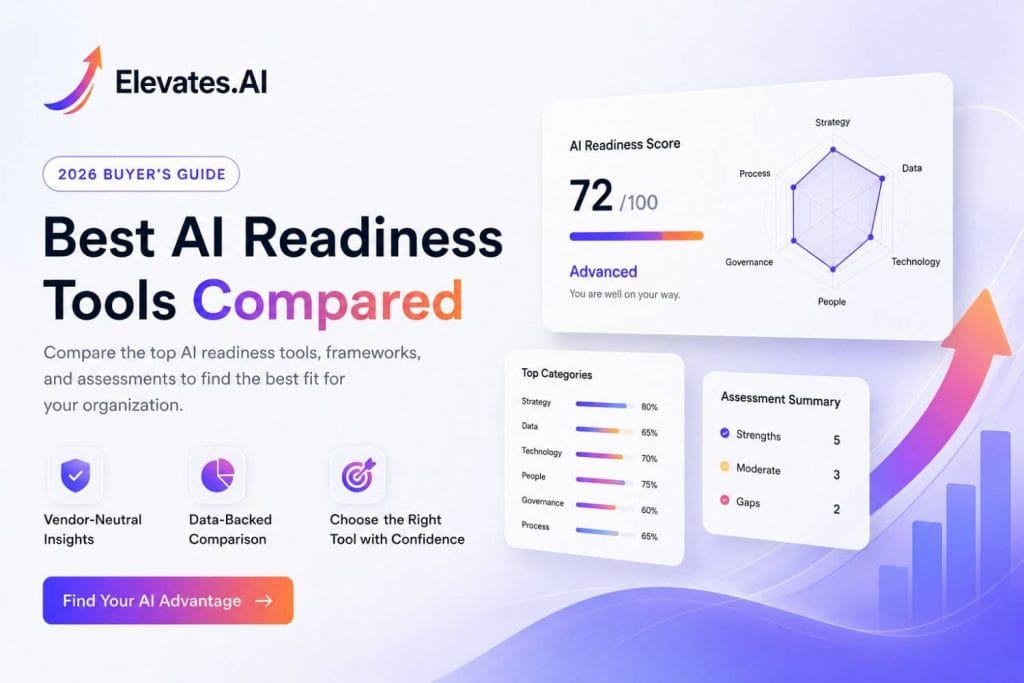
Your AI Readiness Score: 72/100
Interesting.
But then what?
A score without recommendations doesn’t create business value.
The most effective AI readiness tools should provide:
- Clear strengths and weaknesses
- Prioritized improvement opportunities
- Recommended AI use cases
- Governance considerations
- Technology recommendations
- A phased implementation roadmap
- Estimated readiness timeline
- Practical next steps for leadership
This transforms the assessment from a simple questionnaire into a strategic planning tool.
Organizations should also understand the risks associated with AI implementation before selecting vendors or launching enterprise initiatives.
Our AI Adoption Risk Guide explores the operational, governance, technical, and organizational risks that commonly delay AI projects and explains practical strategies for reducing those risks before investment.
Comparing the Leading AI Readiness Tools
Choosing an AI readiness tool isn’t about finding the platform with the longest feature list—it’s about selecting the assessment that best matches your organization’s goals, industry, and stage of AI adoption.
Some tools are designed for organizations already committed to a particular ecosystem. Others focus on governance or regulatory compliance. A few provide strategic consulting engagements rather than self-service assessments.
The goal of this comparison isn’t to declare one platform the winner.
Instead, it’s to help you understand which tool is best for your situation.
Best AI Readiness Tools Compared
| Tool | Best For | Free | Vendor Neutral | Roadmap | Enterprise Ready |
|---|---|---|---|---|---|
| Elevates.AI | Organizations wanting a vendor-neutral assessment and roadmap | ✅ | ✅ | ✅ | ✅ |
| Microsoft AI Readiness | Microsoft ecosystem customers | Partial | ❌ | Partial | ✅ |
| IBM AI Consulting | IBM customers | ❌ | ❌ | ✅ | ✅ |
| Deloitte AI Consulting | Large enterprise transformation | ❌ | Partial | ✅ | ✅ |
| PwC AI Services | Executive AI strategy | ❌ | Partial | ✅ | ✅ |
| NIST AI RMF | AI governance framework | ✅ | ✅ | ❌ | ✅ |
| ISO/IEC 42001 | AI management system standard | Paid Standard | ✅ | ❌ | ✅ |
1. Elevates.AI
Best for:
Organizations looking for an independent AI readiness assessment before purchasing AI software.
Unlike many assessments that immediately recommend consulting services or proprietary platforms, Elevates.AI separates readiness evaluation from product recommendations.
Instead of asking:
“Which AI platform should we buy?”
The assessment first asks:
- Are your business goals clearly defined?
- Is your data usable?
- Is leadership aligned?
- Is governance in place?
- Are employees prepared?
- Which AI projects should come first?
The result isn’t simply a score.
Organizations receive:
- AI Readiness Score
- Readiness Tier
- Opportunity Analysis
- AI Roadmap
- Marketplace recommendations based on assessment results—not assumptions.
If you haven’t taken it yet, start here:
AI Readiness Assessment
Strengths
✅ Vendor neutral
✅ Free assessment
✅ Roadmap included
✅ AI marketplace
✅ Organizational focus
Limitations
Less suitable if you’re only evaluating one vendor ecosystem such as Microsoft or IBM.
2. Microsoft AI Readiness Assessment
Best for:
Organizations heavily invested in Microsoft 365, Azure, Copilot, Power Platform, and Microsoft Fabric.
Microsoft provides excellent guidance for customers already committed to its ecosystem.
Its frameworks help organizations evaluate:
- Copilot readiness
- Microsoft 365 deployment
- Azure AI
- Security
- Governance
However, Microsoft’s guidance naturally assumes Microsoft technologies remain central to the implementation.
For organizations evaluating multiple vendors, a vendor-neutral assessment may provide a broader perspective before platform selection.
Strengths
✅ Strong Microsoft integration
✅ Excellent documentation
✅ Enterprise security guidance
Considerations
Less suitable for organizations comparing multiple AI vendors.
3. IBM AI Consulting
IBM has decades of experience helping enterprises implement AI, analytics, automation, and governance.
Its services are particularly valuable for organizations already using:
- watsonx
- IBM Cloud
- IBM Consulting
- Enterprise AI governance
IBM places strong emphasis on:
- Responsible AI
- Governance
- Explainability
- Risk management
These are especially important for highly regulated industries.
Best for
Large enterprises
Financial institutions
Healthcare
Government
4. Deloitte AI Services
Deloitte approaches AI primarily as a business transformation initiative rather than a software implementation project.
Its engagements typically cover:
- AI strategy
- Operating model
- Change management
- Governance
- Executive transformation
Rather than providing a quick online readiness score, Deloitte generally delivers consulting-led assessments tailored to enterprise clients.
Best for
Fortune 500 companies
Enterprise transformation
Large digital modernization programs
5. PwC AI Transformation
PwC focuses heavily on executive strategy, governance, organizational change, and responsible AI adoption.
Organizations working through digital transformation programs often use PwC to align AI with broader business strategy.
Their approach emphasizes:
- Risk management
- Governance
- Leadership alignment
- Workforce transformation
rather than simply deploying technology.
6. NIST AI Risk Management Framework
Unlike the other options in this guide, the NIST AI Risk Management Framework isn’t a commercial product.
It’s a governance framework.
It helps organizations build trustworthy AI through four core functions:
- Govern
- Map
- Measure
- Manage
NIST is one of the most respected references for AI governance and should complement—not replace—an organizational readiness assessment.
If governance is one of your weakest areas, our AI Governance Framework explains how these principles can be applied within an enterprise AI program.
AI Governance Framework
7. ISO/IEC 42001
ISO/IEC 42001 is the first international management system standard specifically created for Artificial Intelligence.
Instead of assessing technical capability, it defines how organizations should manage AI responsibly across governance, policies, accountability, documentation, and continuous improvement.
Organizations pursuing certification often combine ISO 42001 with internal readiness assessments to understand operational gaps before implementing formal AI management systems.
Which Tool Is Right for You?
There isn’t a universal “best” AI readiness tool.
The right choice depends on your organization’s goals.
Choose Elevates.AI if you need
- Independent assessment
- Vendor-neutral recommendations
- AI roadmap
- Quick readiness score
- Practical next steps
Choose Microsoft if
You’re already committed to:
- Microsoft 365
- Azure
- Copilot
- Microsoft Fabric
Choose IBM if
You’re implementing enterprise AI within the IBM ecosystem.
Choose Deloitte or PwC if
You need large-scale consulting, organizational transformation, or executive advisory services.
Choose NIST or ISO if
Your primary focus is governance, compliance, and responsible AI rather than implementation planning.
Don’t Compare AI Platforms Before Comparing Your Organization
One mistake appears repeatedly across organizations:
Leaders spend weeks comparing AI vendors…
…before spending even one hour evaluating organizational readiness.
That’s backwards.
The most successful AI projects begin with understanding:
- business goals
- data quality
- governance
- leadership alignment
- operational readiness
Only then does vendor comparison become meaningful.
If your organization hasn’t yet evaluated these areas, completing a structured AI Readiness Assessment is typically the highest-value first step.
Free AI Readiness Tools, Frameworks, PDFs & Templates
Not every organization needs an expensive consulting engagement to begin its AI journey.
In fact, some of the best AI initiatives start with a simple question:
“Where are we today?”
That’s why searches like AI readiness tool free, AI readiness assessment PDF, AI readiness checklist, and AI readiness assessment template continue to grow.
However, not all free resources provide the same value. Some help you understand AI governance, while others simply provide static documents with no personalized recommendations.
In this section, we’ll compare the most common types of AI readiness resources and explain when each one makes sense.
Free AI Readiness Tools
Free AI readiness tools are ideal for organizations that want a quick understanding of their current capabilities before committing budget.
However, “free” can mean very different things.
Some tools generate a personalized readiness score and roadmap, while others simply collect contact information before scheduling a sales call.
A useful free assessment should answer questions such as:
- How ready is our organization for AI?
- Which capability is weakest?
- Where should we begin?
- What should we improve first?
- Which AI projects fit our maturity level?
What to look for
✅ Personalized readiness score
✅ Practical recommendations
✅ Business-focused questions
✅ Governance evaluation
✅ Roadmap
✅ Vendor-neutral recommendations
Elevates.AI AI Readiness Assessment
One example of this approach is the Elevates.AI AI Readiness Assessment.
Instead of evaluating a specific AI platform, it measures organizational readiness across multiple business dimensions.
The assessment evaluates:
- Business Strategy
- Leadership Alignment
- Data Readiness
- Technology Infrastructure
- AI Governance
- Security
- Workforce Readiness
- Implementation Planning
Rather than ending with a percentage score, the assessment provides:
- AI Readiness Tier
- Strengths
- Capability gaps
- Priority improvements
- AI roadmap
- Marketplace recommendations based on assessment results
If you’re beginning your AI journey, it’s one of the fastest ways to understand your organization’s current position.
AI Readiness Assessment
AI Readiness Assessment PDFs
Many organizations search for:
- AI Readiness Assessment PDF
- AI Readiness Tool PDF
These documents usually include:
- questionnaires
- maturity models
- governance checklists
- implementation guidance
PDFs are excellent reference materials.
However, they have important limitations.
Advantages
✔ Easy to share
✔ Printable
✔ Useful for workshops
✔ Good governance reference
Limitations
❌ No personalized scoring
❌ No benchmarking
❌ Static content
❌ No recommendations
❌ Cannot prioritize improvements
A PDF can help teams start a conversation.
It cannot replace an interactive assessment that evaluates your organization’s specific situation.
AI Readiness Assessment Templates
Templates remain popular because they’re flexible.
Consultants often adapt templates during discovery workshops, digital transformation projects, and executive planning sessions.
Typical template sections include:
- Executive Summary
- Business Objectives
- Current AI Usage
- Data Inventory
- Governance
- Infrastructure
- Skills Assessment
- Risk Assessment
- Success Metrics
- Roadmap
Templates are valuable because organizations can customize them.
The downside is that someone still needs to interpret the results.
Without experience, teams often struggle to prioritize which improvements matter most.
AI Readiness Checklists
Checklists are excellent for quick self-assessments.
Here’s a simplified example.
AI Readiness Checklist
If several answers are "No," the organization should address those gaps before investing in enterprise AI platforms.
Microsoft AI Readiness Assessment
Many organizations specifically search for Microsoft AI Readiness Assessment.
Microsoft offers excellent guidance for organizations already committed to:
- Microsoft 365
- Azure
- Copilot
- Power Platform
- Microsoft Fabric
Microsoft's documentation covers:
- Security
- Identity
- Governance
- Adoption
- Infrastructure
If your organization has already standardized on Microsoft technologies, Microsoft's readiness guidance is an excellent resource.
However, organizations evaluating multiple AI vendors may prefer beginning with a vendor-neutral assessment before deciding which ecosystem best fits their long-term strategy.
Vendor-Neutral vs Vendor-Led Assessments
This is one of the most important decisions buyers make.
Vendor-Led Assessment
Advantages
- Deep platform expertise
- Excellent implementation guidance
- Faster deployment
Challenges
- Recommendations often focus on the vendor's own products
- Less flexibility for multi-vendor environments
Vendor-Neutral Assessment
Advantages
- Independent evaluation
- Technology-agnostic recommendations
- Broader organizational perspective
- Easier vendor comparison
Challenges
- Doesn't replace implementation consulting
- May recommend multiple possible solutions
Organizations early in their AI journey generally benefit from a vendor-neutral assessment before narrowing their technology choices.
Industry-Specific AI Readiness Matters
AI readiness isn't identical across industries.
A manufacturing company faces very different challenges than a financial institution.
Financial Services
Banks and financial organizations must consider:
- Model Risk Management
- Explainability
- Regulatory Compliance
- Data Residency
- Governance
For industry-specific guidance, see:
AI Readiness for Financial Services
Manufacturing
Manufacturers typically evaluate:
- ERP integration
- MES connectivity
- PLC data
- SCADA systems
- Production quality data
- OT/IT collaboration
Read more in:
AI Readiness Assessment for Manufacturing Companies
Governance
Regardless of industry, governance remains essential.
Organizations scaling AI should establish ownership, approval workflows, monitoring, and accountability before enterprise deployment.
Our guide explains how to build a practical governance model.
AI Governance Framework
How to Choose the Right AI Readiness Tool + FAQs
After comparing frameworks, consulting firms, free assessments, and vendor-specific solutions, one question remains:
Which AI readiness tool is actually right for your organization?
The answer depends less on the technology you're planning to buy and more on where your organization is today.
The best AI readiness tools don't simply produce a score—they help you make better investment decisions, reduce implementation risk, and create a practical roadmap for adoption.
AI Readiness Tool Buyer's Checklist
Before selecting any AI readiness assessment, ask these questions.
Strategy
- Does the assessment evaluate business objectives before technology?
- Does it identify measurable AI opportunities?
- Does it prioritize projects based on business impact?
Data
- Does it assess data quality?
- Does it evaluate accessibility?
- Does it review governance and ownership?
Infrastructure
- Does it review existing systems?
- Does it evaluate integrations?
- Does it consider cloud and security readiness?
Governance
- Does it evaluate AI governance?
- Does it include responsible AI?
- Does it assess compliance requirements?
Organizations looking to strengthen governance should also review the AI Governance Framework, which explains how to establish AI ownership, approval workflows, monitoring, and accountability before deploying AI across the enterprise.
AI Governance Framework
People
- Does it evaluate workforce readiness?
- Does it identify training needs?
- Does it measure executive alignment?
Roadmap
- Does the assessment recommend next steps?
- Does it prioritize improvements?
- Does it explain where to begin?
Without a roadmap, a readiness score has very little practical value.
Which AI Readiness Tool Is Right for You?
Startups
Most startups don't need expensive consulting engagements.
Instead, focus on:
- identifying one AI use case
- validating data availability
- defining success metrics
- launching one pilot
A lightweight readiness assessment usually provides enough guidance.
Small & Medium Businesses
SMBs often need practical recommendations rather than lengthy transformation projects.
Look for assessments that provide:
- quick readiness score
- prioritized improvements
- implementation roadmap
- vendor-neutral recommendations
Enterprise Organizations
Larger organizations should prioritize:
- governance
- security
- compliance
- executive sponsorship
- organizational change management
Enterprise AI success depends more on operating model design than software selection.
Manufacturing
Manufacturers should choose assessments that evaluate:
- ERP integration
- MES connectivity
- PLC data
- production history
- OT/IT collaboration
- factory infrastructure
Our AI Readiness Assessment for Manufacturing Companies explains why factory readiness differs significantly from traditional digital transformation.
Financial Services
Financial institutions need additional assessment criteria including:
- model risk management
- explainability
- regulatory compliance
- auditability
- governance
- data residency
These considerations are explored in the AI Readiness for Financial Services guide.
Should You Use a Free AI Readiness Tool?
For many organizations, yes.
A free assessment is often the fastest way to identify capability gaps before investing thousands—or even millions—of dollars in AI platforms or consulting.
However, not every free tool provides meaningful recommendations.
Look for assessments that include:
- Personalized readiness score
- Improvement recommendations
- AI roadmap
- Governance evaluation
- Business-focused questions
- Vendor-neutral guidance
Why Elevates.AI Takes a Different Approach
Many AI readiness assessments are designed to qualify consulting leads or recommend a specific technology stack.
Elevates.AI was designed differently.
The objective is to help organizations answer one question:
"What should we improve before investing in AI?"
Instead of recommending software immediately, the platform evaluates organizational readiness across multiple dimensions and produces:
- AI Readiness Score
- Readiness Tier
- Business capability analysis
- AI opportunity recommendations
- 90-day implementation roadmap
- Curated AI Marketplace recommendations based on assessment results
This vendor-neutral approach allows organizations to understand their readiness first and evaluate vendors second.
Start your assessment here:
AI Readiness Assessment
Frequently Asked Questions
What is the best AI readiness tool?
There is no single best tool for every organization. The right choice depends on your business goals, existing technology stack, governance requirements, and implementation maturity. Vendor-neutral assessments are often the best starting point because they evaluate organizational readiness before recommending technology.
Are free AI readiness tools worth using?
Yes. High-quality free assessments can identify capability gaps, prioritize improvements, and help organizations determine whether they are ready to invest in AI. The key is choosing a tool that provides actionable recommendations rather than just a score.
Does Microsoft have an AI readiness assessment?
Microsoft provides guidance and readiness resources for organizations adopting Microsoft AI technologies, including Microsoft 365 Copilot and Azure AI. These are particularly valuable for organizations already committed to the Microsoft ecosystem.
Can I use an AI readiness assessment PDF instead?
PDFs and templates are useful for workshops and internal planning, but they cannot generate personalized recommendations, benchmark your organization, or create an implementation roadmap. Interactive assessments typically provide greater value.
How long does an AI readiness assessment take?
Most online assessments take between 5 and 15 minutes, while comprehensive enterprise assessments may take several weeks depending on organizational size and complexity.
Final Thoughts
Artificial intelligence is no longer a future initiative—it is becoming part of everyday business operations. Yet organizations that rush into platform selection without understanding their readiness often face higher costs, longer implementation timelines, and lower returns on investment.
The best AI readiness tools don't tell you which chatbot to buy.
They help you understand:
- where your organization stands today,
- what capabilities need improvement,
- which AI opportunities should come first,
- and how to build a practical roadmap for long-term success.
Before comparing AI vendors, compare your organization's readiness.
That single step can significantly reduce implementation risk and increase the likelihood that your AI investments deliver measurable business value.
Authoritative Sources
- NIST AI Risk Management Framework
https://www.nist.gov/itl/ai-risk-management-framework - Microsoft AI Adoption Framework & Copilot Documentation
https://learn.microsoft.com/copilot/ - IBM AI Governance
https://www.ibm.com/topics/ai-governance - ISO/IEC 42001 – AI Management Systems
https://www.iso.org/standard/81230.html - McKinsey – The State of AI
https://www.mckinsey.com/capabilities/quantumblack/our-insights/the-state-of-ai - Deloitte – State of AI
https://www2.deloitte.com/ - PwC – AI Insights
https://www.pwc.com/ - Google Cloud – AI Adoption Resources
https://cloud.google.com/ - Netzpiloten – From Tool Chaos to a Central AI Workspace
https://www.netzpiloten.de/vom-tool-chaos-zur-ki-zentrale-warum-teams-heute-einen-einzigen-ki-workspace-brauchen/
Final CTA
Ready to find out if your organization is actually prepared for AI?
Take the Elevates.AI AI Readiness Assessment to receive:
- ✅ Your AI Readiness Score
- ✅ Personalized recommendations
- ✅ Readiness tier and benchmarking
- ✅ A practical 90-day AI implementation roadmap
- ✅ Curated AI Marketplace recommendations tailored to your assessment results
Be the First to Discover New AI Insights
Follow Elevates.AI on Google to stay updated with the latest AI readiness assessments, governance frameworks, implementation guides, buyer's guides, and enterprise AI best practices.
 Follow Elevates.AI on Google
The AI Readiness Brief
Every Week, receive practical enterprise AI strategies, implementation frameworks, governance updates, and expert insights—all delivered in a 5-minute read.
| ✓ Enterprise AI Strategy | ✓ AI Readiness Frameworks |
| ✓ Governance & Compliance | ✓ Exclusive Guides & Resources |
Join 500+ AI Professionals
Enter your work email below to receive one high-value email every week. No spam. Unsubscribe anytime.