
Why AI initiatives fail before they even start
Most organizations believe their biggest AI challenge is choosing the right tools.
That belief is wrong.
AI initiatives don’t fail because the technology is weak. They fail because the organization was never ready to absorb it. Teams rush to deploy models, platforms, copilots, and automation without answering a more fundamental question:
Is the organization actually prepared to work with AI?
In most cases, the answer is no.
This disconnect is what we call the AI Readiness Gap — the distance between where an organization thinks it is with AI and where it actually needs to be. It’s quietly draining budgets, slowing transformation, and creating frustration across leadership teams.
What leaders misunderstand about AI readiness
AI readiness is not a technical milestone. It is an organizational condition.
Many companies assume readiness means:
- Having enough data
- Hiring a data science team
- Purchasing an AI platform
- Running a pilot project
Those steps matter, but they come too early. Without organizational readiness, they produce activity without outcomes.
True AI readiness exists when an organization has clarity across four dimensions:
- Strategic alignment
- Data reality
- Operating maturity
- Human readiness
When even one of these is missing, AI efforts stall or regress.
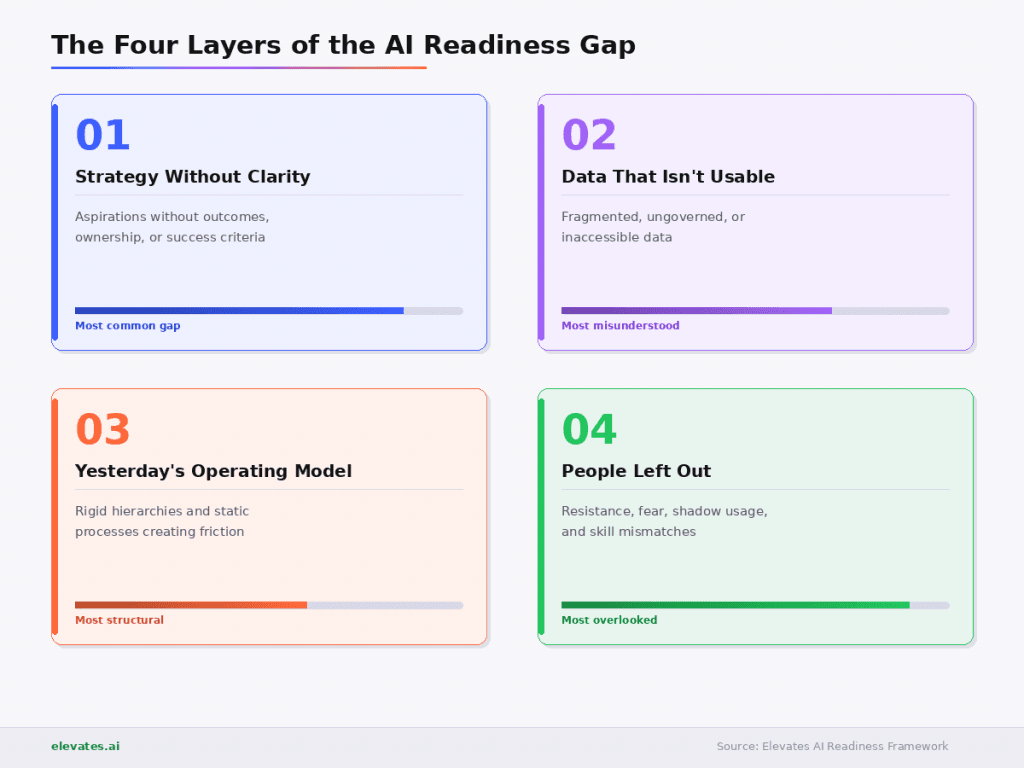
The four layers of the AI readiness gap
1. Strategy without clarity
Executives often say they want to “use AI to be more efficient” or “become AI-driven.” Those are aspirations, not strategies.
Without clear outcomes, ownership, and success criteria, AI becomes a collection of disconnected experiments instead of a coordinated initiative. Teams build in parallel. Leaders lose visibility. Momentum disappears.
AI magnifies ambiguity. It does not resolve it.
2. Data that exists but isn’t usable
Most organizations technically “have data.” What they don’t have is:
- Accessible data
- Trusted data
- Governed data
- Shared data
AI systems trained on fragmented, biased, or outdated data produce inconsistent results. Teams lose confidence quickly, and leadership questions the value of continued investment.
Data readiness is not about volume. It is about reliability and relevance.
3. Operating models built for yesterday
AI introduces new ways of working:
- Faster iteration cycles
- Cross-functional collaboration
- Continuous learning loops
- Human-in-the-loop decision making
Organizations built around rigid hierarchies and static processes struggle to adapt. AI work gets trapped between teams, approvals slow down experimentation, and accountability becomes unclear.
Without operational readiness, AI creates friction instead of leverage.
4. People left out of the equation
This is the most overlooked gap.
Employees are rarely brought into AI initiatives early. They don’t understand how AI affects their roles, how decisions are being made, or what success looks like.
The result:
- Resistance to new workflows
- Fear of displacement
- Shadow usage of unapproved tools
- Skill mismatches across teams
AI adoption is a change management problem before it is a technology problem.
Why buying more tools doesn’t close the gap
When AI projects stall, organizations often respond by:
- Switching vendors
- Expanding pilots
- Hiring external consultants
- Increasing budgets
These actions treat symptoms, not causes. Without readiness, more tooling adds complexity. Teams become dependent on external solutions rather than building internal capabilities. Over time, AI becomes something that “exists” in the organization rather than something that improves outcomes.
What AI-ready organizations do differently
Organizations that succeed with AI follow a different sequence:
- They assess readiness before selecting tools.
- They align leadership on outcomes and constraints — not just aspirations.
- They identify gaps across strategy, data, operations, and people.
- They build a clear, capacity-aligned roadmap before scaling.
They treat AI as an organizational transformation, not a software deployment.
A structured approach to closing the AI readiness gap
Closing the readiness gap requires a structured process — not another tool purchase. The most effective approach follows three stages:
Stage 1: Readiness assessment
A short, structured intake that captures strategic intent, organizational constraints, maturity signals, and timeline expectations. This creates clarity before any analysis begins.
Stage 2: Gap analysis
A systematic evaluation across readiness dimensions that identifies critical gaps, confidence levels, risk signals, and priority areas. The output is not a score — it’s a clear understanding of where the organization is exposed and where it’s ready.
Stage 3: Actionable roadmap
Clear 30/60/90-day guidance that translates readiness into action, aligned to real organizational capacity. Only after readiness is established does tooling become relevant.
This is the approach behind the Elevates Launchpad — a structured AI readiness platform designed to help organizations understand where they stand before they invest in where they’re going.
The real cost of ignoring readiness
The biggest risk with AI isn’t falling behind competitors. It’s investing heavily without understanding why progress never materializes.
Organizations that skip readiness often experience:
- Delayed or absent ROI
- Fractured initiatives across departments
- Low adoption rates
- Executive frustration and loss of sponsorship
- Employee disengagement and resistance
AI exposes organizational reality. It does not hide it.
Start with clarity, not technology
If your organization is exploring AI, the most important step is not choosing a platform. It’s about understanding whether the foundation is ready to support it.
That is where meaningful AI transformation begins.
Start with a readiness assessment. Understand the gap before trying to close it.
→ Begin with the Elevates Launchpad
What is an AI readiness assessment?
An AI readiness assessment is a structured evaluation of an organization’s preparedness to adopt artificial intelligence. It examines strategy alignment, data quality, operating model maturity, and workforce readiness — before any tools are selected. The goal is to identify where the organization is ready, where it’s exposed, and what needs to happen first.
Why do most AI initiatives fail?
According to industry research, the majority of AI projects fail to deliver intended outcomes — not because of technology limitations, but because organizations lack readiness across strategy, data, operations, and people. Without this foundation, new tools add complexity instead of value.
What is the AI readiness gap?
The AI readiness gap is the distance between where an organization believes it is with AI adoption and where it actually needs to be. It typically manifests as unclear strategy, unusable data, rigid operating models, and unprepared teams — all of which must be addressed before AI tools can deliver results.
How do you close the AI readiness gap?
Start with a structured readiness assessment to identify where gaps exist across four dimensions: strategy, data, operations, and people. Then build a prioritized roadmap aligned to actual organizational capacity — before selecting or scaling AI tools.
Be the First to Discover New AI Insights
Follow Elevates.AI on Google to stay updated with the latest AI readiness assessments, governance frameworks, implementation guides, buyer's guides, and enterprise AI best practices.
 Follow Elevates.AI on Google
The AI Readiness Brief
Every Week, receive practical enterprise AI strategies, implementation frameworks, governance updates, and expert insights—all delivered in a 5-minute read.
| ✓ Enterprise AI Strategy | ✓ AI Readiness Frameworks |
| ✓ Governance & Compliance | ✓ Exclusive Guides & Resources |
Join 500+ AI Professionals
Enter your work email below to receive one high-value email every week. No spam. Unsubscribe anytime.
Pingback: 9 Best AI-Powered Workforce Intelligence Platforms in 2026