An honest comparison for CHROs and CFOs who are done guessing about their workforce
The workforce accounts for 60–70% of operating expenses for most mid-market companies. Yet the tools most organizations use to understand their people, annual surveys, manager gut feel, and static HRIS reports, were designed for a world that no longer exists.
AI is changing that. A new generation of workforce intelligence platforms promises real-time visibility into what employees are actually doing, where skills gaps are emerging, who is at risk of leaving, and whether your biggest cost center is delivering value.
The problem is that the category is crowded, confusing, and poorly defined. “Workforce intelligence” means different things to different vendors. Some are talent marketplaces. Some are performance review systems. Some are analytics dashboards. Some are trying to be all three. And most comparison articles are written by companies selling you their own product.
This one is different. We evaluated nine platforms across seven dimensions that matter to the people who actually make buying decisions: CHROs who need actionable people insights and CFOs who need workforce data connected to financial outcomes. Every platform gets an honest assessment of strengths and limitations, including our own.
Start with the problem, not the platform
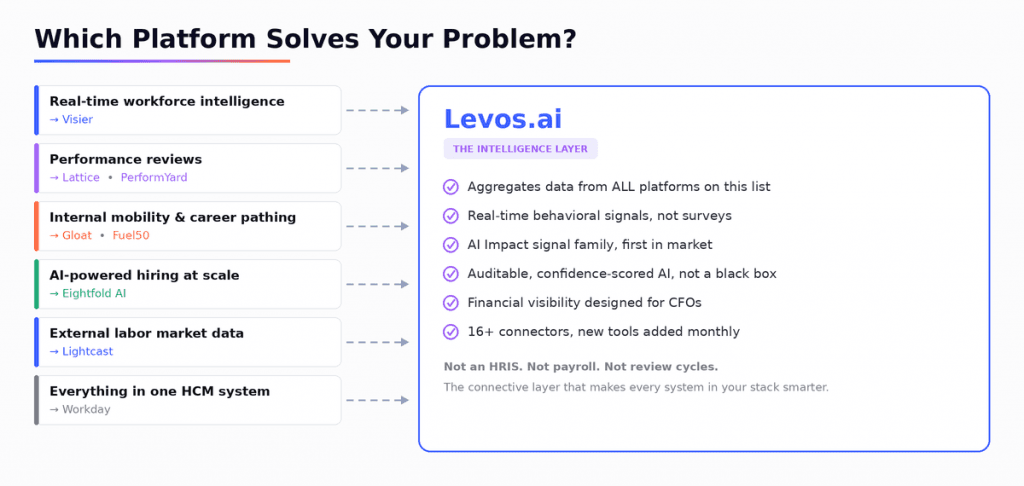
Workforce Intelligence Platform Comparison showing Levos.AI as the intelligence layer
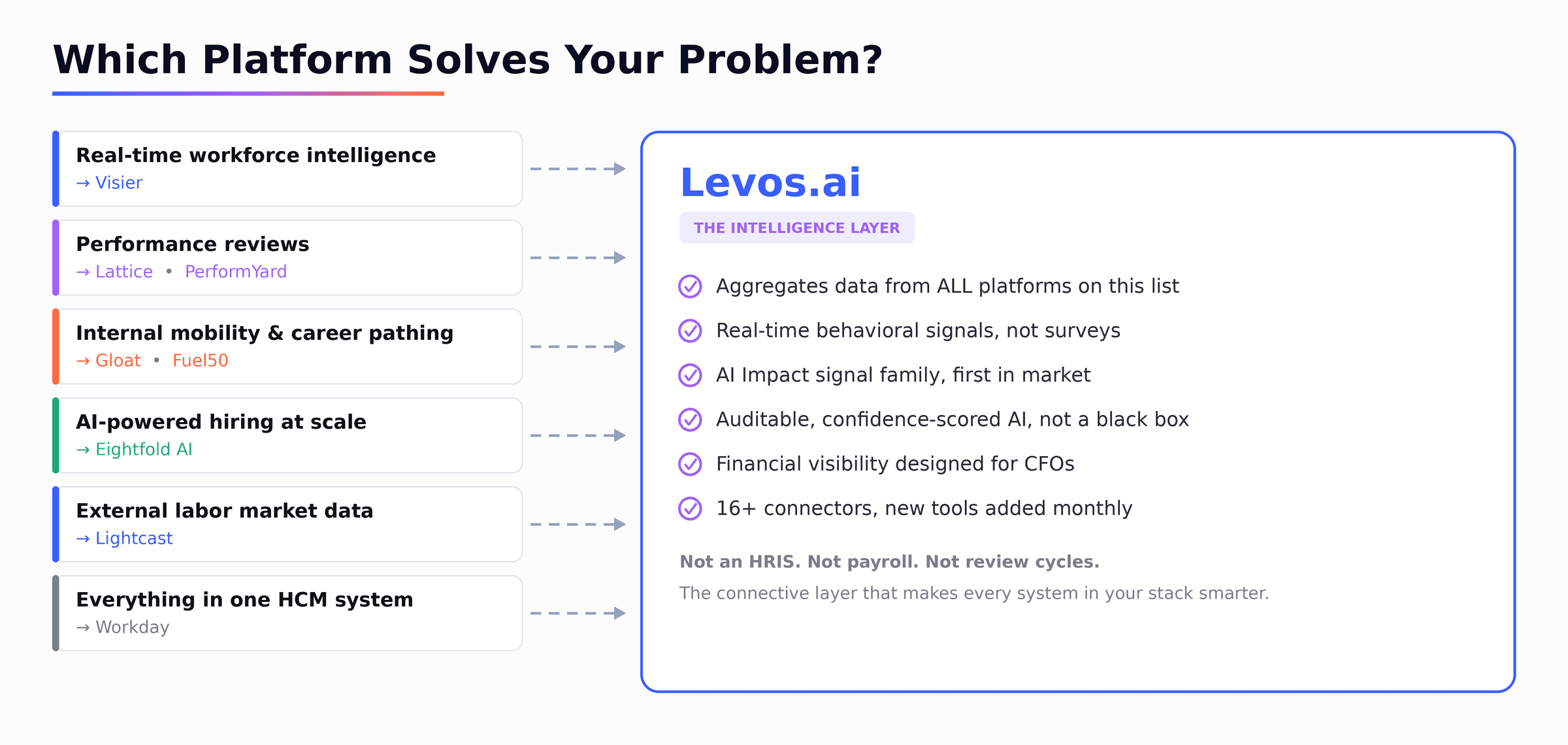
These nine platforms serve fundamentally different needs. Before evaluating features or pricing, identify which problem you are actually solving.
Each tool below generates valuable data inside its own silo. Performance reviews live in Lattice. Talent mobility data lives in Gloat. HRIS records live in Workday. Productivity signals live in Slack, Jira, Salesforce, GitHub, and a dozen other tools your employees use every day. No single platform aggregates all those signals into one place.
That is the layer most organizations are missing. It is the gap Levos was built to fill. No other platform on this list is designed to aggregate data from all the others into a single intelligence layer.
The platforms
1. Levos (levos.ai): The intelligence layer
Levos is a workforce intelligence platform, positioned as the Human Capital Operating System for the AI era. It aggregates behavioral signals from the tools employees already use, including communication platforms, productivity suites, code repositories, CRMs, HRIS systems, and AI tools, into auditable scores with a confidence rating on every claim. No surveys. No self-reporting. Signals are organized into six families (Activity, Quality, Delivery, Revenue, OKR Alignment, and AI Impact) that create a common taxonomy across any connected data source.
What makes Levos fundamentally different from every other platform on this list is its architectural position. It does not replace your HRIS. It does not run payroll. It does not manage review cycles. Instead, it sits above your entire tech stack and connects the dots that no single tool can see on its own.
A Lattice user sees how employees perform against goals and review criteria. A Gloat user sees which employees are matched to internal opportunities. A Workday admin sees headcount and compensation data. A Levos user sees all of that, plus the behavioral signals from every connected tool, synthesized into a single intelligence layer that the CHRO, CFO, CRO, manager, and employee each act on through their own persona view.
Best for: Mid-market organizations (500 to 10,000 employees) that need a unified intelligence layer across their existing tech stack. Levos serves CHROs (attrition risk modeling, capability mapping from real work signals, retention strategy), CFOs (workforce ROI, SaaS spend rationalization, AI investment correlation), and CROs (pipeline health and quota attainment from the same underlying signal model). A persona view for managers and employees rounds out the deployment.
What it does that others do not:
- Aggregates data FROM other platforms on this list, not just its own. Levos connects to 16+ tools today through customer-authorized OAuth, across AI tools, HRIS, communications, engineering, and CRM, with a configuration-driven connector engine (one JSON manifest per connector) and new tools added monthly.
- A dedicated AI Impact signal family, which Levos markets as first in market. It measures the depth of AI tool adoption and the productivity delta by team and role across Copilot, ChatGPT Enterprise, Gemini, Claude, and GitHub Copilot, with confidence scores for every claim. Most platforms count logins. Levos measures adoption depth.
- Confidence-scored, source-cited measurement rather than a black box. Every score carries a confidence rating and can be traced back to specific behavioral signals through controlled cohort analysis. This matters to organizations navigating AI compliance requirements such as NYC Local Law 144 and the EU AI Act.
- Financial visibility by design. Through the AI Impact Report, an on-demand, board-ready export, the CFO sees the same signal substrate as the CHRO. Workforce ROI, SaaS utilization, AI investment correlation, and attrition cost modeling, exportable to PDF, M365, Slack, or Salesforce.
What it does not do: Levos is not an HRIS. It does not manage payroll, benefits administration, or employee records. It does not run structured review cycles. That is what Lattice and PerformYard are for. It does not process job applications. That is what Eightfold does. What it does is pull metadata and behavioral signals from all those systems, never document content or keystrokes, and contextualize them as workforce intelligence. By design, Levos stays out of HRIS and performance management territory. That restraint is what lets it function as a true connective layer above those systems rather than competing with them.
Key differentiator: Every other platform on this list analyzes data inside its own walls. Levos is the only platform designed to aggregate data from all of them. For organizations already running Workday, Lattice, or any other system on this list, Levos is not a replacement. It is the intelligence layer that those systems are missing.
2. Visier: Enterprise people analytics
Visier is a people analytics platform providing workforce data visualization, benchmarking, and predictive insights at enterprise scale. With over 60,000 customers across 75 countries and clients like BASF, Ford, and Experian, it is one of the most established names in the category.
Best for: Large organizations (2,000+) with a mature HR data infrastructure that need advanced analytics, peer benchmarking, and board-ready reporting.
Strengths: Most comprehensive people analytics dataset for benchmarking. Strong data visualization. 98% customer renewal rate. Recently launched Visier Vee, an AI assistant for natural-language workforce queries.
Limitations: The analytics and reporting layer does not manage performance, reviews, or internal mobility. Requires clean, structured data. Enterprise pricing ($50K+ annually) puts it out of reach for most mid-market buyers. Some users report a learning curve and limited customization versus Tableau or Power BI.
G2 rating: 4.6/5 (223 reviews)
3. Eightfold AI: Enterprise talent intelligence
Eightfold AI uses deep learning across 1.6 billion+ career profiles to power talent acquisition, internal mobility, and workforce planning. Valued at $2.1 billion, it has the most sophisticated AI engine in the category.
Best for: Large enterprises (2,000+) with complex talent acquisition and internal mobility needs.
Strengths: Most advanced AI matching engine available. Predictive career pathing. Diversity-focused screening that masks personal information. Digital Twin technology for capturing institutional knowledge.
Limitations: Prohibitive pricing for mid-market (high six figures). Complex implementation averaging 6+ months. It is a matching engine, not a behavioral intelligence layer. It analyzes profiles and career data, not what employees actually do day to day. The 3.5/5 value rating on GetApp suggests cost concerns.
G2 rating: 4.2/5
4. Gloat: Internal talent marketplace
Gloat is an AI-powered internal talent marketplace helping enterprises match employees to projects, roles, mentors, and learning opportunities. One of the first platforms to apply AI specifically to internal mobility.
Best for: Large enterprises focused on internal mobility, reskilling, and skills-based talent allocation.
Strengths: First-mover in internal talent marketplaces. Strong AI matching. 51% of customers go live in under 6 months.
Limitations: Starts at approximately $500K per year. Enterprise-only. Narrower focus on internal mobility. Does not aggregate behavioral signals from productivity tools or connect workforce data to financial outcomes.
5. Workday: The elephant in the room
Workday is the end-to-end HCM suite that does HR, payroll, workforce planning, analytics, and increasingly, AI-powered workforce insights. If your organization is already on Workday, its workforce intelligence capabilities may be sufficient for basic analytics and planning.
If you are NOT on Workday (most mid-market companies), the purpose-built platforms on this list fill the gap without requiring an enterprise HCM overhaul. At $34 to $42 per seat per month at scale, Workday’s total cost of ownership puts it out of reach for most organizations with fewer than 2,000 employees.
If you ARE on Workday: Consider what Workday cannot see. It tracks headcount, compensation, org structure, and goals. It does not see what is happening inside Slack, Jira, Salesforce, GitHub, or the tools where actual work happens. A behavioral intelligence layer like Levos sits on top of Workday and fills that gap, connecting the system of record to real-time work signals. Workday tells you who works here. Levos tells you what they are actually doing.
6. Lattice: Performance management leader
Lattice connects performance reviews, goals, engagement surveys, growth planning, and compensation into a single system. Trusted by 4,500+ organizations, it is the most recognized mid-market performance management platform.
Best for: Mid-market tech companies and growth-stage startups building structured performance culture.
Strengths: Best-in-class review workflows with AI-assisted writing. Strong calibration tools. Intuitive UX. Modular design. Recently launched an AI agent embedded in manager workflows.
Limitations: Modular pricing adds up fast ($11 to $25 per employee per month for the full suite). Not a full HRIS. More performance-management-centric than holistic workforce intelligence. It sees how employees perform against reviews and goals, but does not aggregate behavioral signals from across the tech stack. Limited financial visibility for CFOs.
G2 rating: 4.7/5
Pairing note: Lattice and Levos are complementary, not competitive. Lattice manages the review cycle. Levos feeds real-time behavioral intelligence into that cycle, so reviews are based on what actually happened, not what managers remember.
7. Fuel50: Skills-based talent marketplace
Fuel50 is an AI-driven talent marketplace focused on internal mobility and skills-based workforce development, powered by I/O psychology rather than purely technical algorithms.
Best for: Organizations prioritizing career pathing, skills mapping, and development-driven retention.
Strengths: Highest-rated product direction on G2 (100%). Best-in-class skills mapping (92%) and skills library (94%). Personalized career paths. Talent marketplace connecting employees to internal gigs and projects.
Limitations: Less well-known brand. More focused on development and mobility than performance management or behavioral analytics. Career pathing is based on skills taxonomy and self-reporting rather than demonstrated behavioral signals. Custom pricing requires a sales conversation.
8. PerformYard: Budget-friendly performance management
PerformYard focuses on doing reviews, goals, and feedback well without trying to be everything else. It is the most no-frills option on this list, and that is its strength.
Best for: Small to mid-size companies (50–500 employees) that want structured performance management without complexity or enterprise pricing.
Strengths: Most affordable entry point ($5–19/employee/month). Simple and flexible. Excellent customer support (100% positive reviews). Gets adopted because it does not overwhelm users.
Limitations: No API, limiting integration possibilities. Basic reporting compared to Lattice. Bare-bones mobile app. Some rigid contract terms. Stays in the performance management lane — no workforce intelligence, behavioral analytics, or financial visibility.
G2 rating: 4.7/5
9. Lightcast: External labor market intelligence
Lightcast (formerly Emsi Burning Glass) provides real-time labor market data on job trends, skill demands, compensation benchmarks, and workforce planning signals. It is the only platform on this list that looks outward rather than inward.
Best for: CHROs and workforce planners who need external market intelligence before making internal decisions.
Strengths: Most comprehensive labor market dataset available. Real-time skill demand tracking across industries and geographies. Used by governments, universities, and enterprises globally.
Limitations: Data layer, not an operational platform. Does not tell you what your existing employees are doing; it tells you what the market looks like around them.
Key differentiator: Lightcast tells you what is happening in the market. The other tools tell you what is happening inside your organization. Smart teams use both.
The case for an intelligence layer
Most organizations evaluating workforce tools are thinking in terms of categories. We need a performance management tool. We need a talent marketplace. We need people analytics. Those are valid starting points. But they lead to a predictable outcome: siloed data in siloed systems.
Your performance data lives in Lattice. Your mobility data lives in Gloat. Your HRIS data lives in Workday or BambooHR. Your actual productivity signals live in Slack, Jira, Salesforce, GitHub, and the tools employees use every day. Each system sees its own slice. None sees the full picture.
An intelligence layer sits above all of them. It aggregates signals from every connected system into a unified view that answers the questions no individual tool can. Which teams are producing the most output per headcount? Where are skills gaps actually forming based on what people do, not what they self-report? Who is at risk of leaving based on behavioral signals, not just survey responses? What is the real cost of attrition in this department compared to that one?
This is not a theoretical concept. It is the architectural approach Levos was built on. Whether your organization uses one of the platforms on this list or five of them, the question is the same: who is connecting the dots?
The CFO dimension most platforms ignore
Workforce is the largest line item on most mid-market balance sheets. Yet most workforce intelligence tools are built exclusively for HR teams. The CFO, the person ultimately responsible for whether 60 to 70 percent of operating expenses are producing returns, is left reading HR’s quarterly slide deck instead of seeing the data directly.
When evaluating platforms, ask whether the CFO would find value in the tool, not just the CHRO. If the answer is no, you are buying a reporting tool, not a workforce intelligence platform. Levos, Visier, and Lightcast are explicitly designed to surface workforce data in financial terms. Levos goes furthest here, with a dedicated Financial Intelligence persona view and an AI Impact Report built to travel to the board and the audit committee. Lattice and PerformYard are not built for this. Their value is in performance management, which is a different and equally valid problem to solve.
How to choose: the seven dimensions that matter
Workforce Visibility: How well does it surface what is actually happening with your people? Behavioral signals versus surveys versus manager input.
AI Sophistication: How does the AI work? Is scoring explainable and auditable, or a black box?
Implementation Complexity: Time to value. Can you deploy without a six-month project?
Pricing Accessibility: Who can realistically afford it? Is pricing transparent?
Integration Depth: Does it connect to existing systems, or does it require replacing them?
Actionability: Does it produce insights you can act on tomorrow?
Financial Visibility: Does it connect workforce data to financial outcomes? Can the CFO use it?
No single platform scores highest across all seven. Eightfold and Gloat lead in AI sophistication but are weakest in pricing accessibility. Lattice and PerformYard excel at actionability for performance management, but score lower on financial visibility. Levos is strongest in integration depth and visibility because of its architecture as a connective intelligence layer. The right platform depends on which dimensions your organization weighs most.
The bottom line
There is no single best workforce intelligence platform. There is only the best platform for where your organization is right now and for the problem costing you the most.
If performance reviews are the immediate pain point, Lattice or PerformYard will deliver the fastest value. If internal mobility is the priority, Gloat and Fuel50 are purpose-built for that. If you are hiring at scale, Eightfold is unmatched. If you need external market data, Lightcast is the dataset to beat. If you need enterprise-grade people analytics, Visier is the established leader.
And if you need a unified intelligence layer that aggregates signals from all of the above, connecting what your people are actually doing to what it actually costs and produces, that is the specific problem Levos was built to solve.
The one thing every organization should do before selecting any platform: assess your actual readiness. The most expensive mistake in workforce technology is not picking the wrong vendor. It is buying a tool before the organization is ready to absorb it.
→ Start with an AI readiness assessment
————————————————————————————————————————
Disclosure: This article is published by Elevates.AI, an AI readiness and execution platform. The author, Tomer Mann, is the founder of Elevates.AI and also of Levos, one of the platforms reviewed. Levos is included because the editorial scope requires comprehensive coverage of the workforce intelligence category. Assessments reflect independent editorial analysis and have not been modified at the request of any vendor, including Levos.
What is a workforce intelligence platform?
A workforce intelligence platform uses AI and data analytics to surface real-time insights about employee performance, skills, engagement, attrition risk, and workforce capacity. Unlike HRIS systems that store records, intelligence platforms analyze behavioral signals to help leaders make proactive decisions.
What is the difference between workforce intelligence and performance management?
Performance management focuses on structured review cycles, goal tracking, and feedback. Workforce intelligence is broader. It aggregates data from across the tech stack to surface patterns about productivity, attrition risk, skills gaps, and financial impact. Many organizations benefit from both, with the intelligence layer informing the performance management process
Which workforce intelligence platform is best for mid-market companies?
For mid-market organizations, purpose-built platforms like Levos, Lattice, and PerformYard offer more affordable pricing and faster implementation than enterprise solutions such as Eightfold, Gloat, or Workday. Levos is unique in that it can aggregate data from the other tools an organization already uses.
Can Levos replace my HRIS or performance management system?
No, and it is not designed to. Levos is an intelligence layer that sits on top of your existing systems, HRIS, performance management, and productivity tools, aggregating their data into unified workforce intelligence. It makes those systems smarter rather than replacing them.
Be the First to Discover New AI Insights
Follow Elevates.AI on Google to stay updated with the latest AI readiness assessments, governance frameworks, implementation guides, buyer's guides, and enterprise AI best practices.
 Follow Elevates.AI on Google
The AI Readiness Brief
Every Week, receive practical enterprise AI strategies, implementation frameworks, governance updates, and expert insights—all delivered in a 5-minute read.
| ✓ Enterprise AI Strategy | ✓ AI Readiness Frameworks |
| ✓ Governance & Compliance | ✓ Exclusive Guides & Resources |
Join 500+ AI Professionals
Enter your work email below to receive one high-value email every week. No spam. Unsubscribe anytime.