How to Measure AI ROI:
Metrics Every CXO Must Track
ROI in AI full form is Return on Investment — but for enterprise AI, the old formula breaks. Here’s the 2026 framework boards and CFOs actually accept.
56%
of CEOs report zero revenue or cost benefit from AI (PwC, 2026)
74%
of organizations see ROI from gen AI within year one (Google Cloud, 2025)
29%
of executives say they can measure AI ROI confidently today (IBM, 2026)
$3.70
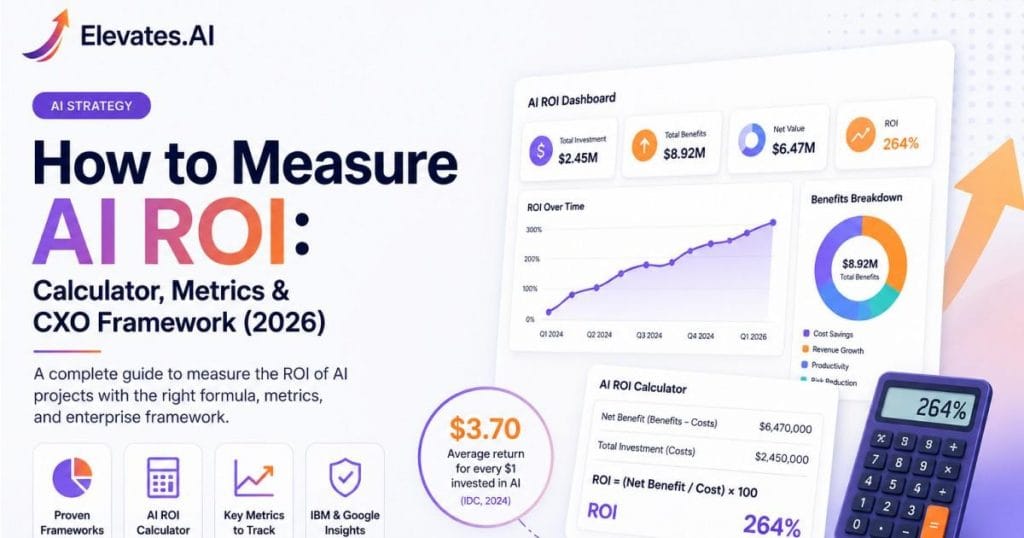
returned per $1 invested in AI — average across enterprise programs (IDC/Microsoft)
Boards no longer ask whether to invest in AI. They ask what the last round of investment actually delivered. For most enterprises, that question lands uncomfortably. Pilots are everywhere, dashboards are full — yet the line connecting AI spend to measurable business outcomes remains stubbornly faint.
That gap is where AI programs get cut.
Knowing how to measure AI ROI — not just track usage or count licenses — is now a survival skill for every CXO. This guide covers the formula, the right metrics for each C-suite function, and the measurement framework that IBM, Google, and McKinsey all converge on. It also links directly to Elevates.AI’s AI readiness assessment so you can benchmark where your organization actually stands before you calculate what you’ve earned.
TL;DR — Key Takeaways
- ROI in AI full form = Return on Investment, but the standard formula (net profit ÷ cost) breaks for AI — you need a modified version
- The AI ROI calculator formula is: (Net Value Generated − Total AI Cost) ÷ Total AI Cost × 100
- Most organizations measure adoption, not value — that’s why 56% of CEOs see no financial return
- IBM’s 2026 data shows only 29% of executives can measure AI ROI confidently — Google Cloud’s ROI of AI study puts achievers at 74% with the right framework
- The fix: baseline first, then metrics by function, then a board-ready ROI narrative
Section 1
ROI in AI — full form, definition, and why the old formula breaks
ROI stands for Return on Investment. For traditional software, that means: did the tool pay for itself? The calculation is simple — net profit divided by investment cost, expressed as a percentage. Apply that to AI and it falls apart almost immediately.
AI affects multiple value streams simultaneously: workflow speed, decision quality, employee capacity, customer experience, risk posture, and revenue generation. Traditional ROI models only capture one or two of these at a time. The rest gets left out of the denominator, making the calculation misleading in both directions.
The AI ROI Calculator Formula
AI ROI = (Net Value Generated − Total AI Cost) ÷ Total AI Cost × 100
Net Value Generated includes:
- Labor cost savings
- Revenue from AI-enhanced products
- Cost avoidance (risks not realized)
- Productivity hours reclaimed
Total AI Cost (TCO) includes:
- Model licenses & API usage
- Infrastructure & compute
- Implementation & integration
- Training, governance & maintenance
According to Shopify’s 2026 AI ROI guide, a key tip is to apply the employee’s fully loaded cost — typically 1.25x to 1.4x base salary — to time-saved metrics. If customer ticket volume grows 20% but headcount stays flat because AI handled the surplus, the ROI is the fully loaded cost of the hire you didn’t make.
Section 2
The AI ROI gap: why most organizations see zero return
The IBM AI ROI study (2026) found that while 79% of organizations report productivity gains, only 29% can confidently measure ROI — and only around 25% of AI initiatives deliver expected returns. Their explanation is sharp: AI value exists, but translating short-term productivity into financial impact is still structurally broken in most organizations.
PwC’s 2026 CEO Survey puts a harder number on it: 56% of CEOs report neither increased revenue nor decreased costs from AI in the last 12 months. Only 12% report achieving both. The divide is structural. CEOs who do report financial returns are two to three times more likely to have embedded AI extensively across decision-making — not just distributed licenses.
“AI spend does not become ROI simply because usage goes up. Value capture requires workflow redesign, not just license distribution.”— Forbes / PwC / Anthropic Analysis, January 2026
The measurement gap is the core problem. Most organizations track AI adoption — logins, active users, prompts sent. Almost none measure actual productivity improvements or business value generated. According to Larridin’s AI ROI Measurement Framework, 72% of enterprise AI investments are destroying value through waste — not because the AI doesn’t work, but because measurement was never designed into the deployment.
Section 3
The metrics every CXO must track — by function
Boards don’t need 46 KPIs. They need a small set that connects AI investment to financial outcomes, operational efficiency, and risk posture — by the function that owns the metric.
💼 CFO
- Financial impact
- Labor cost reduction per employee
- AI-attributable revenue (quarterly)
- Total cost of ownership vs. baseline
- Cost avoidance from AI risk detection
⚙️ COO
- Operational efficiency
- Cost avoidance from AI risk detection
- Financial impact
- Labor cost reduction per employee
- AI-attributable revenue (quarterly)
- Total cost of ownership vs. baseline
🔧 CTO / CIO
- Technical & infrastructure
- AI use cases in production vs. pilots
- Model inference cost per output unit
- Shadow AI instances brought under governance
- Engineering velocity (deploys per sprint)
👥 CHRO
- Workforce & talent
- Hours reclaimed per employee per week
- AI literacy adoption rate by department
- eNPS score (AI upskilling impact)
- Retention of AI-trained talent
📈 CMO
- Revenue & growth
- Sales conversion lift from AI personalization
- Customer acquisition cost (pre/post AI)
- Content output volume & time to publish
- First-contact resolution rate (AI vs. human)
🛡️ CCO / CSO
- Risk & governance
- Breach cost reduction (Shadow AI controlled)
- AI governance maturity score
- Audit trail coverage % across AI systems
- Compliance posture score (quarterly)
Section 4
Hard ROI vs. soft ROI — what IBM’s AI ROI framework says
IBM’s approach to AI ROI separates metrics into two buckets: Hard ROI (concrete financial data — costs saved or profits gained) and Soft ROI (productivity, employee experience, strategic positioning). Both matter, but boards and CFOs are increasingly demanding the hard bucket first.
According to the IBM guide on how to maximize AI ROI in 2026, hard ROI KPIs include: labor cost reductions from automation, operational efficiency gains from streamlined workflows, and increased traffic, lead generation, and conversion rates from AI-powered personalization. Soft ROI, while less tangible, acts as the leading indicator — employee sentiment, adoption breadth, and AI literacy rates predict whether hard ROI will follow.
| Metric type | Hard ROI examples | Soft ROI examples |
|---|---|---|
| Financial | Revenue increase, cost reduction, ROI % | Board confidence, investment secured |
| Operational | Cycle time, cost to serve, error rate | Team coordination, workflow consistency |
| Workforce | Hours saved × loaded salary rate | AI satisfaction, eNPS, skill confidence |
| Risk | Breach avoided, fines not incurred | Governance maturity, compliance posture |
The Futurum Group’s 2026 Enterprise Software Survey found that direct financial impact — combining revenue growth and profitability — nearly doubled to 21.7% as the primary ROI metric for enterprise AI, while productivity gains collapsed 5.8 percentage points as the leading success metric. The message is clear: enterprises are demanding that every AI capability connect directly to the P&L, not just save a few hours per week.
Section 5
What the 2026 AI ROI studies actually show
This is what The ROI of AI 2025/2026 major studies converge on — across Google Cloud, IBM, McKinsey, and PwC:
G – Google Cloud — ROI of AI Study
Survey of 2,500–3,466 senior leaders: 74% of organizations are seeing ROI from their gen AI investments. 86% using gen AI in production and seeing revenue growth estimate 6%+ gains to annual company revenue. 84% transform a use case idea into production within 6 months. Among those with productivity gains, 39% have seen productivity at least double.
cloud.google.com/resources/roi-of-generative-ai →
I – IBM — AI ROI Study 2026
Only 29% of executives can measure AI ROI confidently. Just 25% of AI initiatives deliver expected ROI, and only 16% have scaled enterprise-wide. Yet 79% see productivity gains — confirming value exists but measurement is broken.
ibm.com/think/insights/ai-roi →
M – McKinsey — State of AI 2026
Companies implementing enterprise AI report revenue increases of 3–15% alongside 10–20% improvements in sales ROI. But only 39% report enterprise-level EBIT impact despite 88% adoption — confirming the measurement gap.
P – PwC — 2026 CEO Survey
56% of CEOs report neither increased revenue nor decreased costs. 79% of organizations use AI agents in some form, with 66% reporting measurable productivity improvements. But CEOs who do achieve financial returns are 2–3x more likely to have embedded AI across decision-making — not just distributed tools.
Section 6
The 7-step AI ROI measurement framework for boards
Adapted from WitnessAI’s executive guide and GS Consulting’s enterprise ROI framework.
1 – Capture the true denominator — all AI costs
Start by cataloging every category of AI spend: model licenses, API consumption, infrastructure, vendor contracts, implementation hours, training, governance, and maintenance. Most organizations only count licensing — this leaves the ROI calculation misleading.
2 – Set baselines before deployment — not after
You cannot measure improvement without pre-AI benchmarks. Document current performance on every metric you intend to track. This is the most frequently skipped step — and the one that makes ROI measurement impossible 6 months later.
3 – Assign clean owners per metric
Every metric needs a clear owner — not a team, a person. When accountability is diffused, measurement drifts. The CFO owns financial return. The COO owns cycle time and throughput. The CHRO owns workforce impact. Without ownership, data quality degrades.
4 – Separate “breadth” from “depth” in usage reporting
Logins and active users are breadth metrics. The ROI is in depth — complex workflows completed, decisions improved, strategic outputs generated. Google’s January 2026 Workspace update added Gemini usage metrics to admin dashboards specifically to close this gap.
5 – Convert productivity gains to dollar values
Hours saved × (employee fully loaded cost / work hours) = hard ROI from productivity. Apply 1.25–1.4x salary multiplier to convert to true cost. Thomson Reuters data shows AI saves knowledge workers ~240 hours/year, worth $19,000 per professional annually — that’s your baseline for calculating workforce ROI.
6 – Set measurement cadence by metric type
Financial metrics (sales conversion, labor cost) → quarterly, aligned to board cycles. Strategic metrics (governance maturity, eNPS) → annually. Operational metrics (cycle time, throughput) → monthly. Cadence discipline is what separates an ROI program from a one-time slide.
7 – Build the board-ready ROI narrative
A defensible AI ROI narrative ties each governance control to a specific financial or operational outcome — so compliance spend stops looking like overhead. Map breach cost reductions to Shadow AI controls. Map velocity improvements to headcount ROI. Boards want a story, not a KPI dashboard.
Before you calculate ROI
You can’t maximize AI ROI without measuring AI readiness first
ROI measurement only works when baseline infrastructure is in place — governance, data quality, talent depth, and strategic alignment. Organizations that jump to ROI tracking without those foundations in place are trying to measure a return on a system that was never set up to generate one.
This is what our AI readiness assessment surfaces in under 60 seconds: the specific gaps — in data governance, talent, infrastructure, or strategic sequencing — that are directly preventing ROI from materializing. It maps to your AI maturity score and produces a 30/60/90-day roadmap structured around closing the gaps that matter most to your board.
Organizations track
Adoption
Logins, users, prompts
They should track
Business value
Revenue, efficiency, risk
Organizations track
Adoption
Logins, users, prompts
Find out what’s blocking your AI ROI
Get your AI readiness score, gap analysis, and a sequenced 30/60/90-day roadmap — free, in under 60 seconds. Start free AI readiness assessment →
Frequently asked questions
What is ROI in AI — full form and definition?
ROI in AI stands for Return on Investment in Artificial Intelligence. It measures the net business value generated from AI initiatives against the total cost of deploying and running those systems. Unlike traditional software ROI, AI ROI must account for productivity gains, cost avoidance, revenue uplift, and risk reduction simultaneously.
What is the AI ROI calculator formula?
The standard AI ROI calculator formula is: (Net Value Generated − Total AI Cost) ÷ Total AI Cost × 100. Net value includes labor savings, revenue generated, and cost avoidance. Total AI cost (TCO) includes licensing, infrastructure, implementation, training, and governance.
What does the Google ROI of AI 2025 report find?
Google Cloud’s ROI of AI 2025 report (based on 2,500–3,466 senior leaders) found that 74% of organizations are seeing ROI from gen AI investments, 86% estimate 6%+ annual revenue gains, and 84% move from use case idea to production within six months. Among those with productivity gains, 39% have seen productivity at least double.
What does IBM’s AI ROI study show about enterprise returns?
IBM’s 2026 AI ROI research found that only 29% of executives can measure AI ROI confidently, just 25% of AI initiatives deliver expected ROI, and only 16% have scaled AI enterprise-wide. Yet 79% see productivity gains — showing that value exists but measurement frameworks are broken in most organizations.
How long does it take to see ROI for AI projects?
Deloitte’s research shows typical AI ROI takes 2–4 years, though only 6% of brands see payback in under a year. Google Cloud’s data shows 74% of organizations achieve ROI within year one when they deploy to production (rather than staying in pilot). Finance and customer service have the fastest payback timelines — 8–12 months for agentic systems.
How does AI readiness affect AI ROI?
Organizations with low AI readiness — weak data governance, poor strategic alignment, insufficient talent depth — systematically underperform on AI ROI regardless of tool quality. AI readiness assessment identifies the specific gaps preventing ROI from materializing before they compound into expensive structural debt.
Sources
Google Cloud — The ROI of Generative AI (2025/2026)
IBM Think — How to maximize AI ROI in 2026
McKinsey & Company — State of AI: Global Survey Insights (2025/2026)
PwC — 2026 CEO Survey: AI Financial Returns
Deloitte — State of AI in the Enterprise 2025–2026
WitnessAI — How to Measure AI ROI: Executive Guide (2026)
Larridin — The AI ROI Measurement Framework (2026)
Futurum Group — 2026 Enterprise Software Survey (830 IT decision-makers)
IDC / Microsoft — AI Training ROI Research ($3.70 per $1 invested)
Internal links: What is AI readiness? · AI maturity assessment · Start free assessment
Be the First to Discover New AI Insights
Follow Elevates.AI on Google to stay updated with the latest AI readiness assessments, governance frameworks, implementation guides, buyer's guides, and enterprise AI best practices.
 Follow Elevates.AI on Google
The AI Readiness Brief
Every Week, receive practical enterprise AI strategies, implementation frameworks, governance updates, and expert insights—all delivered in a 5-minute read.
| ✓ Enterprise AI Strategy | ✓ AI Readiness Frameworks |
| ✓ Governance & Compliance | ✓ Exclusive Guides & Resources |
Join 500+ AI Professionals
Enter your work email below to receive one high-value email every week. No spam. Unsubscribe anytime.