AI Readiness for Financial Services: 2026 Checklist
Financial services has spent more on AI pilots than almost any other industry — and still has some of the lowest production deployment rates. The reason isn’t a lack of ambition. It’s that AI readiness in a regulated industry means something different than it does everywhere else. A generic AI readiness checklist doesn’t ask about model risk sign-off, data lineage, or regulator explainability requirements. This one does.
If you want a fast directional answer first, run the free 60-second AI readiness assessment — then come back here for the financial-services-specific layer this guide covers.
1. What AI Readiness Means in Financial Services
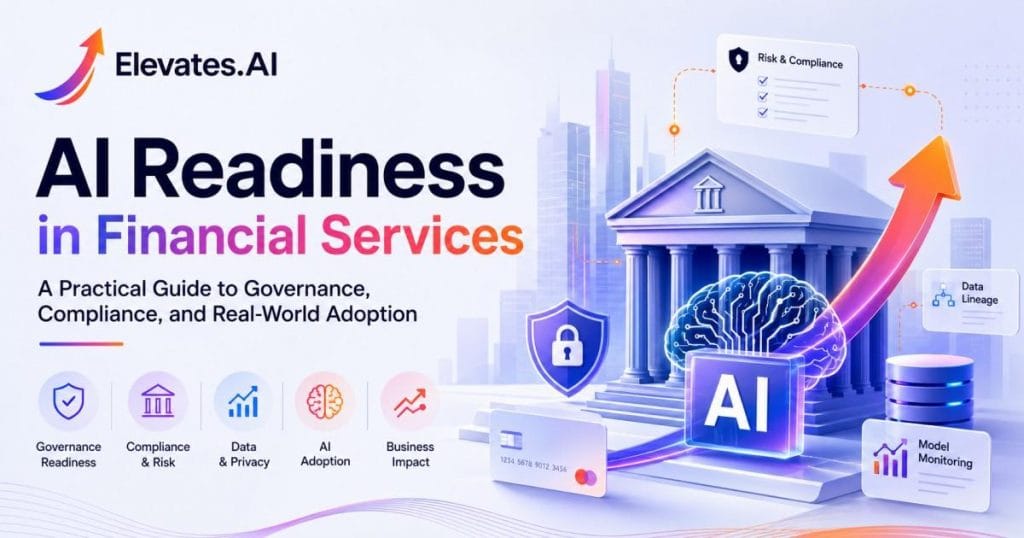
A generic AI readiness assessment checks for data, infrastructure, talent, and strategy. Financial services needs all of that plus a fifth layer most frameworks skip: governance readiness — whether your model risk management function, compliance team, and audit trail requirements are built to support AI before a single model touches customer data.
According to the U.S. Treasury’s report on AI in financial services, financial institutions face a distinct set of risks around explainability, third-party model dependency, and data privacy that don’t apply the same way in other industries. That’s the gap a financial-services-specific readiness check has to close.
For the general framework this builds on, see What Is AI Readiness? and the full AI Readiness Assessment Guide.
2. Why Financial Services Needs a Higher Readiness Bar
Four constraints make this industry structurally different from a typical AI adopter:
- Model risk governance — many institutions require formal sign-off (modeled on frameworks like SR 11-7) before any model, including AI, goes into production.
- Data privacy and residency — GLBA, PCI DSS, and regional data-residency rules constrain where data can move and which vendors can touch it.
- Explainability requirements — a model that denies a loan or flags fraud may need to produce a reason a regulator or customer can understand, ruling out pure black-box approaches for certain use cases.
- Legacy core systems — many banks run on decades-old core banking platforms that weren’t built to expose clean, structured data to anything, let alone an AI system.
The World Economic Forum’s report on AI in financial services frames this as a trust problem as much as a technical one: institutions that treat governance as a prerequisite, not an afterthought, adopt AI faster in the long run because they don’t get stalled in compliance review after the fact.
3. Where AI Is Already Being Used in Financial Services
Before assessing readiness, it helps to know what “done well” looks like. The current landscape breaks into a few clear categories:
AI in Banking
Fraud detection and real-time transaction monitoring remain the most mature use case — models trained on millions of transactions catching anomalies humans would miss. IBM’s overview of AI in finance also points to credit risk scoring and anti-money-laundering monitoring as high-adoption areas, largely because the ROI case is easiest to prove to a risk committee.
AI in Fintech
Fintechs move faster than incumbent banks because they’re not retrofitting AI onto legacy cores — many were built AI-native. Common applications include automated underwriting, personalized financial recommendations, and embedded lending decisions.
Financial Services Chatbots
Customer-facing conversational AI has moved well past simple FAQ bots into transaction support, dispute initiation, and basic advisory triage — though most institutions still route anything regulatory or high-stakes to a human.
AI in Financial Modeling and Forecasting
AI-assisted forecasting is increasingly used for cash flow prediction, market risk modeling, and scenario analysis — augmenting rather than replacing traditional quantitative models in most institutions.
Agentic AI in Financial Services
The newest category: AI agents that don’t just answer questions but execute multi-step workflows. MIT Sloan’s coverage of AI developments in finance and industry reporting on large institutions both point to this as the fastest-growing area — and the one requiring the most governance maturity, since agents that take action (not just generate text) carry materially higher operational risk if something goes wrong.
4. What’s Actually Blocking Adoption
The barriers aren’t usually the model. They’re almost always upstream of it:
- Data fragmentation across core banking, CRM, and risk systems that were never designed to talk to each other.
- Unclear model ownership — no single team empowered to approve, monitor, or retire an AI model once it’s live.
- Vendor risk review bottlenecks — third-party AI tools can sit in procurement and security review for months before a pilot even starts.
- Talent gaps in the specific overlap of AI engineering and financial services compliance — a rarer combination than either skill alone.
This mirrors what Deloitte’s analysis of AI transforming financial services identifies as the core tension: the technology is rarely the constraint — organizational readiness to govern it is.
5. The AI Readiness Checklist for Financial Services
A financial-services-specific version of the standard readiness check should confirm:
- Data lineage: can you trace where a data point came from and how it was transformed before it reaches a model?
- Model risk sign-off path: is there a defined committee or process that approves models before production, and can it review AI on the same timeline as traditional models?
- Explainability plan: for any customer-facing or credit-related use case, can you produce a reason code a regulator would accept?
- Vendor and data residency review: has legal/compliance pre-cleared the categories of vendors and data movement you’re planning to use?
- Monitoring and drift detection: is there a plan for ongoing model monitoring, not just a one-time approval?
Running this alongside a general-purpose score gives a fuller picture — the 60-second AI readiness assessment covers the foundational layer (data, infrastructure, talent, strategy) that this checklist builds on.
6. Vendor-Neutral vs. Vendor-Led Assessments in a Regulated Industry
In financial services specifically, vendor neutrality isn’t just a nice-to-have — it can be a compliance issue. If the same firm that scores your readiness also sells the AI platform, procurement and risk teams often have to treat the recommendation with extra scrutiny, adding review cycles rather than removing them.
A readiness process that separates diagnosis from product recommendation — documented at Trust & Methodology — moves through internal risk review faster because there’s no conflict of interest to evaluate. Matched tools live separately in the AI Marketplace, after the score, not baked into it.
7. From Readiness Score to a Compliant Implementation Roadmap
A readiness report that ends at “improve data governance” isn’t actionable for a bank’s engineering or risk team. The gap needs to close all the way down to a ticket: which data pipeline, which model risk reviewer, which compliance sign-off gate, and in what order.
Elevates.AI’s 90-day roadmap sequences these findings into phases with named owners — including, for regulated clients, an explicit governance sign-off step built into the timeline rather than treated as a blocker discovered after the fact.
Frequently Asked Questions
Which AI is best for financial services?
There’s no single “best” AI for financial services — the right choice depends on the use case. Institutions typically use a mix: specialized fraud-detection models, forecasting tools for financial modeling, and general-purpose large language models (often deployed through an internal, governed platform rather than a public consumer tool) for research, drafting, and analysis.
What is the 30% rule for AI?
There isn’t one official “30% rule” — the phrase gets used for at least three different things: a rough guideline that AI can automate a large share of repetitive tasks while humans retain final judgment on the rest, a budgeting heuristic for how much of an AI investment should go toward data quality and governance versus modeling, and an informal investor benchmark for AI infrastructure cost ratios. In financial services, the most relevant version is the first: using AI to handle high-volume, repetitive analysis while keeping a human accountable for judgment calls that carry regulatory or client impact.
How does JPMorgan use AI?
JPMorgan Chase built an internal generative AI platform called LLM Suite, used by roughly a quarter-million employees for tasks like drafting reports, summarizing documents, and generating client materials. The bank built it in-house rather than using consumer AI tools specifically to maintain data security and regulatory compliance, and has reported meaningful efficiency gains from the rollout. It also runs specialized systems for fraud detection and legal document analysis, and is now expanding into agentic AI for more complex, multistep workflows.
Can I use AI to manage my finances?
Consumer-facing AI tools for personal budgeting, spending categorization, and basic financial guidance are widely available and can be useful for everyday money management. For anything involving regulated financial advice, tax strategy, or investment decisions, these tools should supplement — not replace — guidance from a licensed professional, since consumer AI tools generally aren’t fiduciaries and aren’t liable for the advice they generate.
Sources
This guide references data and frameworks from the following sources:
- U.S. Department of the Treasury — Artificial Intelligence in Financial Services
- World Economic Forum — Artificial Intelligence in Financial Services (2025)
- MIT Sloan — AI Developments Finance Pros Should Be Tracking
- IBM — What Is AI in Finance?
- Deloitte — How AI Is Transforming the Financial Services Industry
Find out where your institution actually stands
Run the free 60-second AI readiness assessment — no signup required to see your score and tier recommendation.
Be the First to Discover New AI Insights
Follow Elevates.AI on Google to stay updated with the latest AI readiness assessments, governance frameworks, implementation guides, buyer's guides, and enterprise AI best practices.
 Follow Elevates.AI on Google
The AI Readiness Brief
Every Week, receive practical enterprise AI strategies, implementation frameworks, governance updates, and expert insights—all delivered in a 5-minute read.
| ✓ Enterprise AI Strategy | ✓ AI Readiness Frameworks |
| ✓ Governance & Compliance | ✓ Exclusive Guides & Resources |
Join 500+ AI Professionals
Enter your work email below to receive one high-value email every week. No spam. Unsubscribe anytime.