Is My Business AI Ready? The Complete AI Readiness Assessment Guide (2026)
Why AI Readiness Matters Before You Buy AI Tools
According to PwC’s 29th Global CEO Survey, 56% of CEOs report their company has realized neither higher revenue nor lower costs from AI over the past year, and only 12% — what PwC calls the “vanguard” — have captured both. The difference isn’t the tools. PwC found that CEOs whose organizations built strong AI foundations first are three times more likely to report meaningful financial returns.
That pattern shows up everywhere. McKinsey’s latest State of AI survey found that 88% of organizations now use AI regularly, but only 39% report any enterprise-level profit impact from it. Usage and value are two different things, and readiness is what separates them.
This guide is the framework for answering one question honestly: is your business actually AI ready, or just AI-curious? If you want a fast directional answer first, take the free 60-second AI Readiness Assessment — then use this guide to understand what your score means and what to do next.
What Is an AI Readiness Assessment?
An AI readiness assessment is a structured evaluation of whether your organization has the data, infrastructure, talent, governance, and strategic clarity needed to adopt AI successfully — before you spend money on tools or headcount.
It’s different from simply asking “should we use AI?” A readiness assessment answers a narrower, more useful question: what specifically is missing, and in what order should we fix it? For the full framework this page builds on, see What Is AI Readiness? and take the AI Readiness Assessment directly.
9 Signs Your Business Is AI Ready
1. You can name 2–3 specific problems AI would solve — not “we should use AI,” but “our support team spends 6 hours a day on tickets a model could triage.”
2. Your core data lives in accessible systems — not scattered across spreadsheets, personal drives, and tools that don’t talk to each other.
3. Someone owns AI decisions — even part-time — without a named owner, pilots stall in committee.
4. Your key workflows are documented — if you can’t describe a process step-by-step, AI has nothing consistent to plug into.
5. You’ve budgeted for a pilot, not a full rollout — readiness often means starting smaller than leadership expects.
6. Leadership agrees on how success will be measured — before the pilot starts, not after it’s already running.
7. You have a plan for reviewing AI output — someone accountable for catching errors before they reach a customer.
8. You’re not chasing AI FOMO — the initiative is driven by a business case, not a competitor’s press release.
9. You know what failure looks like — a defined threshold for when to pause or kill a pilot, not just a hoped-for win.
AI Readiness Checklist
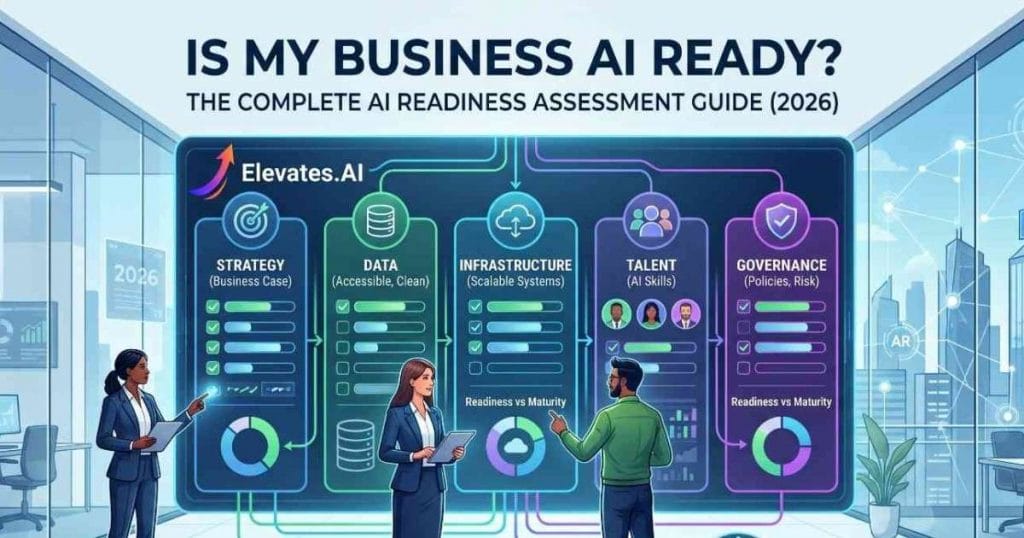
A quick, honest audit across the five areas that determine readiness:
- Strategy — Is there a defined business case, with a specific problem and a way to measure whether AI solved it?
- Data — Is your data accessible, reasonably clean, and structured enough for a model to use?
- Infrastructure — Can your current systems support an AI tool at the scale you’re planning?
- Talent — Do you have — or can you access — the skills to implement and maintain what you’re building?
- Governance — Are there policies for data use, risk, and human oversight of AI output?
Score yourself honestly against each line. If more than two are unchecked, that’s not a failure — it’s exactly what the free assessment is built to catch before you spend on tooling.
AI Readiness vs. AI Maturity
These get used interchangeably, but they answer different questions:
- AI readiness — a point-in-time check of whether you can start an AI initiative responsibly right now.
- AI maturity — how deeply AI is already embedded in how you operate, typically scored across progressive stages over time.
In practice: run readiness first. Once you have a baseline, the AI Maturity Assessment tracks how that baseline changes as you scale.
Common AI Adoption Mistakes
Buying tools before defining the problem — the tool gets selected first, then teams reverse-engineer a use case to justify it.
Skipping the pilot and going straight to enterprise rollout — Deloitte’s 2026 State of AI report found only 34% of organizations are using AI to “deeply transform” their business — most are still stuck at surface-level use, often because they scaled before validating a smaller version first.
No baseline metrics before starting — without a “before” number, you can’t prove AI changed anything.
Ignoring data quality until it breaks something — the most common cause of stalled pilots industry-wide.
No change management plan — a technically sound model still fails if the team using it wasn’t brought along.
Treating a vendor’s readiness assessment as neutral — a scorer with a product to sell has a built-in incentive to find gaps only their product fills.
Industry-Specific AI Readiness
Generic readiness frameworks miss the constraints that are specific to certain industries. Three worth calling out:
Financial Services
Banks, credit unions, and fintechs carry an extra layer most frameworks skip: model risk governance, explainability requirements, and data residency rules. See the full breakdown in AI Readiness for Financial Services.
Healthcare
Patient data privacy (HIPAA and equivalent regional rules), clinical liability, and the need for auditable, explainable decisions in anything touching diagnosis or treatment make healthcare one of the slowest-adopting, highest-stakes verticals for AI.
SaaS
SaaS companies typically clear the data and infrastructure bar fastest since many are already cloud-native — but often underestimate governance: who owns model behavior once it’s embedded in a product customers pay for and rely on.
How to Improve Your AI Readiness Score
- Fix data quality first — it’s the most common reason pilots stall, regardless of industry.
- Assign clear ownership before buying any tool — someone needs to be accountable for the decision.
- Start with a single pilot with one measurable KPI, not a company-wide rollout.
- Redesign the workflow, not just the task — McKinsey’s research found this is the single biggest factor separating high performers from everyone else, more predictive of impact than any other attribute they tested.
- Revisit governance and sign-off requirements now, before a pilot forces the conversation under time pressure.
Take the Free AI Readiness Assessment
Reading a checklist gets you part of the way. A structured, scored assessment gets you the rest — a specific number, a tier recommendation, and a starting point for the roadmap. The 60-second AI Readiness Assessment requires no signup to see your score.
Frequently Asked Questions
How do I know if my business is AI ready?
Run a structured readiness assessment covering strategy, data, infrastructure, talent, and governance. If more than two of those five areas have real gaps, treat that as your starting point rather than moving straight to tool selection.
What’s a good AI readiness score?
There’s no universal passing score — what matters is knowing which specific dimension is weakest so you can address it before committing budget. A lower score isn’t a stop sign; it’s a map of what to fix first.
How long does it take to become AI ready?
It depends entirely on the size of the gaps. Fixing a single missing data pipeline might take weeks; building out a full governance and model-risk process can take months. Most organizations can meaningfully improve within one quarter if they prioritize the biggest gap first.
Do I need a consultant to assess AI readiness?
Not necessarily for an initial read. Self-serve tools can give a fast, directional score. Traditional consulting engagements make more sense once you’re ready for a detailed, stakeholder-driven gap analysis and roadmap.
What’s the difference between AI readiness and AI maturity?
Readiness measures whether you’re prepared to start responsibly right now. Maturity measures how deeply AI is already embedded in your operations, typically over a longer timeline.
Sources
This guide references data and frameworks from the following sources:
- IBM — How to Maximize AI ROI in 2026
- Google Cloud — ROI of AI 2025
- Cisco — AI Readiness Index
- Deloitte — State of AI in the Enterprise 2026
- McKinsey — The State of AI: Global Survey 2025
- PwC — 29th Global CEO Survey
Ready to find out if your business is AI ready?
Take Elevates.AI’s free 60-second AI Readiness Assessment to receive your readiness score, personalized recommendations, and a 90-day implementation roadmap.
Be the First to Discover New AI Insights
Follow Elevates.AI on Google to stay updated with the latest AI readiness assessments, governance frameworks, implementation guides, buyer's guides, and enterprise AI best practices.
 Follow Elevates.AI on Google
The AI Readiness Brief
Every Week, receive practical enterprise AI strategies, implementation frameworks, governance updates, and expert insights—all delivered in a 5-minute read.
| ✓ Enterprise AI Strategy | ✓ AI Readiness Frameworks |
| ✓ Governance & Compliance | ✓ Exclusive Guides & Resources |
Join 500+ AI Professionals
Enter your work email below to receive one high-value email every week. No spam. Unsubscribe anytime.