Most AI failures are not model failures. They are workflow failures.
Enterprises buy the AI tool, the model access, and the integration layer, and then nothing changes. The orchestration that was supposed to connect intake, decision, and action across systems never gets built. The work stays manual. The pilot stalls. The ROI never lands.
That is the workflow automation gap. It shows up in nearly every Elevates.AI readiness assessment, and it is the single most common reason mid-market AI investments underperform. When the gap surfaces, Make is one of the marketplace tools we point readers toward, because the platform was built to close exactly this category of failure.
The Workflow Automation Gap in Four Numbers
Organizations are buying AI faster than they are wiring it into the operating model. McKinsey found that 88% of organizations use AI in at least one function, yet only 39% report measurable enterprise-level impact (McKinsey, 2025). The delta is not capability. The delta is execution plumbing.
Gartner is sharper on the agentic wave. The firm predicts that over 40% of agentic AI projects will be canceled by the end of 2027, driven by escalating costs, unclear business value, and inadequate risk controls (Gartner, 2025). Those are orchestration and governance problems, not model problems. See the Gartner press release.
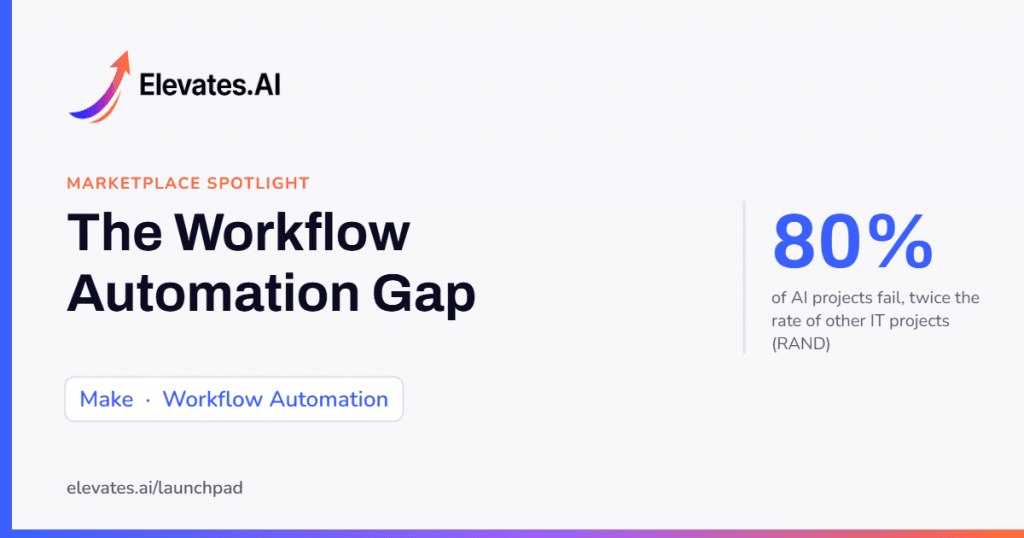
RAND Corporation goes further on AI projects overall, finding that more than 80% fail, roughly twice the failure rate of comparable IT projects that do not involve AI (RAND, 2024). RAND’s leading root causes are organizational and structural, including infrastructure and integration gaps, not algorithm quality.
The market reflects the demand. Mordor Intelligence values workflow automation at $23.77 billion in 2025, growing at a 9.41% CAGR through 2031 (Mordor Intelligence, 2025). That growth is buyers trying to retrofit orchestration onto AI stacks they have already paid for.
The pattern is consistent. Enterprises have the tools. They do not have the connective tissue.
How Make Closes the Workflow Automation Gap
Make is a visual workflow automation and AI orchestration platform with more than 3,000 pre-built app integrations, including direct connections to OpenAI, Anthropic, and Google. Process-mining company Celonis acquired it in 2020, and it now serves organizations across more than 200 countries and territories.
Functionally, Make sits in the gap between point AI tools and core systems of record. A team can build a multi-step scenario that ingests a signal from one system, routes it through conditional logic, calls an AI model for classification or generation, writes the output back to a CRM or data warehouse, and triggers a downstream notification. All of that runs visually, on a single canvas, without engineering tickets.
In April 2025 Make launched Make AI Agents, which can be embedded inside scenarios to reason, choose the next step, and trigger real workflows across those integrations, with direct connections to more than 350 AI applications. The platform holds SOC 2 Type II and GDPR compliance, with SSO and data residency options on enterprise plans.
For the orchestration gap specifically, Make replaces the brittle middle layer where most AI pilots break. It is not the model. It is the routing logic, the error handling, the human-in-the-loop checkpoints, and the writeback paths that decide whether AI output ever reaches production.
Who Make Fits Best
Make is a strong fit when the Elevates.AI assessment surfaces three signals together. First, the organization runs more than five core SaaS systems generating data that should be triggering action elsewhere. Second, at least one high-volume manual process exists where staff copy data between tools or rerun the same task daily. Third, the team has a process owner or operations lead who can map the workflow, even if they cannot code.
The company-size sweet spot is roughly 50 to 2,000 employees. Smaller teams often do not have the process volume to justify the orchestration investment. Larger enterprises usually hold an iPaaS contract already and use Make as a complement for departmental automations rather than a core platform.
There is a free tier. Paid plans start at $9 per month for Core, then $16 for Pro and $29 for Teams, each including 10,000 monthly credits, with custom enterprise pricing above that. Annual billing saves roughly 15%. Make moved from an operations model to a credits model in August 2025, so AI-heavy scenarios consume credits faster than simple module runs. For most mid-market buyers, Pro or Teams is the realistic starting point.
What to Consider Before You Implement
Make is not the right answer for every workflow automation gap. Three honest trade-offs are worth weighing before you sign up.
Credit-based pricing requires discipline. Every step in a scenario consumes credits, and AI calls consume more than standard module runs. Teams that do not monitor scenario complexity tend to see surprise overages by month three or four. Build a governance routine before you scale.
The visual builder lowers the floor but does not remove the ceiling. Complex error handling, custom API logic, and large-scale data transforms still benefit from a developer in the loop. If your assessment also surfaced a technical capability gap, Make alone will not close it.
The category is crowded. Make competes directly with Zapier, n8n, and Workato. The right choice depends on your stack, your data sensitivity, and your team’s appetite for self-hosting. Make tends to win on visual clarity and AI-native integrations. Zapier tends to win on ecosystem breadth. n8n tends to win on developer control and self-hosting, which we covered in a separate spotlight. The marketplace surfaces the option that fits the assessed gap profile, not the loudest brand.
How the Elevates.AI Assessment Surfaces This Gap
The 60-second assessment maps responses across six readiness dimensions, including process maturity, integration depth, and execution capacity. When a respondent reports high tool sprawl, low integration coverage, and manual handoffs between systems, the platform flags a workflow automation gap in the Gap Analysis Report.
That gap then drives the 90-day Implementation Roadmap. Make appears as a recommended option in the AI Execution Marketplace when the gap profile matches the platform’s strengths: mid-market scale, multi-system orchestration, and a process owner ready to own the build. The recommendation comes with an honest read on the readiness work required before implementation, not a blind handoff.
That is the point of the marketplace. Buyers do not need another tool list. They need a routing layer that connects assessed gaps to the right intervention.
Start Here
If your systems are full of data that never triggers action anywhere else, the workflow automation gap is probably your highest-priority starting point. Confirm it before you buy anything.
Take the 60-second assessment at elevates.ai/launchpad.
Ready to evaluate the platform directly? Sign up for Make through the Elevates.AI marketplace.
Disclosure: Elevates.AI maintains an affiliate relationship with Make. The recommendation criteria above are independent of that relationship and are driven by assessment gap profile matching, not commercial terms.
Sources
McKinsey, 2025. The State of AI. Gartner, 2025. Agentic AI project cancellations. RAND Corporation, 2024. AI project failure research. Mordor Intelligence, 2025. Workflow automation market. Make, 2026. Product documentation and pricing.
Is Make better than Zapier for AI workflows?
It depends on the workflow. Make tends to win when scenarios involve branching logic, multi-step AI calls, or data transformations across more than three systems. Zapier tends to win when the workflow is a simple linear trigger and the priority is ecosystem breadth. For most AI orchestration use cases that surface in an Elevates.AI assessment, Make is the stronger starting point because of its visual routing and native AI agent support.
How long does it take to implement Make at mid-market scale?
A focused first automation typically goes live in two to four weeks with a dedicated process owner. A broader rollout across three to five departments usually takes 90 to 120 days. The bottleneck is rarely the tool. It is process documentation and ownership clarity, which is why the Elevates.AI assessment surfaces those readiness signals first.
Does Make replace the need for an integration platform?
For organizations under roughly 2,000 employees, Make can serve as the primary integration platform. For larger enterprises with established Workato or MuleSoft contracts, Make typically operates as a complement for departmental and AI-specific automations rather than a core replacement. The assessment helps clarify which role fits your stack.
Be the First to Discover New AI Insights
Follow Elevates.AI on Google to stay updated with the latest AI readiness assessments, governance frameworks, implementation guides, buyer's guides, and enterprise AI best practices.
 Follow Elevates.AI on Google
The AI Readiness Brief
Every Week, receive practical enterprise AI strategies, implementation frameworks, governance updates, and expert insights—all delivered in a 5-minute read.
| ✓ Enterprise AI Strategy | ✓ AI Readiness Frameworks |
| ✓ Governance & Compliance | ✓ Exclusive Guides & Resources |
Join 500+ AI Professionals
Enter your work email below to receive one high-value email every week. No spam. Unsubscribe anytime.